
Measurement of Carrier Lifetime in Perovskite for Solar Cell Applications
30 Apr 2018Hybrid perovskite photovoltaics (PV) show promise because of their good efficiencies, which can be around 20%. Along with their PV characteristics, perovskite materials exhibit a high degree of radiative recombination. The kinetics of the photoluminescence decay can be employed to reveal important information concerning the optimization and characterization of perovskite photovoltaic materials. In this application note, the time-resolved emission from a perovskite photovoltaic is measured using the HORIBA DeltaFlex lifetime system.
Related products
Request Quote for All Products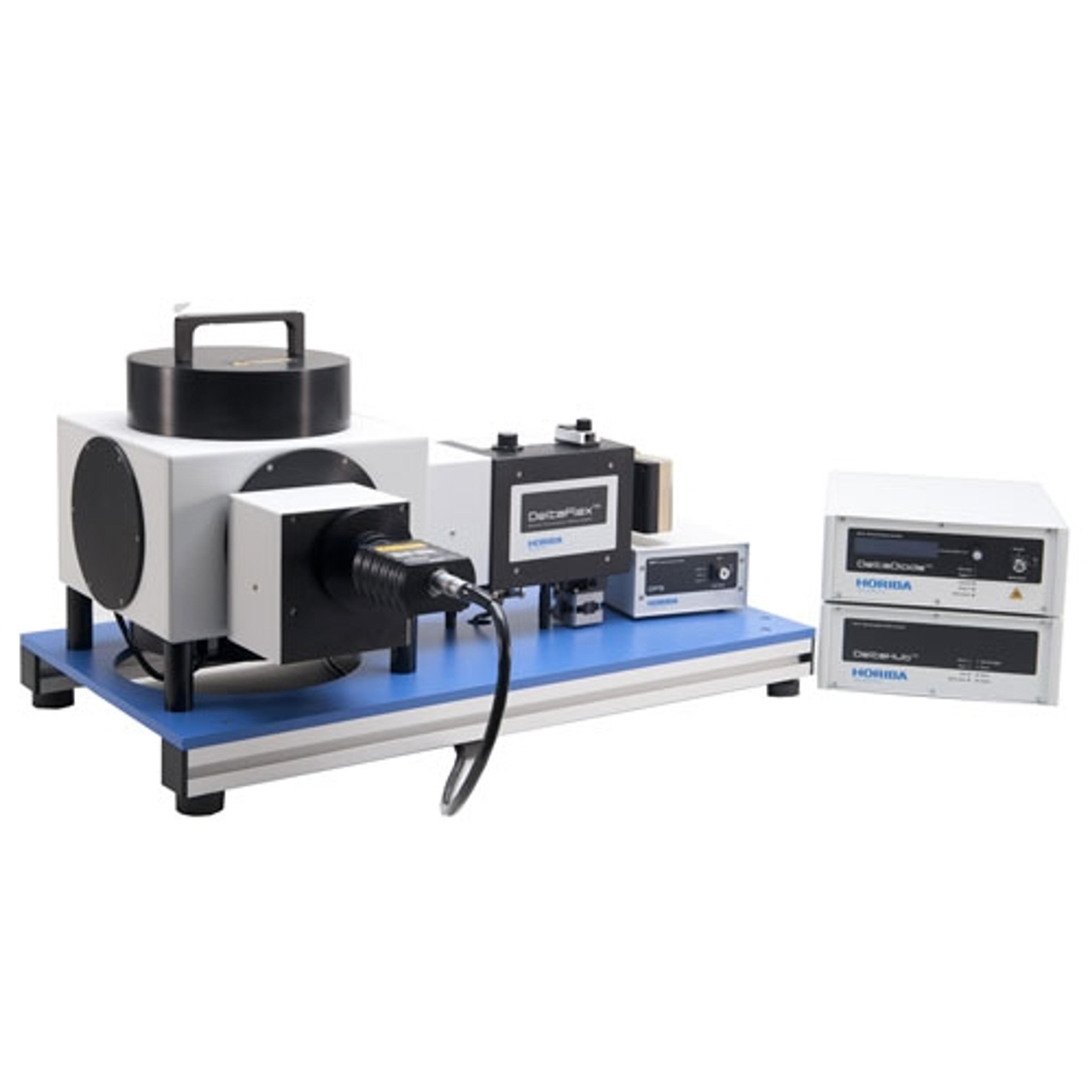
DeltaFlex Lifetime Fluorescence Spectrofluorometer
HORIBA ScientificThe HORIBA DeltaFlex TCSPC system is one of our Delta series of next generation TCSPC lifetime instrumentation. Designed for the measurement of luminescence lifetimes ranging over 11 orders of magnitude, the DeltaFlex enables fast and efficient acquisition of lifetime data from 25ps to 1 second. Features Measure lifetimes from 25ps with laser diodes and PPD detection module Up to 1,000 TCSPC measurements per second – ideal for kinetics studies Monochromator wavelength selection DeltaDiodes available from UV to NIR. Consult the DeltaDiode page for full details SpectraLEDs can be used to acquire longer lifetimes (µs – s) and available from UV to NIR. Upgrade to a monochromator based NIR system (DeltaFlex-NIR-H or DeltaFlex-NIR-R) Easy to add accessories with F-Link bus Comprehensive software package Measurement modes Lifetime – measure 25ps to 1s Kinetic TCSPC – 1 to 10 000 decays measured sequentially in 1ms to 1min per decay Anisotropy – reconvolution analysis to resolve shorter rotational correlation times Time-Resolved Emission Spectra (TRES) – Collect up to 100 wavelength dependent decays Steady-State