Life Science Learning Lab Uses the Implen NanoPhotometer® in Student Teaching Program
17 Jul 2017The Life Science Learning Lab (German name Gläsernes Labor) on the Berlin-Buch campus in Germany is a facility that offers students the opportunity to experiment in a variety of scientific fields and to gain insight into the work of various research groups on the campus. The Gläsernes Laboratory provides four hour courses led by trained scientist on numerous subjects, e.g. water analysis, radioactivity, neurobiology, photosynthesis, plastics, dyes and fragrances. In addition, the genetics lab carries out DNA extraction, genetic fingerprinting, virus detection and the analysis of genetically modified foods. The Gläsernes Laboratory also offers holiday programs, adult education and preparations for studies in life sciences.
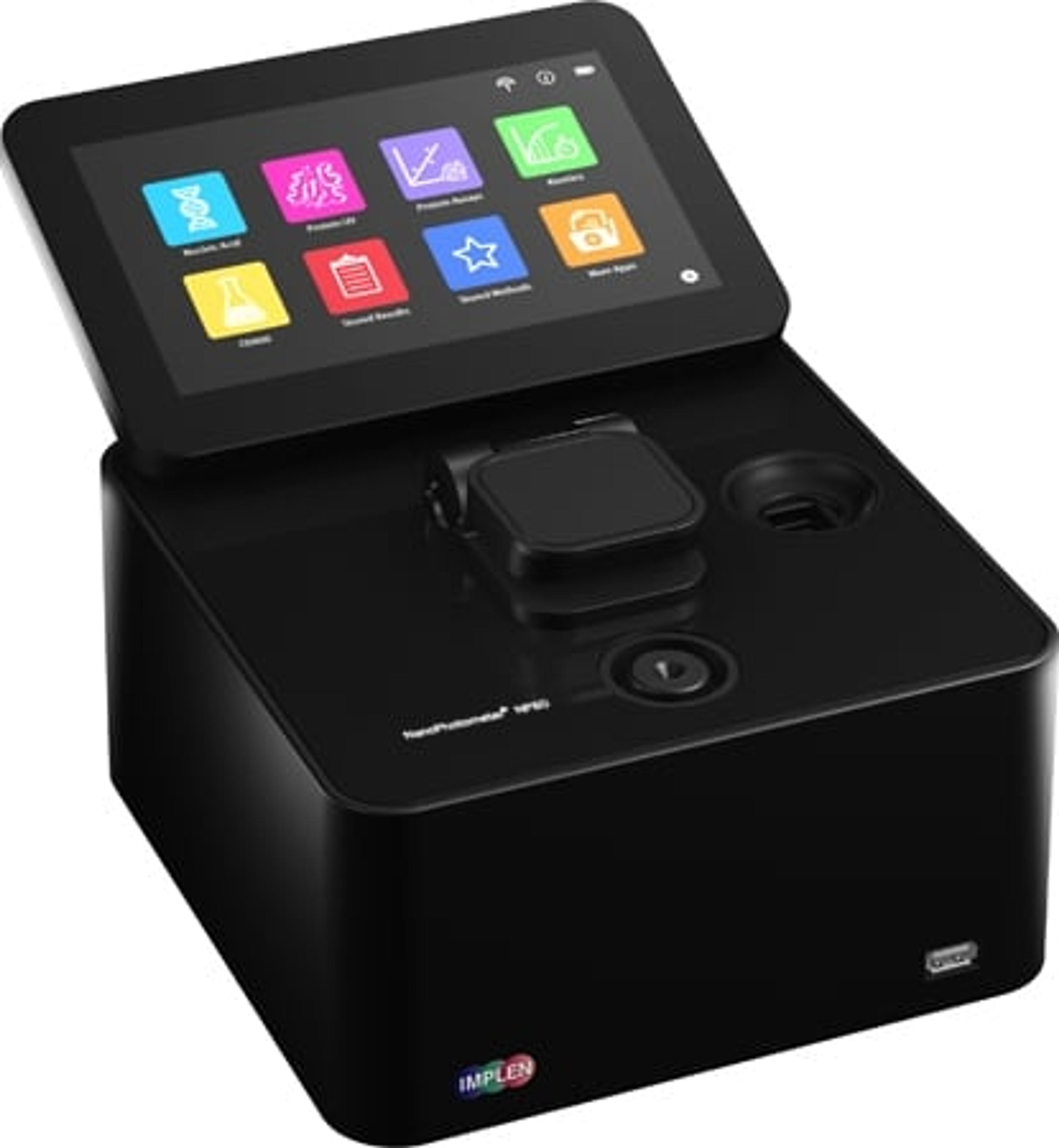
Image: Students measure the activity of alkaline phosphatase using the Implen NanoPhotometer® NP80. The measured data are evaluated directly on a computer.
New Courses at the Gläsernes Laboratory
The course catalogue of the Gläsernes Laboratory is constantly revised; this offers students the possibility to get hands-on experience with the latest methods of modern life sciences. For two new courses, “Proteins” and “Project Week: System Biology”, the Gläsernes Laboratory required a new Spectrophotometer. The NanoPhotometer® NP80 was kindly provided by Implen Inc., a German manufacturer of high-quality UV/VIS Spectrophotometers. Both courses are designed for interested high-school students who want to carry out more sophisticated experiments and gain practical experience in the laboratory. The NanoPhotometer® is also utilized in adult education courses, specifically “Fit for Study: Biotechnology”.
- “Proteins”
The course “Proteins” deals with the structure and analysis of proteins, especially enzymes. The basics of enzyme kinetics are investigated using the example of alkaline phosphatase. The students measure the substrate conversion and determine the enzymes’ substrate saturation with the help of the NanoPhotometer®. In doing so, they learn important scientific methods, such as how to create a standard curve. Students also gain a better understanding of physical principles such as Beer-Lambert law. The aim of the course is to understand the function of enzymes as well as garner experience concerning how lab experiments are carried out and evaluated. The skill gained when using a spectrophotometer is indispensable. The Implen NanoPhotometer® allows easy detection of enzyme kinetics by automatic measurements at selectable time intervals. Data export and evaluation is also convenient with the Implen unit, which provides results configured in Excel and PDF formats.
- “Project Week: System Biology”
During the “Project Week: System Biology”, students are invited to get to know the very interesting and wide field of system biology. System biology is an interdisciplinary research field that works with quantitative methods of computer science and mathematics to understand complex biological processes. Biological systems are investigated in their entity in order to gain an integrated picture of the regulatory processes across all levels: from the genome through the proteome and organelles, to the behavior and biomechanics of the whole organism. The students use CellDesigner™ software to create mathematical models of biological processes. These models are then tested under lab conditions. Participants examine the growth of E. coli under various conditions, e.g. availability of different nutrients. They create growth curves using the NanoPhotometer® and thus discover the principle of catabolite repression. In addition, students investigate the activity of the enzyme β-galactosidase and illustrate experimentally the function of the operon model. During the “Project Week: System Biology” the Implen NanoPhotometer® is used to measure the optical density of bacterial cultures as well as enzyme activity.
- Adult Education and “Fit for Study: Biotechnology”
The focus of the practical course is the cloning of the human ubiquitin gene, followed by ligation into a vector, transformation of E. coli, expression of the recombinant protein and detection by Western blot. For cloning, a precise determination of the DNA concentration is necessary, for which a spectrometer was previously used in another building on the campus. Now the participants themselves can measure the DNA concentration using the micro volume function of the Implen NanoPhotometer® and calculate the quantity required for the ligation. The use of the NanoPhotometer® to measure the DNA concentration is a great asset in the execution of the course and allows the students to work with a modern, time and material-saving method.
Acknowledgment
The extended course catalog of Gläsernes Laboratory has only become possible through the purchase of the Implen NanoPhotometer®. The student lab team thanks Implen for their support and looks forward to more exciting student courses. Our thanks also go to Mr. Riemenschneider from Intas, who advised us and established contact with Implen.