ResourceSeparations

LC-MRM Quantification of Src-Family Kinases using Protein Standards Expressed in Cell-Free Systems

LC-MRM Quantification of Src-Family Kinases using Protein Standards Expressed in Cell-Free Systems

6 Jul 2015

This poster describes a method for the quantification of SFK expression using peptides unique to each sequence. Each of the SFK proteins screened in this study produced at least 2 unique peptides, and all SFK proteins could be detected and quantified in a single experience when applied in parallel, offering a clear advantage over immunoblotting.

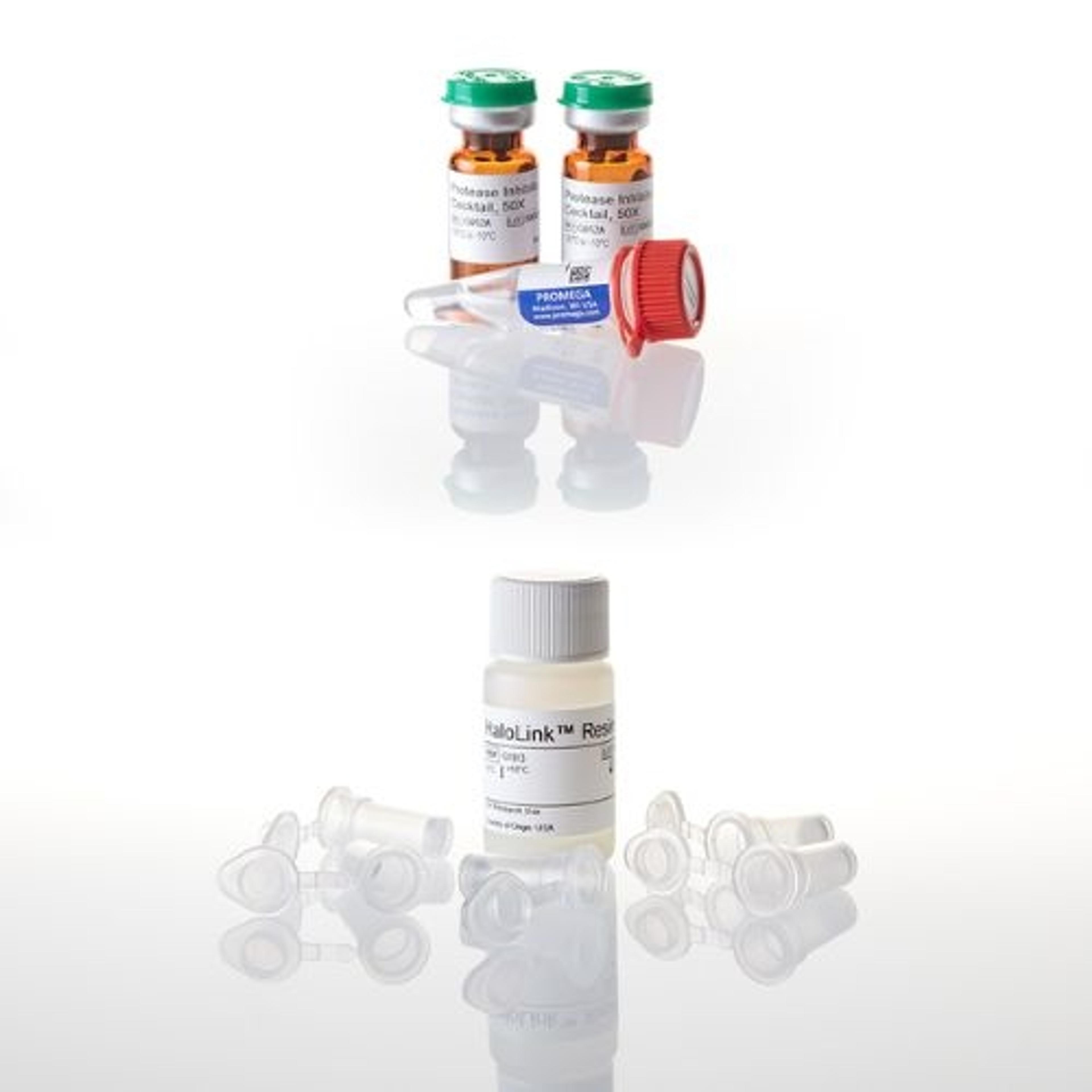
HaloTag® Mammalian Protein Purification System

Promega Corp.

It can be challenging to purify sufficient high-quality protein from mammalian cells. Boost protein recovery 30-60% with an optimized covalent protein tag, called HaloTag®. This complete kit offers strong improvements in recovery, purity, cost and protein functionality over historical FLAG® and poly-His tag purification strategies.

(0)

Magne® HaloTag® Beads

Promega Corp.

  HaloLink - Promega Magnetic Beads for Covalent immobilization of HaloTag® fusion proteins.   Features of the Promega HaloLink Magnetic Beads: • Magnetic-Based: Easy and quick immobilization of HaloTag® fusion proteins with minimal loss of sample material. • Covalent Bond: Allows stringent washing of immobilized HaloTag® fusion protein, removing nonspecific proteins and enhancing overall data.  • Multiple Applications: Immobilized HaloTag® fusion proteins can be used for protein interaction analysis, enzyme assays and purification of fusion proteins containing a protease cleavage site. HaloLink™ Magnetic Beads from Promega provide a rapid and reliable method to covalently capture and immobilize HaloTag® fusion proteins to a paramagnetic particle. Immobilization through the HaloTag® Ligand provides for consistent, surface-directed orientation of the fusion protein, thus providing more reliable results in applications such as protein:protein interaction studies with the fusion protein. The result is a paramagnetic bead with very high binding capacity for HaloTag® fusion proteins and very low nonspecific protein binding. The paramagnetic feature allows for streamlined assay development and facilitates applications with automated assays developed on robotic platforms. A variety of vectors for the expression of HaloTag® fusion proteins in bacterial, mammalian or cell-free systems are available.

(0)

Links

Tags

UHPLC and HPLCHigh performance liquid chromatography (HPLC) and ultra high performance liquid chromatography (UHPLC), also known as UPLC, are analytical techniques used to separate, identify and quantitate components of complex mixtures including biological samples such as proteins and lipids as well as chemical mixtures of pesticides, drugs and oils. Both techniques are liquid chromatographic methods but differ by operating pressures (HPLC < 6000 psi < UHPLC ). Components of HPLC and UHPLC systems include columns, detectors, pumps, autosamplers and column heaters. Explore a range of UHPLC and HPLC columns for your specific sample needs including reverse phase, normal phase, ion exchange, HILIC, ion exclusion and size exclusion columns. For more specialized HPLC, explore FPLC, countercurrent LC and simulated moving bed systems. Find the best UHPLC and HPLC equipment in our peer reviewed product directory: compare products, check customer reviews and receive pricing direct from manufacturers.AntibodiesAntibodies are used in techniques such as confocal and fluorescence microscopy, flow cytometry, ELISA, ELISPOT, immunohistochemistry, western blotting and immunopreciptation. Select specific antigen reactivity, high specific affinity, low non-specific binding, monoclonal or polyclonal, primary or secondary antibodies and associated conjugates such as an enzyme or dye for visualization.Western BlottingWestern blotting equipment is used to transfer and identify specific proteins within a sample, reveal protein modifications, as well as give a semi-quantitative estimation of their concentration. Western blotting equipment includes all apparatus necessary to transfer proteins from gel to membrane and subsequent processing steps. Protein transfer can be performed by electroblotting with wet, semi-dry and dry transfer systems onto nitrocellulose and PVDF membranes. Blocking, washing and labeling of membranes follows, involving buffers, blocking reagents, blotting / incubation trays, labeling reagents, immunoblotting assays, antibodies and conjugates. Automated equipment for these steps is available to accelerate your lab workflow. Finally, detection and imaging of proteins can be conducted using gel documentation and imaging systems. Find the best western blotting equipment in our peer-reviewed product directory: compare products, check customer reviews and receive pricing direct from manufacturers.Cell-Based AssaysCell-based assays are used to monitor the presence, quantity and activities of a desired cellular analyte including drug molecules or biomarkers. This can reveal information on cell health (apoptosis, cytotoxicity, viability and proliferation assays), cell metabolism, cell migration and cell signaling mechanisms. Find the best cell-based assay products, kits and equipment with our peer reviewed product directory: compare products, check customer reviews and receiving pricing direct from manufacturers.LC-MSLC-MS (liquid chromatography-mass spectrometry) systems and equipment are used for separation and quantitative analysis of complex mixtures, combining liquid chromatography and mass spectrometry. Quantify proteins, contaminants, pesticides or screen for drug metabolites with a high level of sensitivity. LC-MS systems and equipment include reverse phase, normal phase and specialized columns integrated with various MS detectors such as time-of-flight (TOF), quadrupole, orbitrap or ion trap mass analyzers. LC-MS/MS instruments equipped with a qTOF or triple quadrupole analyzer give greater sensitivity and resolving power to your analysis. Find the best LC-MS equipment in our peer-reviewed product directory: compare products, check customer reviews and receive pricing direct from manufacturers.ImmunoassayImmunoassays are laboratory tests that utilize antibody-antigen interactions to detect specific substances. They are widely used in diagnostics for detecting diseases, drug testing, and environmental monitoring. These assays offer rapid, sensitive, and precise detection of biomarkers, making them invaluable in clinical and research labs. Browse our peer-reviewed product directory to compare immunoassay systems, read user reviews, and get pricing directly from manufacturers.Cancer ResearchAlthough cancer is often referred to as a single condition, it actually consists of more than 100 different diseases. Microscopy, mass spectrometry, high throughput sequencing and flow cytometry are some of the most common techniques employed in cancer research labs.KinasesPeptidesPeptides are short chains of amino acids that play key roles in biological processes, including signaling, immune responses, and enzyme regulation. Peptide research is critical in drug discovery, diagnostics, and vaccine development. Browse our peer-reviewed product directory to find the best peptides and peptide-related products, compare options, check reviews, and get pricing directly from manufacturers.