ResourceSeparations

Improvement in Speed and Reproducibility of Protein Digestion and Peptide Quantitation, Utilizing Novel Sample Preparation Technology in a Full Solution Workflow

Improvement in Speed and Reproducibility of Protein Digestion and Peptide Quantitation, Utilizing Novel Sample Preparation Technology in a Full Solution Workflow

22 Oct 2015

Traditional trypsin digest protocols are time consuming, with some protocols taking up to one and a half days to complete and involving multiple steps including evaporation and reconstitution. This adds potential for a high degree of variability. This application note describes a rapid and precise protocol for peptide analysis utilizing immobilized, heat stable trypsin and micro-elution solid-phase extraction (SPE) coupled with next generation ultra-high pressure liquid chromatography and high resolution mass spectrometry (UHPLC-HRMS).

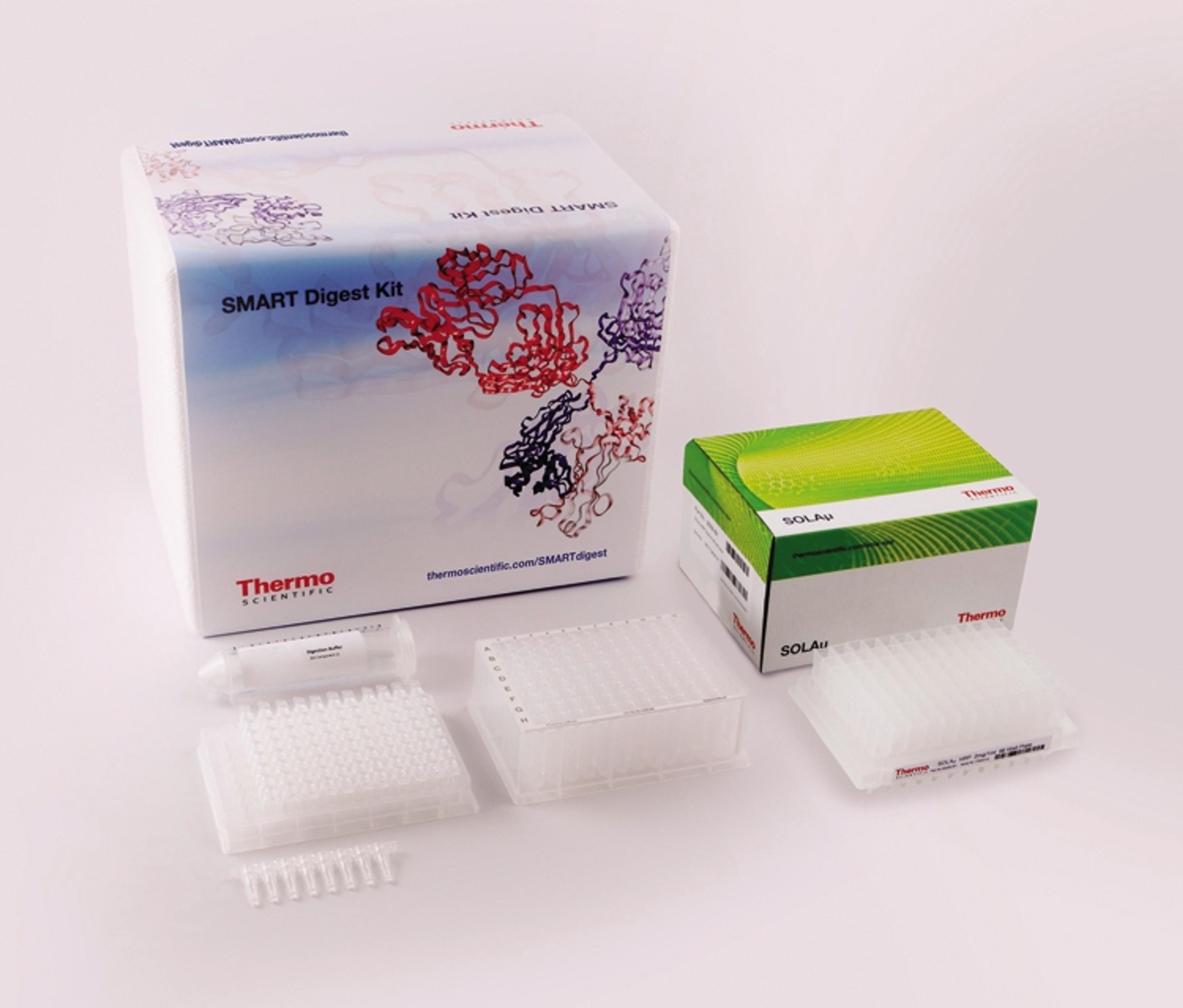
Thermo Scientific™ SMART Digest™ Kits

Thermo Fisher Scientific

Obtain high quality analytical results from protein digests by using Thermo Scientific™ SMART Digest™ Kits. A significant advance in sample preparation for biopharmaceutical and protein research, the kits provide fast and simple protein digestion with high reproducibility, high sensitivity, and high levels of data quality in a format that's compatible with automation. The SMART Digest Kits are a significant improvement over current in-solution protein digestion technologies, which are not reproducible, have poor sensitivity, and employ protracted methodologies not amenable to automation.   Features: Easy and simple Significantly increased speed of sample processing. 3-step sample preparation. Easily automate entire protocol for high-throughput processing. Reliable results Increased reproducibility over existing protocols. Higher sensitivity. Higher data confidence.

(2)

Links

Tags

UHPLC and HPLCHigh performance liquid chromatography (HPLC) and ultra high performance liquid chromatography (UHPLC), also known as UPLC, are analytical techniques used to separate, identify and quantitate components of complex mixtures including biological samples such as proteins and lipids as well as chemical mixtures of pesticides, drugs and oils. Both techniques are liquid chromatographic methods but differ by operating pressures (HPLC < 6000 psi < UHPLC ). Components of HPLC and UHPLC systems include columns, detectors, pumps, autosamplers and column heaters. Explore a range of UHPLC and HPLC columns for your specific sample needs including reverse phase, normal phase, ion exchange, HILIC, ion exclusion and size exclusion columns. For more specialized HPLC, explore FPLC, countercurrent LC and simulated moving bed systems. Find the best UHPLC and HPLC equipment in our peer reviewed product directory: compare products, check customer reviews and receive pricing direct from manufacturers.LC-MSLC-MS (liquid chromatography-mass spectrometry) systems and equipment are used for separation and quantitative analysis of complex mixtures, combining liquid chromatography and mass spectrometry. Quantify proteins, contaminants, pesticides or screen for drug metabolites with a high level of sensitivity. LC-MS systems and equipment include reverse phase, normal phase and specialized columns integrated with various MS detectors such as time-of-flight (TOF), quadrupole, orbitrap or ion trap mass analyzers. LC-MS/MS instruments equipped with a qTOF or triple quadrupole analyzer give greater sensitivity and resolving power to your analysis. Find the best LC-MS equipment in our peer-reviewed product directory: compare products, check customer reviews and receive pricing direct from manufacturers.Mass SpectrometryMass spectrometry (MS) is a powerful analytical technique used to identify and quantify molecules based on the mass-to-charge ratio of gas-phase ions. It provides detailed information about the structure, composition, and properties of compounds and is widely used across fields such as environmental monitoring, materials science, drug discovery and development, food and beverage testing, and wider chemical research. Key MS techniques include tandem mass spectrometry (MS/MS), liquid chromatography–mass spectrometry (LS-MS) and inductively coupled plasma (ICP-MS). Choosing from these wide range of techniques and technologies can be a daunting task, so keep up to date with scientific applications, performance expectations, and customer reviews here all in one place. Visit our product directory to receive quotes direct from the manufacturer. Protein PurificationProtein purification is a vital step in drug discovery, therapeutics, biotech and life science research. The purification process typically involves subcellular or membrane protein extraction with cell lysis kits, separation of proteins from cell debris by filtration or spin columns, and the isolation of proteins of interest from other proteins and impurities with affinity purification (including fusion protein tags and antibody binding proteins A, G and L), immunoprecipitation or chromatographic methods, such as ion exchange, size exclusion and immobilized metal affinity chromatography. All purification methods come in multiple formats for your laboratory needs, including agarose or magnetic beads, resins, columns and filter plates. Find the best protein purification equipment in our peer-reviewed product directory: compare products, check customer reviews and receive pricing direct from manufacturers.Solid-Phase ExtractionSolid-phase extraction (SPE) is used for clean-up, extraction and concentration of semi-volatile or non-volatile analytes from complex mixtures including blood, urine and food samples. Multiple formats are available for conducting SPE, including prepacked SPE cartridges, disks and microplates, as well as SPE sorbent powders for manual packing. SPE systems can be used to automate the process and extract multiple samples at once. Solid-phase microextraction (SPME) and supported liquid extraction (SLE) products are also available in the same formats. Find the best SPE, SLE and SPME equipment in our peer-reviewed product directory: compare products, check customer reviews and receive pricing direct from manufacturers.Protein QuantificationThe detection and quantification of proteins in a sample is vital across life sciences, pharmaceutical research and clinical diagnostics, and a variety of equipment is available to scientists to simplify the workflow. Proteins of interest can be easily labeled and detected on light-based detection instruments. Immunoassay kits allow you to identify a specific protein of interest and protein detection beads or antibody microarrays allow you to identify multiple specific proteins at once. Protein interactions and enzyme activity can also be monitored with protein-protein interaction assays. Additionally, the biophysical characterization of proteins is made easy with biokinetic analyzers. Find the best protein detection and quantification products in our peer-reviewed product directory: compare products, check customer reviews and receive pricing direct from manufacturers.PeptidesPeptides are short chains of amino acids that play key roles in biological processes, including signaling, immune responses, and enzyme regulation. Peptide research is critical in drug discovery, diagnostics, and vaccine development. Browse our peer-reviewed product directory to find the best peptides and peptide-related products, compare options, check reviews, and get pricing directly from manufacturers.Solid Phase Extraction (SPE)Solid phase extraction (SPE) is a sample preparation technique used to separate and concentrate analytes from complex mixtures. It is widely used in environmental, pharmaceutical, and clinical analysis. SPE provides higher sensitivity and selectivity compared to traditional liquid-liquid extraction methods, making it essential for accurate and reproducible results. Explore SPE tools and systems in our peer-reviewed product directory; compare products, check reviews, and get pricing directly from manufacturers.Digestion