ResourceMaterials

High-temperature investigation of a thermal barrier coating

17 Jul 2023

Investigation of material properties at or near their operating temperatures has become increasingly important for verifying mechanical stability. For instance, the environments in a combustion chamber and the first section of gas turbines requires materials that are highly resistant to creep and oxidation. Turbine blades used in the first sections are made of creep-resistant Ni-based superalloys covered with thermal barrier coatings (TBCs). The TBC thermally isolates the core material, allowing higher gas inlet temperatures to be reached. Surface temperatures of 1200°C can be tolerated through state-of-the-art design and the appropriate choice of materials. This prevents the temperature of the Ni superalloy from surpassing 1000°C, resulting in higher energy conversion efficiency.

Nanoindentation at elevated temperatures is an ideal technique for verifying the mechanical stability of the different layers as test conditions approach operating temperatures. This application note details a study by Bruker Nano in which the cross-section of a Ni-based alloy coated with a 100 μm thick NiCoCrAlY bond coat layer was investigated; this configuration is comparable to a turbine blade directly after production.

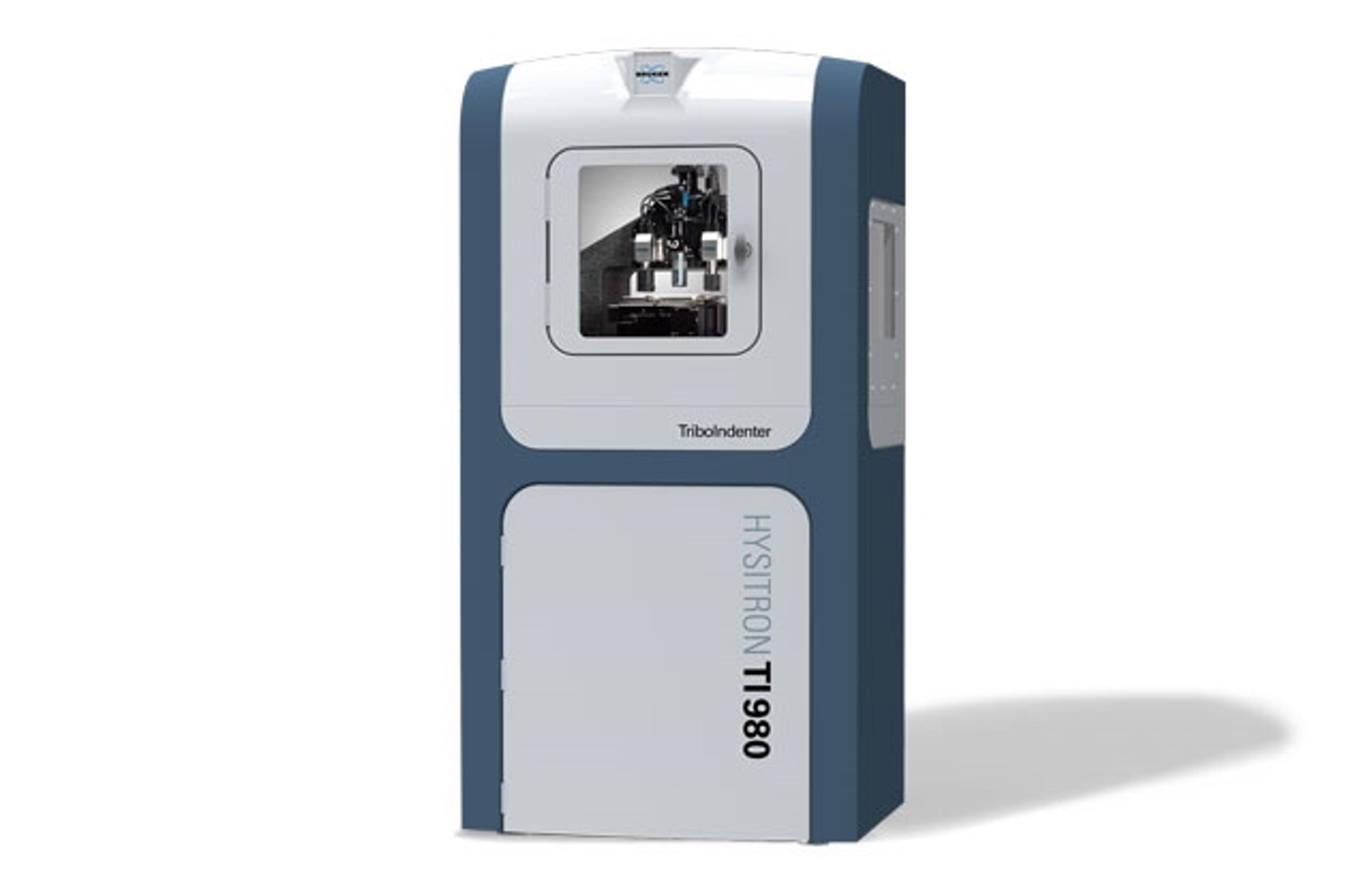
Hysitron TI 980

Bruker Nano Surfaces and Metrology

The Hysitron TI 980 nanoindenter achieves remarkable advances in control and throughput capabilities, testing flexibility, applicability, measurement reliability, and system modularity. This industry-leading system builds upon decades of Hysitron technological innovation to deliver new levels of extraordinary performance, enhanced capabilities, and ultimate versatility in nanomechanical characterization. 

(0)

Links

Tags

Thermal Analysis EquipmentThermal analysis equipment is used for measuring heat flow, weight loss, dimension changes or thermomechanical properties and is important for analyzing a material’s performance and stability. Thermal analysis equipment includes differential scanning calorimeters (DSC), thermogravimetric analyzers (TGA), thermomechanical analyzers (TMA), dilatometers, thermometers, vapor sorption analyzers, boiling and melting point apparatus. Thermal analyzers can reveal properties such as melting, crystallization and glass transitions or other processes such as oxidation, decomposition, volatilization, as well as coefficients of thermal expansion and modulus. Find the best thermal analysis equipment in our peer-reviewed product directory: compare products, check customer reviews and receive pricing direct from manufacturers.Mechanical TestingMechanical testing explores the elastic and inelastic nature of a material when force is applied. A mechanical test shows whether a material is suitable for its intended application by measuring hardness, tensile strength, elongation, elasticity, and fatigue limit.Light MicroscopyLight microscopes or optical microscopes are used to visualize microscale objects under magnification, including cells, clinical specimens and materials. Lab equipment for light microscopy includes confocal microscopes, fluorescence microscopes, zoom and stereo microscopes. Microscope slides and imaging reagents are available for visualizing samples, as well as various microscope stages and incubators for large or temperature-sensitive samples. Find the best light microscopes in our peer-reviewed product directory: compare products, check customer reviews and receive pricing direct from manufacturers.Electron MicroscopyElectron microscopes (EM) are used to create high-resolution images of samples at the nanoscale by means of an accelerated beam of electrons as a source of illumination. Types of electron microscope include scanning electron microscopes (SEM), transmission electron microscopes (TEM), scanning transmission electron microscopes (STEM) and cryo-electron microscopes. Focused ion beam (FIB) microscopes are useful for modifying or milling a sample surface with nanometer precision, as well as imaging. Find the best electron microscopes in our peer-reviewed product directory: compare products, check customer reviews and receive pricing direct from manufacturers.Atomic Force Microscopy / Scanning Tunneling MicroscopyAtomic force microscopes (AFM) and scanning tunneling microscopes (STM) are high-resolution forms of scanning probe microscope (SPM) used to generate topological information of a sample down to the atomic scale. Instruments can generate an image of the surface topology, manipulate objects and reveal information on localized properties such as Young’s modulus, conductivity, and magnetism. High-quality STM and AFM probes optimized for your application are available, as well as other SPM-based instruments such as scanning ion conductance microscopes (SICM) & near-field scanning optical microscopes (NSOM). Find the best AFM and STM equipment in our peer-reviewed product directory: compare products, check customer reviews and receive pricing direct from manufacturers.Thermal ProcessesAlloys
High-temperature investigation of a thermal barrier coating