ResourceSeparations

High Salt Gradient Analysis of Post-Translational Modifications - Deamidation Monitoring

High Salt Gradient Analysis of Post-Translational Modifications - Deamidation Monitoring

23 Dec 2015

This application shows an easy deamidation monitoring using the Vanquish Flex UHPLC system with UV detection. Therapeutic proteins have a major role in today’s medical treatment for a wide array of diseases. The diversity and efficacy of biotherapeutics makes them ideally suited for the treatment of various diseases such as rheumatoid arthritis, multiple sclerosis, and several types of cancer. Due to the complexity of biotherapeutics, they are prone to post-translational modifications that have to be characterized. One of the most common non-enzymatic post-translational modifications in therapeutic proteins is the deamidation of asparagine residues. It has been reported that deamidation can lead to allergic reactions as well as a reduction of the half-life, pharmacological dynamic, stability, or even a loss of the biological function. Thus it is crucial to characterize and control deamidation products in biopharma processes to ensure a high quality product.

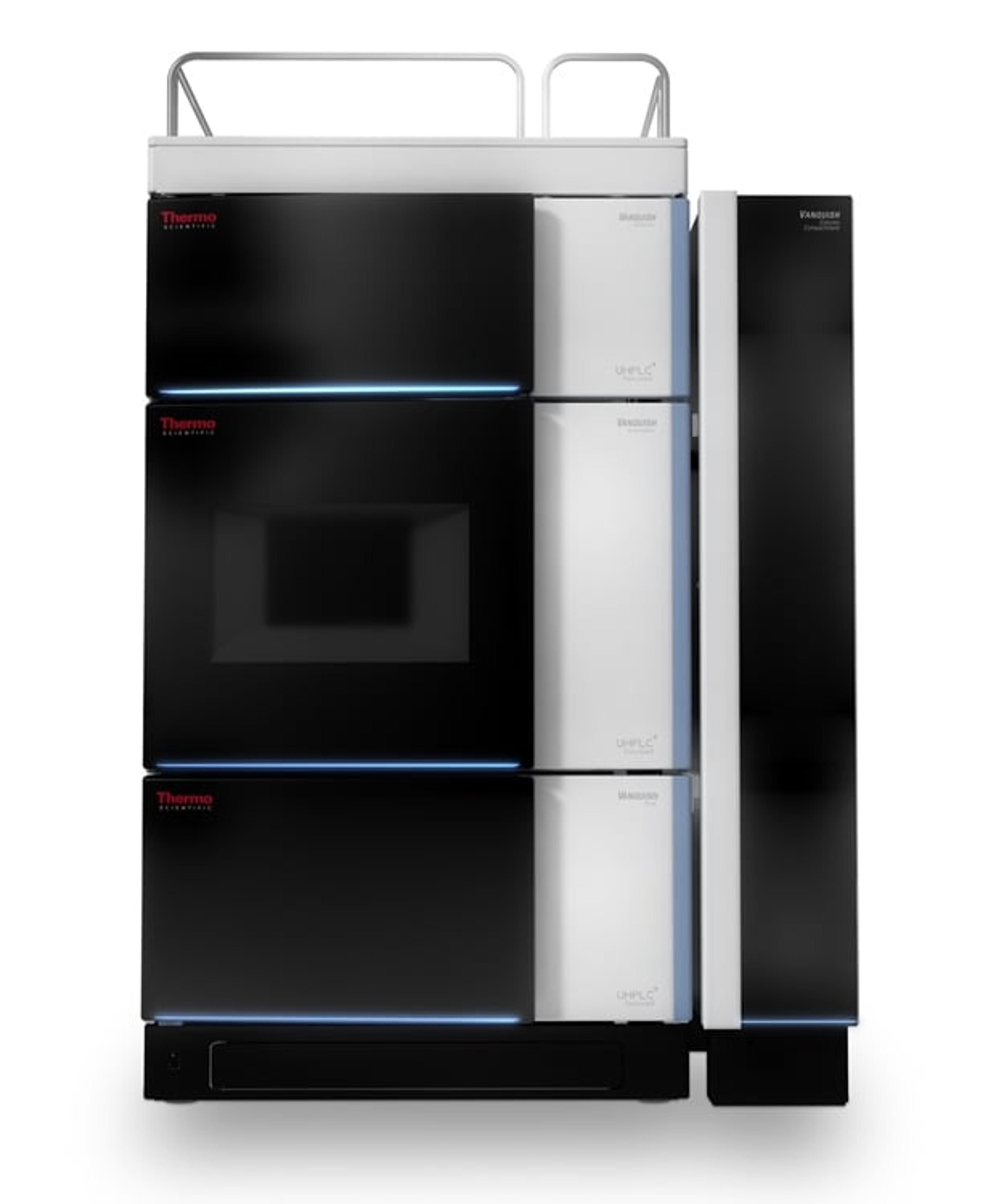
Thermo Scientific™ Vanquish™ Flex Quaternary UHPLC System

Thermo Fisher Scientific

The Thermo Scientific™ Vanquish™ Flex Binary UHPLC system is biocompatible with a state-of-the-art binary high-pressure pump and state-of-the-art binary solvent blending. This ultra high performance liquid chromatography system shares all Vanquish values, such as a design focused on uptime, robustness and reliability. Multiple detection options as well as Thermo Scientific™ Viper™ fingertight connections throughout the system will give you the performance you need with the ease of use you want. Our SmartFlow™ pumping technology with automatic compensation for changing eluent compressibility ensures excellent flow and gradient precision, independent of eluent composition and backpressures. This gives you unrivaled retention time precision and highest data confidence, even for ternary and quaternary gradients, and for more freedom in method development and application switching. Detection capabilities include high sensitivity and linearity Diode Array Detection with LightPipe technology, selective and sensitive Fluorescence Detection and near-universal detection capabilities with the Vanquish Charged Aerosol Detector. Key Features: Integrated modularity design concept to offer uncompromising UHPLC State-of-the-art quaternary solvent blending 1000 bar of pump pressure and flow rates up to 8 mL/min Industry-leading flow and gradient precision Multiple detection options including DAD, FLD and CAD Relevant Applications: Separations of Intact mAbs Analysis of labeled glycans Ternary gradient impurity profiling Efficient, reliable peptide mapping

(14)

Links

Tags

UHPLC and HPLCHigh performance liquid chromatography (HPLC) and ultra high performance liquid chromatography (UHPLC), also known as UPLC, are analytical techniques used to separate, identify and quantitate components of complex mixtures including biological samples such as proteins and lipids as well as chemical mixtures of pesticides, drugs and oils. Both techniques are liquid chromatographic methods but differ by operating pressures (HPLC < 6000 psi < UHPLC ). Components of HPLC and UHPLC systems include columns, detectors, pumps, autosamplers and column heaters. Explore a range of UHPLC and HPLC columns for your specific sample needs including reverse phase, normal phase, ion exchange, HILIC, ion exclusion and size exclusion columns. For more specialized HPLC, explore FPLC, countercurrent LC and simulated moving bed systems. Find the best UHPLC and HPLC equipment in our peer reviewed product directory: compare products, check customer reviews and receive pricing direct from manufacturers.Protein PurificationProtein purification is a vital step in drug discovery, therapeutics, biotech and life science research. The purification process typically involves subcellular or membrane protein extraction with cell lysis kits, separation of proteins from cell debris by filtration or spin columns, and the isolation of proteins of interest from other proteins and impurities with affinity purification (including fusion protein tags and antibody binding proteins A, G and L), immunoprecipitation or chromatographic methods, such as ion exchange, size exclusion and immobilized metal affinity chromatography. All purification methods come in multiple formats for your laboratory needs, including agarose or magnetic beads, resins, columns and filter plates. Find the best protein purification equipment in our peer-reviewed product directory: compare products, check customer reviews and receive pricing direct from manufacturers.EnzymesEnzymes are macromolecular biological catalysts used across life science, pharmaceutical and clinical research. Various enzymes can be purchased for research applications including ligases, high fidelity polymerases, nuclease, protease, restriction enzymes, tissue dissociation enzymes and enzyme inhibitors. Find the best enzymes in our peer-reviewed product directory: compare products, check customer reviews and receive pricing direct from manufacturers.PharmacokineticsBiopharmaceuticalsBiopharmaceuticals are proteins and other compounds (such as nucleic acids) produced by living organisms that have uses as therapeutics or for in vivo diagnostics. The most well known example of a biopharmaceutical product, and the first to be approved for therapeutic use, was recombinant human insulin.Post-Translational ModificationsBiotherapeuticsBiotherapeutics are proteins and other compounds (such as nucleic acids) produced by living organisms that have uses as therapeutics or in <i>in vivo</i> diagnostics. The most well-known example of a biotherapeutic product, and the first to be approved for therapeutic use, was recombinant human insulin.
High Salt Gradient Analysis of Post-Translational Modifications - Deamidation Monitoring