
Hassle Free Assay Development Through the Use of Avidity Binding Metal Chelation Surface Coating
Hassle Free Assay Development Through the Use of Avidity Binding Metal Chelation Surface Coating
13 Aug 2015This poster describes an alternative to conventional approach to biomolecule attachment, utilizing a metal polymer surface chemistry. Purified target molecules from cell lysate were coupled with monoclonal antibodies using the AMG Coupling Kit from Anteo Technologies. Attaching biomolecules onto solid supports is a necessary step in developing immunoassays for disease research, such as cancer or infectious diseases. However, direct immobilization of antibodies to synthetic surfaces can damage proteins and adversely impact both their structure and function.
Related products
Request Quote for All Products
AMG™ Activation Kit for Multiplex Microspheres
Anteo TechnologiesAnteo identified the most common problems scientists experience transferring from ELISA to Multiplex Assays: Binding difficult antibodies and antigens to microspheres, complex protocols for inexperienced xMAP users, lengthy microsphere and protein preparation before coupling, lack of reproducibility between experiments and limited storage of ready-to-couple microspheres. From these findings, Anteo developed AMG (Anteo Mix&Go) Activation Kit for Multiplex Microspheres, designed to solve the problems mentioned above. Using the AMG Activation Kit, scientists are enabled to test even the most problematic proteins on Luminex® xMap®. Activation and coupling takes fewer steps improving efficiency in terms of time and cost to companies globally. Additionally, the ability to store the activated microspheres for use at a later time; up to 1 year, is something that is not possible with EDC coupling chemistry. Another advantage to using the AMG Activation Kit is increased stability and functionality of antibodies, and decreased background noise. How It Works: Download the infographic
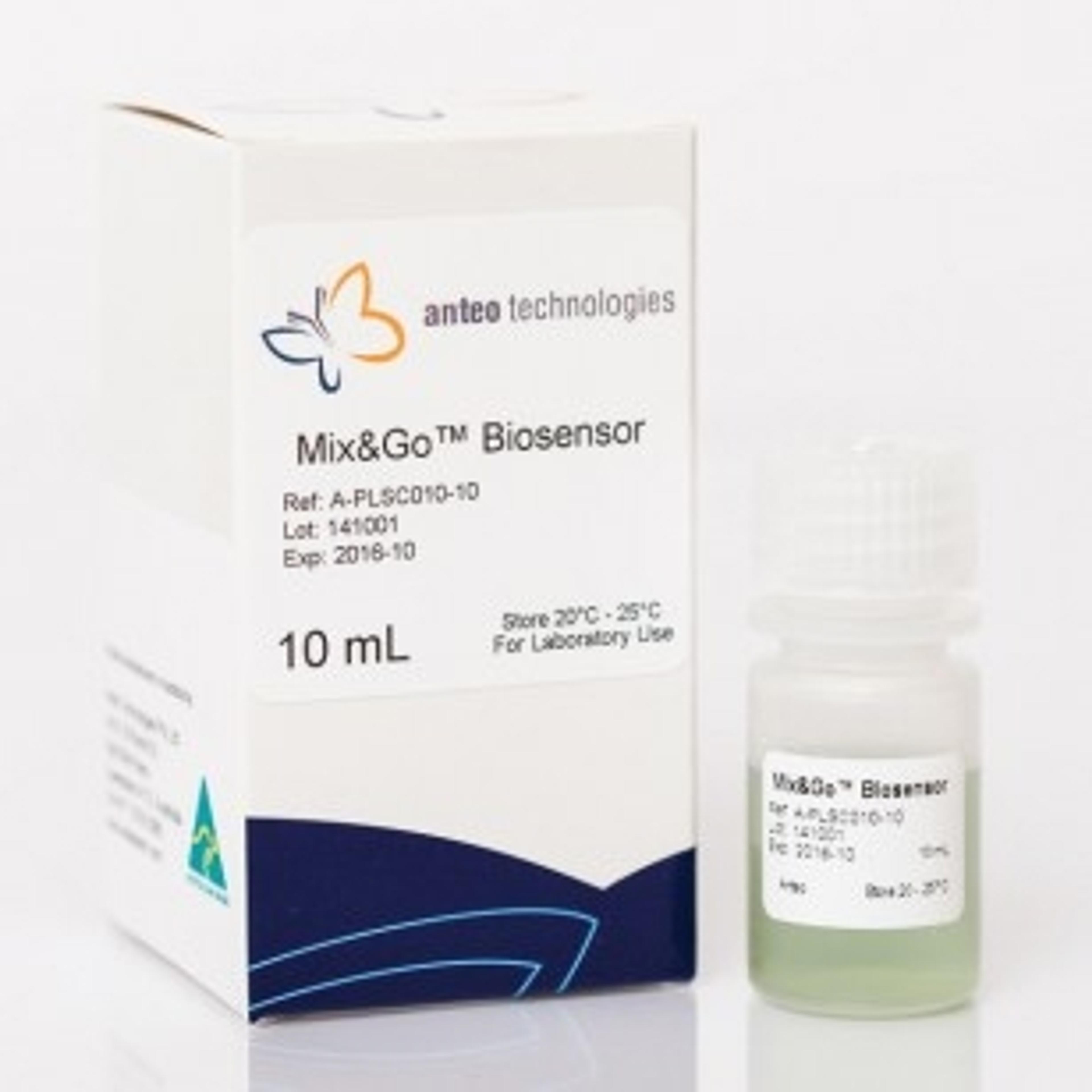
Mix&Go™ Biosensor
Anteo TechnologiesMix&Go Biosensor is a ready-to-use Activation Reagent specifically developed for binding biomolecules onto planar surfaces including polystyrenes, certain cyclic olefin copolymers, microarray slides, silicon oxides, titanium oxides, ceramics and gold surfaces (excluding gold colloids in suspension). Mix&Go Biosensor can modify the strength of binding, wettability and surface charge of base materials commonly used in biosensor applications. By using Mix&Go surface coatings, it is possible to control protein binding and improve the stability of bound biomolecules across a range of surfaces used in biosensors. Mix&Go Biosensor has many advantages over methods such as EDC, including: Mix&Go is water based and replaces the dry chemicals you would use with the EDC method Using Mix&Go instead of NHS/EDC chemistry can save up to 3-4 hours of lab time Increased stability of antibodies Higher functionality of antibodies Decreased background Mix&Go improves reproducibility between experiments by providing uniformity between surfaces.

AMG™ Coupling Kit, 200 nm Magnetic Particles
Anteo TechnologiesThe 200 nm Coupling Kit makes conducting lateral flow tests and biomolecule separation (including cell separation) easier and more flexible. The Kit contains Mix&Go™ activated 200 nm magnetic particles that give you increased antibody binding capacity and functionality, while the included blocking buffer decreases background noise. Reduce reagent preparation time; remove traditional surface preparation steps such as EDC and replace these steps with the 200 nm pre-activated magnetic particles provided. This Kit reduces aggregation and gives you the freedom and ability to produce multifunctional particles for diverse applications, including dual labelling. For lateral flow tests, magnetic particles are easier to handle than gold. Magnetic separation removes the need to perform centrifugation and filtration concentration. At Anteo, we have also seen greater sensitivity using magnetic particles instead of gold during lateral flow tests. This 200 nm Kit gives you a higher binding capacity than the AMG™ Coupling Kit, 1µm Magnetic particles per mass of particles, potentially leading to a higher yield. Features & Benefits: Easier and more flexible lateral flow tests Easier and more flexible biomolecule separation For diverse applications, including dual labelling Increase antibody functionality Reduce reagent preparation time by 3-4 hours Highly monodispersed Low background noise Kit reduces aggregation High reproducibility between experiments Applications: Particle Based Immunoassays Lateral Flow Bioseparations and Immunoprecipitation Kit components: Activated 200 nm Magnetic Particles Coupling Buffer Blocking Buffer Storage Buffer Low Binding Microcentrifuge Tubes Sizes: 10 Reactions 30 Reactions