GeneCopoeia Genome Editing Tools for Safe Harbor Integration in Mice and Humans

25 Sept 2014

This application note discusses the use of a ‘Safe Harbor’ for transgene integration in mice and humans, and a demonstration of the ability of the GeneCopoeia genome editing tools for Human AAVS1 and Mouse Rosa26 Safe Harbor to integrate transgenes at a safe genomic site.

Mouse ROSA26 safe harbor gene knock-in kit and clones

GeneCopoeia

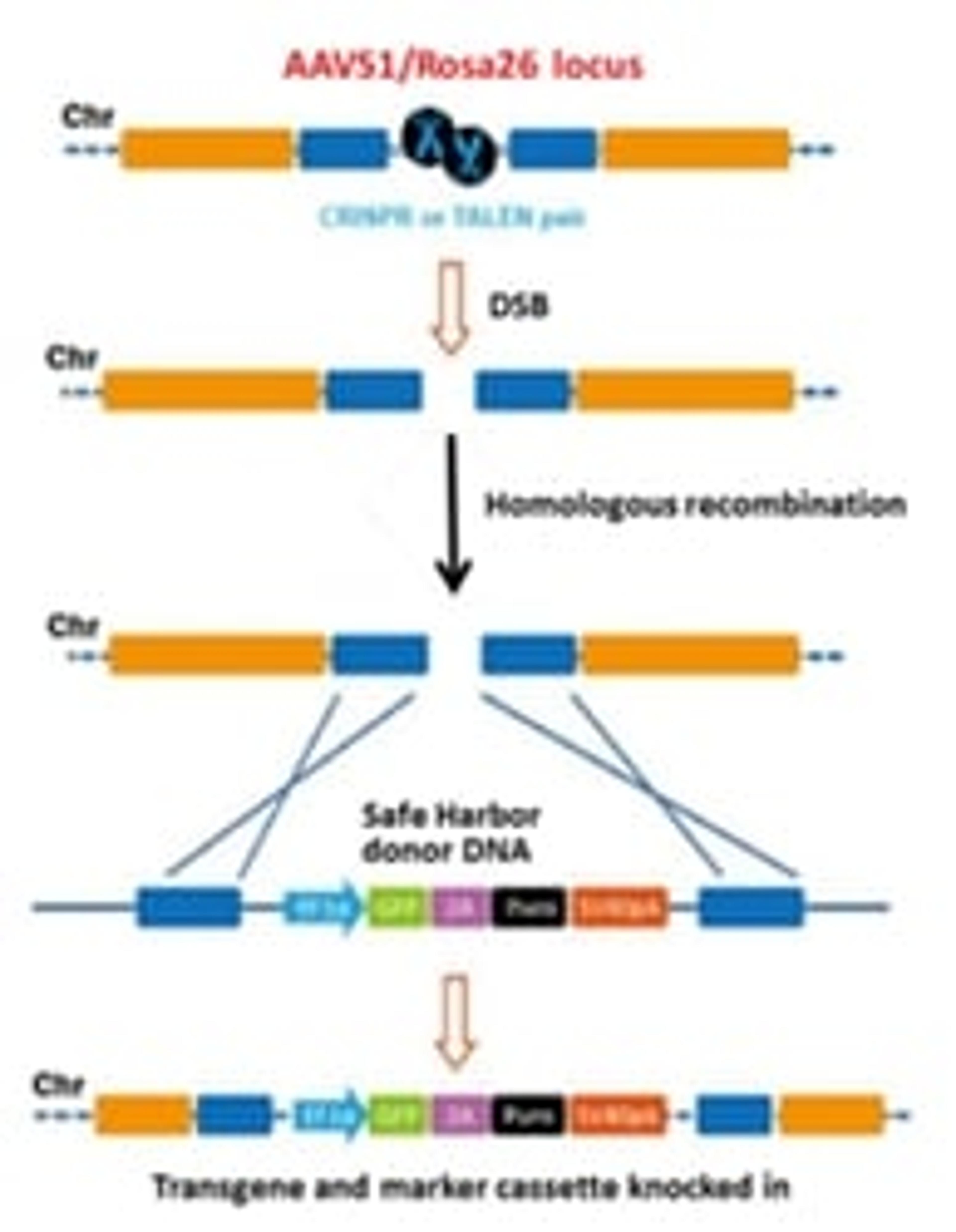
Mouse ROSA26 safe harbor gene knock-in kit and clones. ROSA26 (also known as ROSAβgeo26 locus) in mice genome is first found in chromosome 6 in one particular strain of mice-named ROSAβgeo26-expressed β galactosidase from a randomly inserted transgene at high levels uniformly in nearly all tissues examined. This locus expresses one coding transcript and two noncoding transcripts, and only the non-coding transcripts are disrupted by the insertion. While pups homozygous for the insertion are born at slightly lower frequency than heterozygous pups, homozygotes appeared to develop normally and were fertile. So, the “Rosa26” locus has since been used as a transgene insertion site that causes no apparent adverse effects on fitness, and permits stable gene expression. ROSA26-specific TALENs or CRISPR-Cas9 system can generate a DNA double-strand break (DSB) in ROSA26 in mouse genome, stimulating natural DNA repair mechanism. In the presence of ROSA26 ORF knockin clones, homologous recombination (HR) happens and integrantes DNA fragment from ORF knockin clone into the safe harbor locus.

(0)

Links

Tags

Genome AnalysisGenomics, the study of genomes, includes functional genomics, evolutionary genomics and comparative genomics. There are many genomic technologies such as DNA sequencing of whole genomes, computational biology and bioinformatics. DNA and nucleic acids must be isolated and concentrated from cells for analysis with kits, automated analyzers and software. Other useful technologies for studying genomics include PCR, microarrays and electrophoresis.Protein PurificationProtein purification is a vital step in drug discovery, therapeutics, biotech and life science research. The purification process typically involves subcellular or membrane protein extraction with cell lysis kits, separation of proteins from cell debris by filtration or spin columns, and the isolation of proteins of interest from other proteins and impurities with affinity purification (including fusion protein tags and antibody binding proteins A, G and L), immunoprecipitation or chromatographic methods, such as ion exchange, size exclusion and immobilized metal affinity chromatography. All purification methods come in multiple formats for your laboratory needs, including agarose or magnetic beads, resins, columns and filter plates. Find the best protein purification equipment in our peer-reviewed product directory: compare products, check customer reviews and receive pricing direct from manufacturers.TransfectionTransfection introduces nucleic acids (DNA or RNA) into cells, facilitating gene expression, genome editing, and functional studies. It�s widely used in genetic research, drug discovery, and therapeutic development. Find transfection reagents, kits, and systems in our product directory with reviews and pricing options.Genome EditingGenome editing involves altering the DNA of an organism, which holds promise for disease treatment, agriculture, and gene therapy. Techniques like CRISPR-Cas9 are revolutionizing this field, enabling precise genetic modifications. Explore genome editing tools in our peer-reviewed product directory; compare products, check reviews, and get pricing directly from manufacturers.