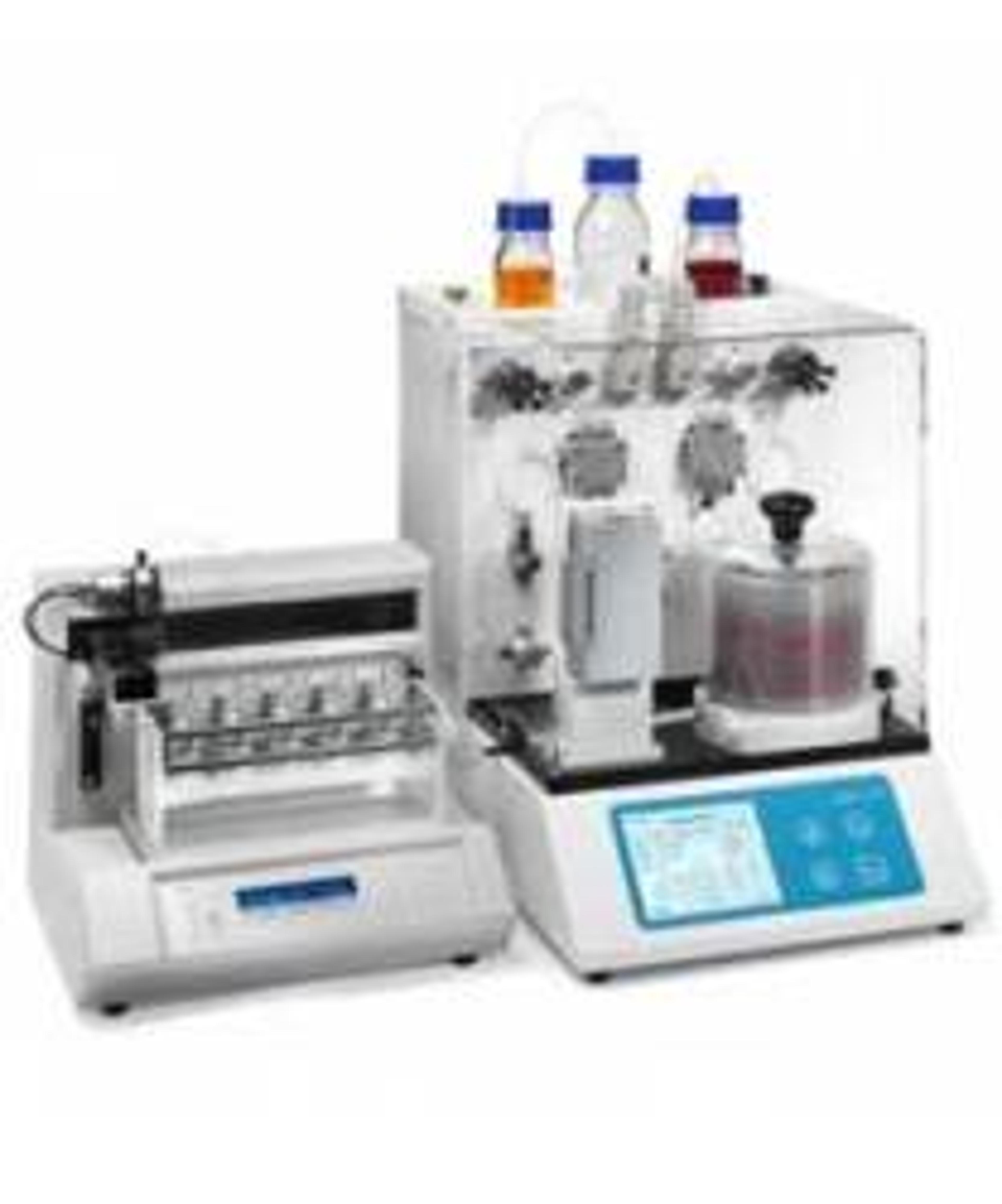
FlowSyn™: An Integrated Bench-top Continuous Flow Reactor

16 Jul 2011

This application note demonstrates the capabilities of FlowSyn, a compact integrated continuous flow reactor. Two examples are presented: accelerated esterification under superheated conditions, and an aromatic nucleophilic substitution reaction.

FlowSyn Continuous Flow Reactor

Uniqsis Ltd

FlowSyn - Making Flow Chemistry Simple FlowSyn is a fully integrated continuous flow reactor with everything you need to start doing flow chemistry including reaction optimization, synthesis and scale up. To provide maximum flexibility, a wide range of mixer and reactor options are available as well as additional modules for performing multiple experiments, or sub-ambient chemistry. • Ability to perform continuous flow chemistry under microwave-like conditions (up to 260oC). • Perform sub-ambient continuous flow chemistry using the 'Cold Coil'. • Run up to 10 automated sequential experiments with the 'Automated Experiment Package'.A pair of high pressure pumps are used to deliver reagent solutions from either stock bottles or sample injection loops through a 'T'-mixer into the electrically heated flow reactors. Reactions can be heated to 260?C and 150?C in the coil and column reactor modules respectively. Back pressure regulators of up to 1000 psi are used to pressurise the system and thus perform superheating of solvents, allowing the chemist to access'microwave like' conditions with no limitation on scale. FlowSyn is very easy to use with a high resolution user interface. The user is guided through the process for setting up a flow chemistry reaction by inputting parameters for reagent volumes, temperatures and reaction times. The user can choose to collect all of the reaction plug, or only the 'steady state' part. FlowSyn will then equilibrate and run the reaction, and finally flush the system through with solvent. Throughout FlowSyn will monitor the pressure of the system, and shut down if a problem occurs allowing FlowSyn to be safely run unattended.

(0)

Links

Tags

Combinatorial ChemistryCombinatorial chemistry, also known as combichem, is a technique used in drug discovery to create libraries of structurally related compounds. A library is generated by synthesis with a chemical reactor system or by computer-based modeling of compound combinations. When undertaking combinatorial chemistry consider reagents, buffers, resins and standards.Lab-on-a-ChipLab-on-a-chip (LOC) technology uses microfluidic chips, such as microarrays, to perform biochemical assays on a small scale. Benefits of lab-on-a-chip include the small volume of sample required as well as the speed of analysis. In selecting lab-on-a-chip devices consider the assay, cost, reliability, sensitivity and signal to noise ratio.High-Throughput ScreeningHigh-throughput screening (HTS) is an automated drug discovery technique for identification of active compounds against a compound library. Use HTS readers and integrated assay preparation / analysis workstations to screen your compounds. Identify active compounds against various HTS libraries, including membranes, proteins and peptides and HTS cell lines. Find the best high-throughput screening products in our peer-reviewed product directory: compare products, check customer reviews and receive pricing direct from manufacturers.ADME-ToxicologyADME-toxicology (ADME-Tox) studies are used in pharmacology and pharmacokinetics to assess the activity/toxicity of drugs <i>in vivo</i> or <i>in vitro</i>. Find bioassays for absorption, distribution, metabolism, and excretion of drug molecules including cytotoxicity, transporter/permeability, metabolism and activity assays as well as hepatocytes and cell lines for ADME. Find the best ADME-toxicology products in our peer-reviewed product directory: compare products, check customer reviews and receive pricing direct from manufacturers.Assay AssemblyAssay Assembly is technique used in drug discovery to develop assays to test the cytotoxicity, genotoxicity, or other activities of a compound on a cell. Assay assembly requires chip assembly, a delivery system and a detection and analysis method. Beneficial features of assay kits or automated systems include high-throughput, high speed and sensitivity and low signal to noise ratio.Compound LibrariesCompound libraries, or chemical libraries, are used in drug discovery for the identification of potential therapeutics compounds. Used in conjunction with high-throughput screening, the libraries of stored compounds are often generated for specific purposes as a drug target or disease model. Cheminformatics are commonly used when designing a compound library and software can be used to analyze the screening process.  Medicinal ChemistryMedicinal chemistry is a broad discipline encompassing the design, identification, synthesis and development of chemicals in drug discovery. It includes a number of techniques covering structural biology, synthetic chemistry and molecular biology. Technologies used in medicinal chemistry include ADME, lab-on-a-chip, high content screening and assay assembly.Microarray AnalysisMicroarrays, also known as biochips, are used for the detection and analysis of multiple genes, proteins, antibodies, or biomarkers on a single microchip. This can reveal information on protein or gene expression, single nucleotide polymorphism (SNP), copy number variation (CNV), epigenetics and patient health in clinical diagnostic tests. Discover a range of microarray scanners and prefabricated antibody, protein, RNA and DNA microarrays for your analysis or consider creating your own custom microarrays with a microarray printer. Find the best microarray products in our peer-reviewed product directory: compare products, check customer reviews and receive pricing direct from manufacturers.Process ChemistryProcess chemistry is an important stage of drug development for scaling-up drug production or chemical synthesis reactions. It is useful for optimizing economical and efficient drug production. Process chemistry uses reactors and pump systems as well as reagents, standards and buffers.SNPs TechnologySingle nucleotide polymorphisms (SNPs) are individual base variations in a DNA sequence. SNPs are used in research to study predispositions to disease and drug discovery. Products for studying single nucleotide polymorphisms include SNP arrays and detection systems to detect polymorphisms, SNP typing systems for genotyping DNA, and PCR to amplify specific SNPs.High-Content ScreeningHigh-content screening (HCS), also known as high-content analysis (HCA), is a high-throughput technique used in drug discovery to identify substances that alter the phenotype of cells. HCS uses fluorescent microscopic imaging and automated image analysis to investigate cellular events such as apoptosis, cell viability, GPCR activation, oxide production, neurite outgrowth, and cell signaling. Find the best fluorescent labeling reagents, cellular assays, and high-content imaging systems in our peer-reviewed product directory: compare products, check customer reviews and receive pricing direct from manufacturers.Biopharmaceutical AdvancesBiopharmaceutical advances follow the development of pharmaceuticals derived from biotechnology, also known as biotechnology medicines. Biopharmaceuticals may be produced from cell lines, plants, or microbial cells. Important considerations of biopharmaceutical use include application, cost, production process and purification.Clinical TrialsClinical Trials, an essential part of drug discovery process, assess the safety and effectiveness of a new medication or device in the pharmaceutical industry. Clinical Trials are a phased process (Phase 0, Phase I, Phase II, Phase III and Phase IV) which begins after initial preclinical testing.Continuous Flow Reactor
FlowSyn™: An Integrated Bench-top Continuous Flow Reactor