ResourceSeparations

Efficient Multi-Well Protein Purification Strategies

10 Apr 2011

This application note by Pall Life Sciences describes methods using 96-well filter plates combined with chromatography media for fractionation of small-volume protein samples in order to optimize larger-scale purifications. Methods are discussed for batch-mode protein separations, protein purification strategies and for moderate to high throughput protein isolation. The filter plate-based strategy allows for rapid screening of multiple purification schemes. To overcome mass transfer limitations associated with conventional resin-based chromatography, membrane chromatography was developed to obtain better flow distribution, fast flow rates, and increased accessibility for rapid purification of target proteins or removal of contaminants.

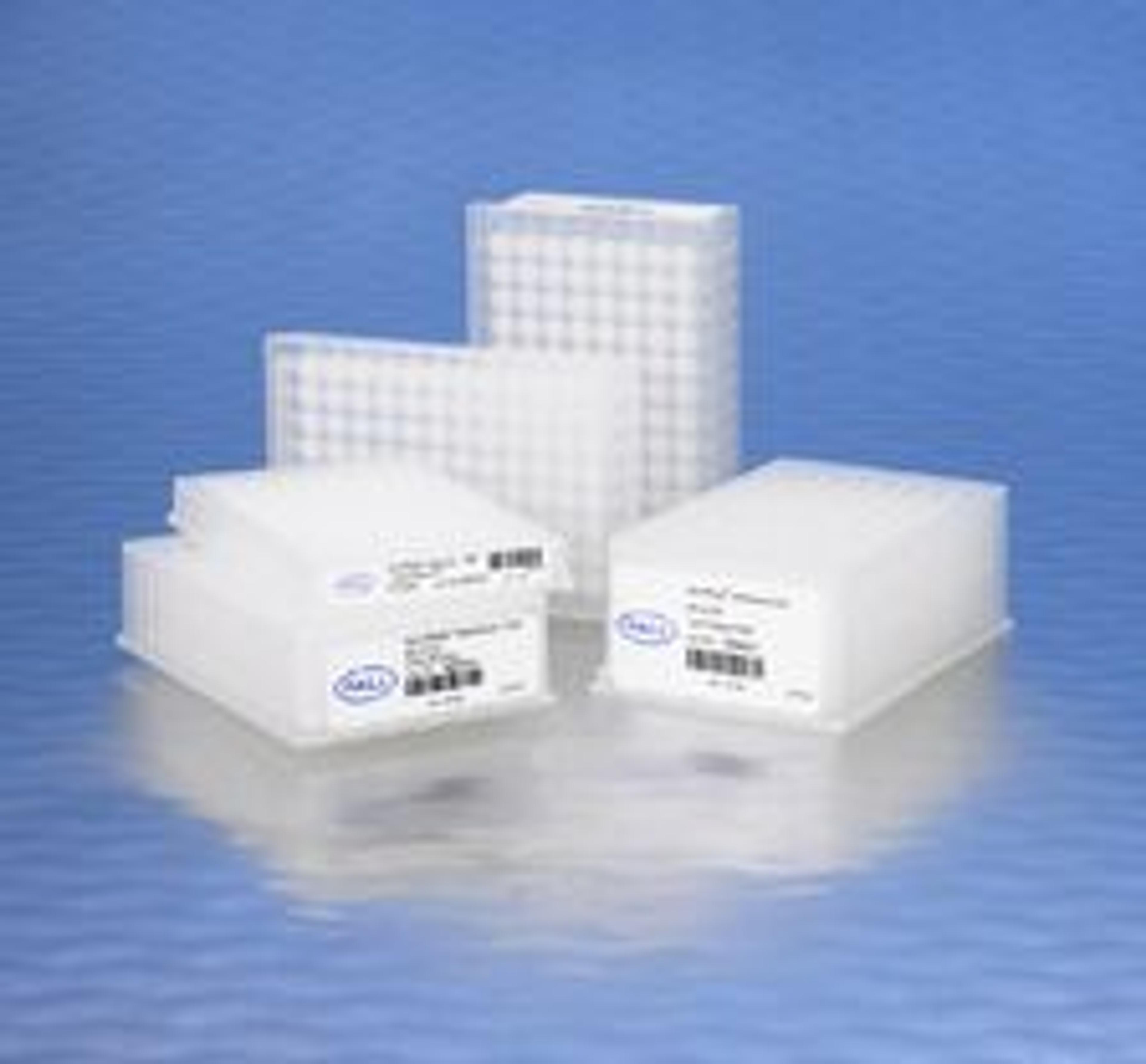
AcroPrep™ Advance Filter Plates

Pall Life Sciences - Laboratory, Food, Beverage

  AcroPrep™ Advance filter plates are the newest edition to Pall’s filter plate family. New sealing technology and advanced tip design make these the first choice in critical sample prep applications.   Aplications: Lysate Clearance DNA purification Protein purification Multiplex assays Aqueous filtration Particulate removal Size exclusion Bead-based assays Neonatal screening Flow cytometry Solvent filtration Concentration, purification and desalting of proteins and nucleic acids    Features: Smooth well design – Provides consistency in filtration times, as well as efficient sample and bead recovery Optimized outlet tips – Minimizes sample leakage during incubation steps and reduces the presence of hanging drops following filtration New well geometry – Results in faster, more uniform filtration rates across the plate, thereby improving well-to-well, plate-to-plate and lot-to-lot consistency 100% visual inspection – Ensures each well has proper membrane placement and is free from debris Automation compatible – Manufactured in accordance with SBS guidelines, allowing plates to be run in manual, semi-automated and automated processes  

(0)

Links

Tags

Ion ChromatographyIon chromatography, also known as ion exchange chromatography, is a high-performance liquid chromatographic technique used for the separation and identification of ions or polar molecules in a sample, including proteins, nucleotides and amino acids. Equipment includes ion exchange columns, ion exclusion columns, ion chromatography systems, pumps, and detectors. Find the best ion chromatography equipment in our peer-reviewed product directory: compare products, check customer reviews and receive pricing direct from manufacturers.Combinatorial ChemistryCombinatorial chemistry, also known as combichem, is a technique used in drug discovery to create libraries of structurally related compounds. A library is generated by synthesis with a chemical reactor system or by computer-based modeling of compound combinations. When undertaking combinatorial chemistry consider reagents, buffers, resins and standards.ProteomicsProteomics is the systemic bioinformatics study of proteins and amino acids, including their structure, size, function and identification. Tools used in proteomics include chromatography, blotting and gels, protein arrays, mass spectrometry and ELISA and associated analysis software. Analyzers and proteomic systems should be sensitive, high resolution, fast and may be automated for high-throughput.Assay AssemblyAssay Assembly is technique used in drug discovery to develop assays to test the cytotoxicity, genotoxicity, or other activities of a compound on a cell. Assay assembly requires chip assembly, a delivery system and a detection and analysis method. Beneficial features of assay kits or automated systems include high-throughput, high speed and sensitivity and low signal to noise ratio.Medicinal ChemistryMedicinal chemistry is a broad discipline encompassing the design, identification, synthesis and development of chemicals in drug discovery. It includes a number of techniques covering structural biology, synthetic chemistry and molecular biology. Technologies used in medicinal chemistry include ADME, lab-on-a-chip, high content screening and assay assembly.Process ChemistryProcess chemistry is an important stage of drug development for scaling-up drug production or chemical synthesis reactions. It is useful for optimizing economical and efficient drug production. Process chemistry uses reactors and pump systems as well as reagents, standards and buffers.Protein PurificationProtein purification is a vital step in drug discovery, therapeutics, biotech and life science research. The purification process typically involves subcellular or membrane protein extraction with cell lysis kits, separation of proteins from cell debris by filtration or spin columns, and the isolation of proteins of interest from other proteins and impurities with affinity purification (including fusion protein tags and antibody binding proteins A, G and L), immunoprecipitation or chromatographic methods, such as ion exchange, size exclusion and immobilized metal affinity chromatography. All purification methods come in multiple formats for your laboratory needs, including agarose or magnetic beads, resins, columns and filter plates. Find the best protein purification equipment in our peer-reviewed product directory: compare products, check customer reviews and receive pricing direct from manufacturers.Biopharmaceutical AdvancesBiopharmaceutical advances follow the development of pharmaceuticals derived from biotechnology, also known as biotechnology medicines. Biopharmaceuticals may be produced from cell lines, plants, or microbial cells. Important considerations of biopharmaceutical use include application, cost, production process and purification.Clinical TrialsClinical Trials, an essential part of drug discovery process, assess the safety and effectiveness of a new medication or device in the pharmaceutical industry. Clinical Trials are a phased process (Phase 0, Phase I, Phase II, Phase III and Phase IV) which begins after initial preclinical testing.
Efficient Multi-Well Protein Purification Strategies