ResourceMaterials

Detection and Identification of Microplastic Particles in Cosmetic Formulations Using IR Microscopy

Detection and Identification of Microplastic Particles in Cosmetic Formulations Using IR Microscopy

2 Nov 2015

It is estimated that there is in excess of 150 million tons of plastic materials in the world’s oceans. Much of this pollution consists of large items such as discarded drink bottles and plastic bags. However, there is increasing research into the amount of much smaller materials, termed microplastics, in the river and ocean systems which present a different type of problem for marine life. Infrared (IR) spectroscopy is the established technique for identifying polymer materials and has been used extensively for identifying large (over 100 micrometer) polymer materials. For microplastics, down to a few micrometers in size, an IR microscope can be used for the detection and identification of these materials. This application note demonstrates the detection of these microplastics using an IR microscope.

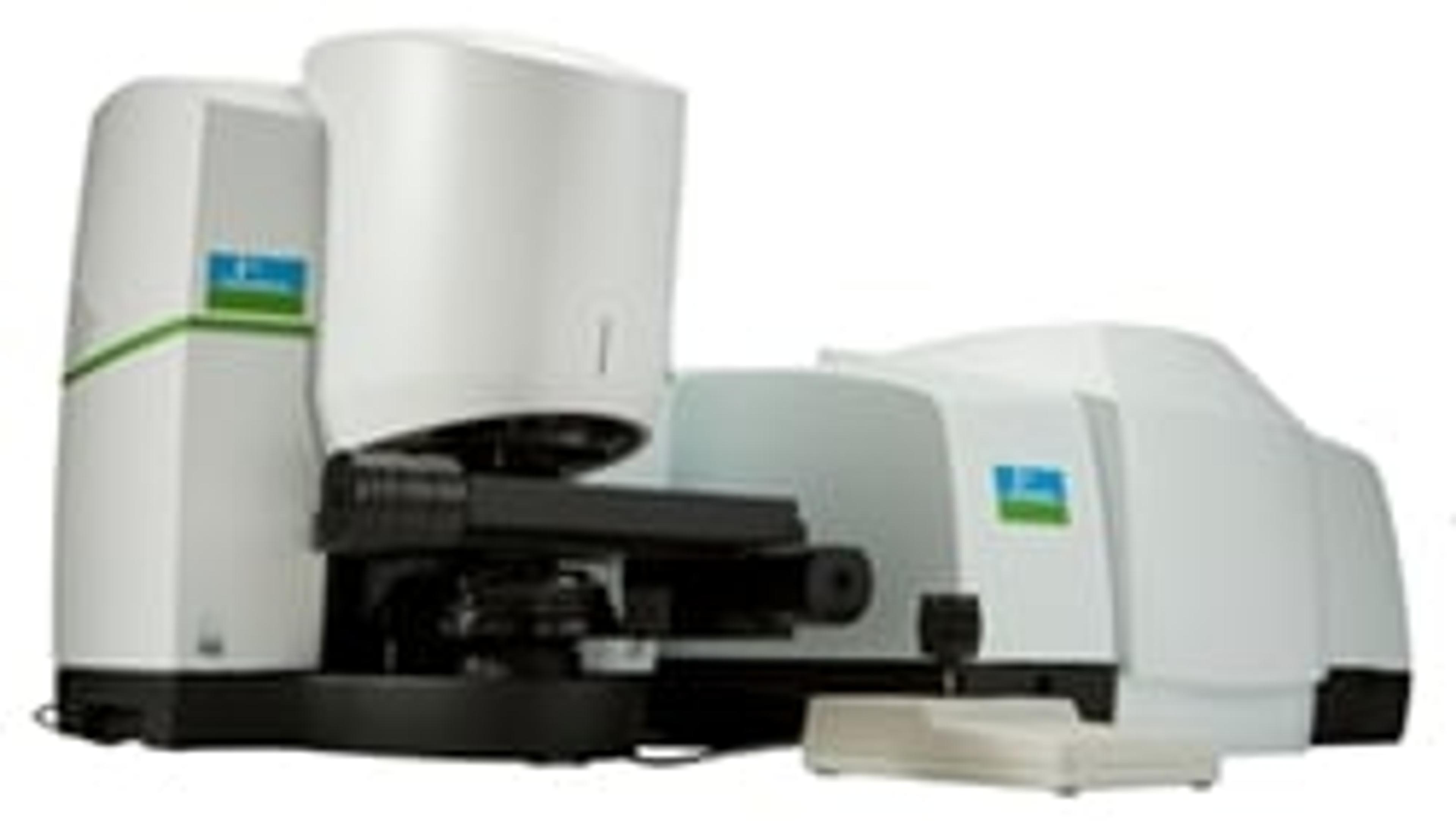
Spotlight 200 FT-IR Imaging System

PerkinElmer

Spotlight 200 FTIR Microscope System is a high-performance microscopy platform, designed to generate high-quality, reproducible data from a variety of sample types. The combination of the highly-automated, very easy-to-use system and exceptional sensitivity ensures that quality spectra can be obtained from sample areas down to the accepted diffraction limit of 10 microns. In addition, the Spotlight 200 also has the capability to be fully upgraded to the Spotlight 400 Imaging System.Features & Benefits: Highest performance signal-to-noise system giving best quality spectra and fastest imaging Can operate in transmission, reflectance and micro-ATR for maximum sampling flexibility Can be used in extended range mid-IR, near-IR or dual range configurations to give maximum information from samples in the shortest possible time Rapid, high-performance instrument allows exceptional applications capability 10 μ spatial resolution Can be upgraded to a Spotlight 400 Imaging System allowing even faster imaging and the opportunity to add ATR Applications: Product defect analysis Impurity identification Component distribution studies Forensics Academic research
(0)

Spectrum Software Suite

PerkinElmer

PerkinElmer's suite of highly configurable IR spectroscopy software provides beginners and experts alike an intuitive and interactive user interface. It provides operational simplicity without losing functionality. Pre-configured macros are ideal for those looking to get an answer fast, to generate results and move on. Or you have the flexibility drill down into as much details and analysis as you would like. We provide you the functionality at your finger tips to develop your own macros to support your evolving research requirements.

(0)

Links

Tags

Infrared / IR SpectroscopyInfrared (IR) spectroscopy measures the interaction of infrared light with a sample, including transmission, reflectance & absorbance, facilitating the identification of analytes. Equipment used for quantitative analysis includes Fourier-transform infrared (FTIR) spectrometers, infrared cameras, FTIR gas analyzers, as well as attenuated total reflectance (ATR) accessories and pellet or film presses. Find the best IR spectroscopy products in our peer-reviewed product directory: compare products, check customer reviews and receive pricing direct from manufacturers.Environmental Monitoring and TestingEnvironmental monitoring and testing uses handheld portable analyzers, kits, spectrometers or chromatography systems for air, water, soil, food and other sample testing. Useful features of analyzers such as BOD and COD include portability, easy calibration, automation and sensitivity.  Environmental test kits for pH, water, moisture, etc, should be accurate, sensitive, reliable, fast and easy to use.Non-Destructive TechniquesNon-destructive techniques (NDT) describes a variety of analytical techniques used to evaluate the properties of a material. Common methods include ultrasonic, magnetic-particle, liquid penetrant, radiographic, remote visual inspection (RVI), and eddy-current testing. NDT is regularly used in forensic engineering, civil engineering, mechanical engineering, electrical engineering, systems engineering, aeronautical engineering, and medicine.Particle CharacterizationParticle characterization instruments are used to determine particle size distribution, shape, surface area, zeta potential, density and porosity of particles and materials. Multiple tecchniques are available for determining particle size, shape and count including dynamic light scattering (DLS), laser diffraction, electrozone (Coulter technique), imaging particle analysis and single particle optical sensing. Determine the density of your material with a gas pycnometer or examine its surface area and porosity with gas adsorption analyzers and mercury porosimeters. Find the best particle characterization instruments in our peer-reviewed product directory: compare products, check customer reviews and receive pricing direct from manufacturers.Polymeric MaterialsPolymeric materials are widely used in industries ranging from biomedical devices to packaging and electronics. Research into these materials focuses on their properties, including strength, flexibility, and degradation. Advances in polymer science have enabled the development of more sustainable and high-performance materials. Explore the best polymeric material products in our peer-reviewed product directory; compare products, check reviews, and get pricing directly from manufacturers.PolymersPolymers are large molecules made up of many repeat units. Natural polymers such as DNA and proteins are essential to life, whereas synthetic polymers such as polystyrene and polyethylene are used widely due to their functionality. Typical techniques for analysis include GPC, SEC, DSC, FT-IR and NMR.CosmeticsInfrared Imaging
Detection and Identification of Microplastic Particles in Cosmetic Formulations Using IR Microscopy