ResourceSpectroscopy
Detection and Identification of Contaminations in the Manufacturing Process Using an IR Microscope
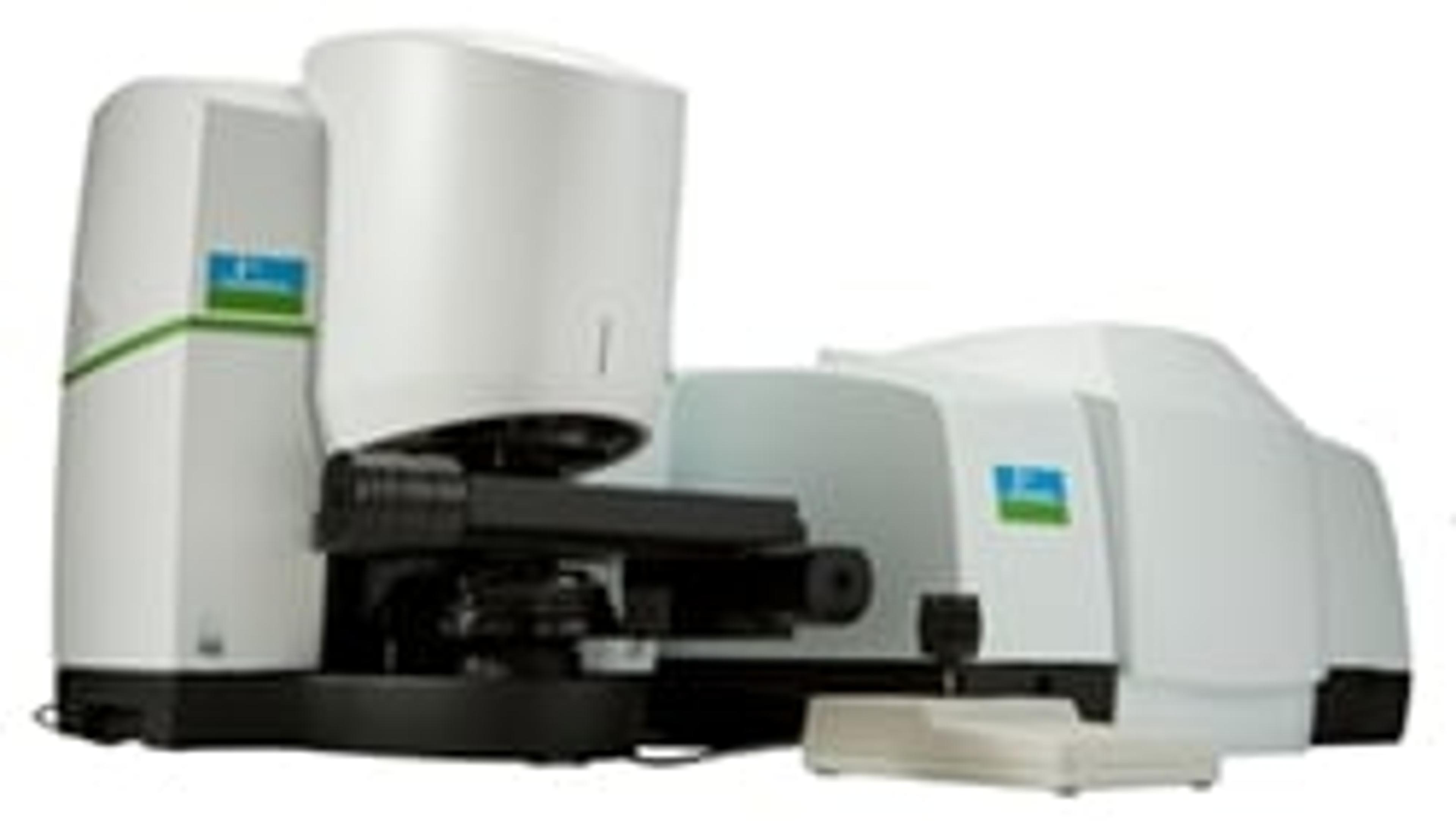
27 Mar 2016In this study from PerkinElmer the Spotlight 200i system, an automated infrared (IR) microscope, is used to rapidly detect and identify contaminants in a range of manufactured products. Using this technique even samples a few micrometers in size can be analyzed, allowing for complete quality control in the manufacturing process.
Links
Tags
Sample PreparationSample preparation can improve the quality and speed of separation techniques. Products to assist sample preparation include filtration equipment, evaporators, membranes and sieves.Infrared / IR SpectroscopyInfrared (IR) spectroscopy measures the interaction of infrared light with a sample, including transmission, reflectance & absorbance, facilitating the identification of analytes. Equipment used for quantitative analysis includes Fourier-transform infrared (FTIR) spectrometers, infrared cameras, FTIR gas analyzers, as well as attenuated total reflectance (ATR) accessories and pellet or film presses. Find the best IR spectroscopy products in our peer-reviewed product directory: compare products, check customer reviews and receive pricing direct from manufacturers.Near Infrared SpectroscopyNear-infrared (NIR) spectroscopy measures the interaction of near-infrared light with a sample, including transmission, reflectance and absorbance, facilitating the identification of analytes. Measurements can be conducted using a Fourier-transform near infrared (FT-NIR) spectrometer, while there are also UV-Vis- NIR spectrophotometers that measure a broader spectrum of wavelengths. Find the best NIR spectroscopy products in our peer-reviewed product directory: compare products, check customer reviews and receive pricing direct from manufacturers.Sample ManagementSample management systems include sample storage devices such as freezers and plate storers, sample environment enclosures and sample organization, retrieval and sorter systems. Useful system features include high-throughput, automation, robotic arms, automated liquid handling and associated database systems. Accessories in sample management include barcode scanners, heat sealers and tubes.Robotic InstrumentsRobotic instruments can be used for high-throughput automation of many lab processes. Such processes use instruments for assays like cell based assays and ELISA, for sample preparation like shakers, centrifuges and incubators, and for analysis such as sequencing and western blot analyzers. Useful features of robotic instruments include speed, reproducibility, barcode readers, software and automation.Robotic WorkstationsRobotic workstations are automated platforms enabling the user to perform high-throughput, multi-application processes, from sample preparation tasks such as PCR set-up, DNA purification and NGS library preparation, to integrated sample prep and analysis workstations. Automation makes processes consistent, fast, precise and fully walk-away. Find the best robotic workstations in our peer-reviewed product directory: compare products, check customer reviews and receive pricing direct from manufacturers.Particle CharacterizationParticle characterization instruments are used to determine particle size distribution, shape, surface area, zeta potential, density and porosity of particles and materials. Multiple tecchniques are available for determining particle size, shape and count including dynamic light scattering (DLS), laser diffraction, electrozone (Coulter technique), imaging particle analysis and single particle optical sensing. Determine the density of your material with a gas pycnometer or examine its surface area and porosity with gas adsorption analyzers and mercury porosimeters. Find the best particle characterization instruments in our peer-reviewed product directory: compare products, check customer reviews and receive pricing direct from manufacturers.Non-Destructive TechniquesNon-destructive techniques (NDT) describes a variety of analytical techniques used to evaluate the properties of a material. Common methods include ultrasonic, magnetic-particle, liquid penetrant, radiographic, remote visual inspection (RVI), and eddy-current testing. NDT is regularly used in forensic engineering, civil engineering, mechanical engineering, electrical engineering, systems engineering, aeronautical engineering, and medicine.Surface Area TestingPhysisorption studies fundamental parameters essential for the characterization of materials such as the specific surface area and pore size distribution. Properties such as porosity, strength, hardness, permeability, separation selectivity, corrosion, and thermal stress resistance can all be directly correlated to the porous structure of a material.RegulatoryPharmaceutical regulations impact on all areas of drug development, manufacture and control and supply. Services are provided from the early stages of drug development and clinical trials through to dossier submission, approval and marketing. Regulatory also includes submission of analytical studies from the pharmaceutical product and safety. Bioprocessing / FermentationBioprocessing is the use of biological materials to perform commercial, scientific or medical research processes. Biological materials used include cells, enzymes and organisms. Usually bioprocessing requires a batch or continuous bioreactor such as a fermentor or cell culture system. The advantages of using a reactor include high productivity, easy configuration, adjustable values and automation.Digital MicroscopyDigital microscopy involves using digital cameras and sensors to capture high-resolution images of samples for analysis. It offers enhanced imaging capabilities compared to traditional optical microscopy and is widely used in biological and material science research. Explore digital microscopy systems in our peer-reviewed product directory; compare products, check reviews, and get pricing directly from manufacturers.Quality ControlQuality control is needed in all production processes. Quality control is a monitoring procedure or set of procedures that are put in place to ensure that a manufactured product adheres to a defined set of quality criteria. AutomationAutomation in laboratories and manufacturing processes enhances efficiency, precision, and scalability by reducing the need for manual intervention. It plays a critical role in improving productivity, minimizing human error, and accelerating workflows in fields like diagnostics, drug development, and industrial testing. Automation technologies include robotic systems, automated liquid handlers, and process control systems that streamline complex tasks and ensure consistent, reproducible results. Explore our peer-reviewed product directory to discover the best automation solutions, compare options, read user reviews, and get prices directly from manufacturers.Contamination PreventionContamination prevention aims to control and minimize the risk of contamination during experiments. Biological safety cabinets and sterilization equipment are examples of technologies used to prevent contamination.