
Cement Analysis by the Pressed Powder Method on Benchtop WDXRF Supermini200 According to ASTM C114-11
6 Nov 2012Cement is one of the most important materials for construction. Many kinds of hydraulic cements, including Portland cement, with various physical properties are produced by changing the composition of clinker minerals. It is therefore important to control the chemical composition of cement products and interim products. This application note demonstrates quantitative analysis for Portland cement by the pressed powder method according to ASTM C114-11 on Rigaku Supermini200, a benchtop sequential wavelength dispersive X-ray fluorescence spectrometer.
Related products
Request Quote for All Products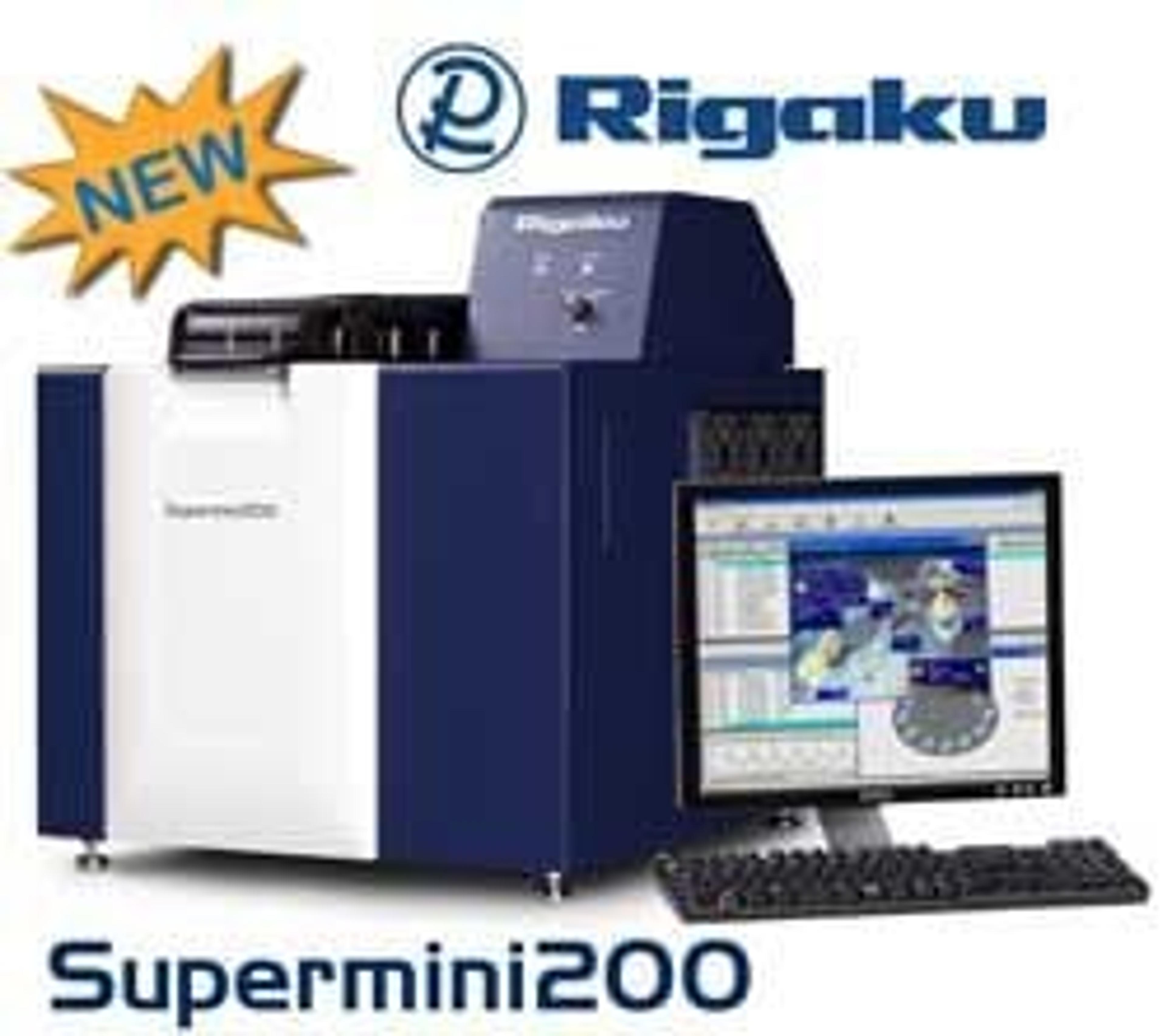
Supermini 200 Benchtop WDXRF Spectrometer
Rigaku CorporationThe new Supermini200 has improved software capabilities as well as a better footprint. As the world's only high-power benchtop sequential wavelength dispersive X-ray fluorescence (WDXRF) spectrometer for elemental analysis of oxygen (O) through uranium (U) of almost any material, the Rigaku Supermini200 uniquely delivers low cost-of-ownership (COA) with high resolution and lower limits-of-detection (LLD). Not only is the Rigaku Supermini200 an affordable choice for your XRF elemental analysis needs, the running costs are also low. P10 gas for the flow proportional detector is the only consumable. The Supermini200 does not require a source of cooling water, plumbing, or an external chiller, thereby decreasing system maintenance and lowering the overall lifetime cost of ownership of the system and yearly budgets for consumables and maintenance.Supermini is the only high powered (200 W) X-ray tube benchtop WDXRF system, providing excellent excitation resulting in lower detection limits and shorter measurement times. A unique and proprietary optical system is also employed to enhance sensitivity beyond the gains of the tube power.Supermini 200 Benchtop WDXRF Spectrometer Features: Analyze oxygen through uranium (O → U) Analyze: solids, liquids, powders, alloys and thin films Atmosphere: air, helium or vacuum X-ray tube: 50 kV, 200 W Pd-anode Primary beam filter: Zr is standard; Al optional Detectors: F-PC and scintillation Crystals: 3-position changer Autosampler: 12-position standard Vacuum: rotary pump standard Power: 100 – 120V (50/60 Hz) 15A or 200 – 240V (50/60 Hz) 10A