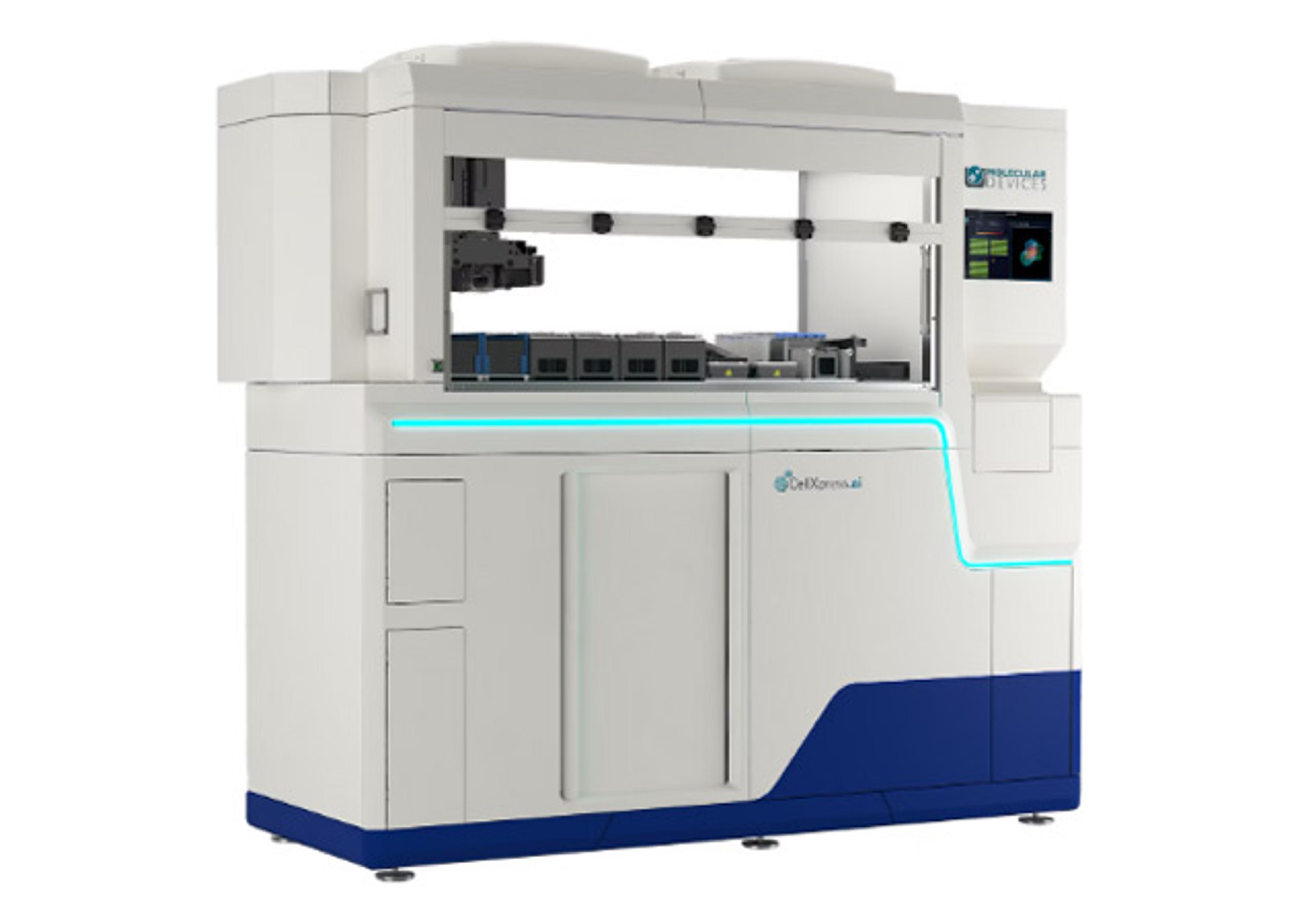
Cell culture automation with the CellXpress.ai cell culture system

27 Mar 2024

Finding efficient anti-cancer drugs and drug combinations is critical for therapy success. Accordingly, there is a critical need to develop methods for efficient drug efficacy testing to discover new viable therapeutic targets. Being highly representative of the structure and behavior of tumors, 3D cancer cell models, such as tumoroids, are highly valuable tools for cancer research and drug development. However, manual 3D cell culture workflows are time-consuming, error-prone, and inconsistent, making their adoption for high-throughput drug screening cumbersome. To expedite and standardize the spheroid assay, Molecular Devices® developed 3D cell culture automation methods using the CellXpress.ai™ Automated Cell Culture System to provide automated plating, passaging, media exchange, organoid monitoring in response to compound treatment, and endpoint assays. In this application note, Molecular Devices presents a study in which the automation of a colorectal cell culture workflow was described, where the culture and imaging of colorectal cancer 3D spheroids formed from HCT116 cell lines in U-shape low attachment plates were automated.

CellXpress.ai Automated Cell Culture System

Molecular Devices®

The CellXpress.ai™ Automated Cell Culture System is an AI-driven cell culture innovation hub that gives your team total control over demanding cell culture feeding and passaging schedules—eliminating time in the lab while maintaining a 24/7 schedule for growing and scaling multiple stem cell lines, spheroids, or organoids.

(0)

Links

Tags

Cell / Tissue CultureCell culture or tissue culture is used to study the biology of cells or tissues and to isolate cellular products in an environment which can be manipulated and well defined. Accurately control your culture environment with bioreactors or culture incubators, bind your cells to a surface or together with an extracellular matrix. Distinguish cell types with differential media or proliferate cells with certain characteristics using selective media. Enrich your media with supplements such as growth factors, sera and vitamins. Find the best cell and tissue culture products, kits and equipment in our peer-reviewed product directory: compare products, check customer reviews and receive pricing direct from manufacturers.Cell Lines Stem Cells and Primary CellsPrimary cell cultures, established cell lines and stem cells are vital for <i>in vitro</i> and <i>ex vivo</i> experimentation. High-quality cells, optimized for your applications, alongside optimized cell substrates, growth medium and supplements, are critical for experimental success. Explore a range of cells suitable for your applications, including isogenic cell lines, competent cells, induced pluripotent stem cell (iPSC)-derived cell lines, fungal/bacterial/mammalian cell lines, stem cells and cancer cell lines. Find the best cells for your research in our peer-reviewed product directory: compare products, check customer reviews and receive pricing direct from manufacturers.Microplate Readers / DetectorsMicroplate readers are used to automate the detection and analysis of labeled or label-free components in microplates during assays or live-cell monitoring. Microplate readers are generally distinguished by their mode of detection. Types include absorbance, luminescence, fluorescence intensity, fluorescence polarization, TRF / FRET and multimode microplate readers. Microplate readers deliver a high throughput of samples by reading multiple wells simultaneously, with the 96-well format the most commonly used. As a result, microplate readers are often used in the drug discovery, bioassays, research and pharmaceutical industries for screening applications. Microplate loading can also be automated, with robotic microplate stackers to increase throughput. Find the best microplate readers in our peer-reviewed product directory: compare products, check customer reviews and receive pricing direct from manufacturers.Cell-Based AssaysCell-based assays are used to monitor the presence, quantity and activities of a desired cellular analyte including drug molecules or biomarkers. This can reveal information on cell health (apoptosis, cytotoxicity, viability and proliferation assays), cell metabolism, cell migration and cell signaling mechanisms. Find the best cell-based assay products, kits and equipment with our peer reviewed product directory: compare products, check customer reviews and receiving pricing direct from manufacturers.Robotic InstrumentsRobotic instruments can be used for high-throughput automation of many lab processes. Such processes use instruments for assays like cell based assays and ELISA, for sample preparation like shakers, centrifuges and incubators, and for analysis such as sequencing and western blot analyzers. Useful features of robotic instruments include speed, reproducibility, barcode readers, software and automation.Robotic WorkstationsRobotic workstations are automated platforms enabling the user to perform high-throughput, multi-application processes, from sample preparation tasks such as PCR set-up, DNA purification and NGS library preparation, to integrated sample prep and analysis workstations. Automation makes processes consistent, fast, precise and fully walk-away. Find the best robotic workstations in our peer-reviewed product directory: compare products, check customer reviews and receive pricing direct from manufacturers.Software PlatformsSoftware platforms are useful for various stages of laboratory experiments from data collection to data storage and processing. For instance lab software is available for system control, data management, data analysis and qualification / validation.Automation Supplies / AccessoriesAutomated accessories and consumables make lab processes fast, efficient and reliable. Useful automation accessories include microplate sealers, label printers and reagent reservoirs.Plate ProcessingAutomated plate processing is used in microplate technologies for high-throughput, speed and efficiency. Plate processing systems include microplate handlers for moving plates, heat sealers, stackers and carousels for storage, retrieval and delivery, microplate washers and piercers. Useful features of plate processors include walk-away automation, compatibility and easy integration with microplate systems.Automated Liquid HandlingAutomated liquid handling equipment is used to mix, dilute and dispense allotted volumes of liquid into microplates and other vessels automatically. The robotic, liquid handling arms can dispense from single channel to 3456 multichannel as well as operate nanoliter dispensing, enabling high throughput of samples. Find the best automated liquid handlers in our peer-reviewed product directory: compare products, check customer reviews and receive pricing direct from manufacturers.SpheroidsSpheroids are clusters of cells that have been grown in 3D culture to be used as <i>in vitro</i> model systems. These 3D microtissues can be used for toxicology testing, DMPK studies and many other applications involving cell analysis.Cell Based AssaysCell-based assays use living cells to measure biological responses to various treatments or stimuli. They are essential for drug discovery, toxicology testing, and understanding cellular mechanisms. These assays are used to assess cell viability, proliferation, gene expression, and other cellular activities. Browse our peer-reviewed product directory to find the best cell-based assay tools and reagents, compare products, read customer reviews, and get pricing directly from manufacturers.Cancer ResearchAlthough cancer is often referred to as a single condition, it actually consists of more than 100 different diseases. Microscopy, mass spectrometry, high throughput sequencing and flow cytometry are some of the most common techniques employed in cancer research labs.
Cell culture automation with the CellXpress.ai cell culture system