
CD Detection of Myoglobin Structure During an Automated pH Titration
CD Detection of Myoglobin Structure During an Automated pH Titration
12 Jan 2016This application note describes the use of CD to follow the denaturation of myoglobin during an automated pH titration with acid. Circular dichroism spectroscopy (CD) is very sensitive to the secondary structure of polypeptides and proteins. Circular dichroism is a form of light absorption spectroscopy that measures the difference in absorbance of right- and left-circularly polarized light by a substance. Secondary structure determination by CD is reported to achieve accuracies of 0.97 for helices, 0.75 for beta sheet, 0.50 for turns, and 0.89 for other structure types.
Related products
Request Quote for All Products
J-1000 Series Circular Dichroism Spectrometers
JASCO (USA)The JASCO J-1100 is a CD Spectrometer system designed to meet most of the demands for biomolecule analysis in a compact, lower cost package.The simple yet powerful design is perfect as a workhorse for generating consistent CD data for research as well as an effective tool for teaching CD in academic environments. The JASCO J-1500 is designed to meet the most demanding of CD applications. The performance level is unparalleled and the layout is suited for adaptation to a variety of different sampling methods. With CD, LD and Absorbance provided as standard the base unit is already very capable but when combined with optional measurement modes and sampling accessories in addition to the new Simultaneous Multi-Probe (SMP) acquisition system you can unleash the power only dreamed of by earlier systems. FEATURES Wide spectral range from vacuum UV to Near-IR Standard built-in mercury lamp and optional NIST traceable standard sample for system validation High-efficiency purge capability enabling to enhanced vacuum UV measurement Extremely low stray light and high S/N ratio providing wide dynamic range High speed scanning Simultaneous Multi-probe measurements (SMP) with acquisition of up to four data channels Flexible design allowing field upgrades for different measurement modes and accessories as applications evolve Spectra Manager II or Spectra Manager CFR (For FDA regulated labs): 64 bit innovative, cross-platform Spectroscopy Software Suite for data acquisition, analysis and presentation including several methods of secondary structure calculation
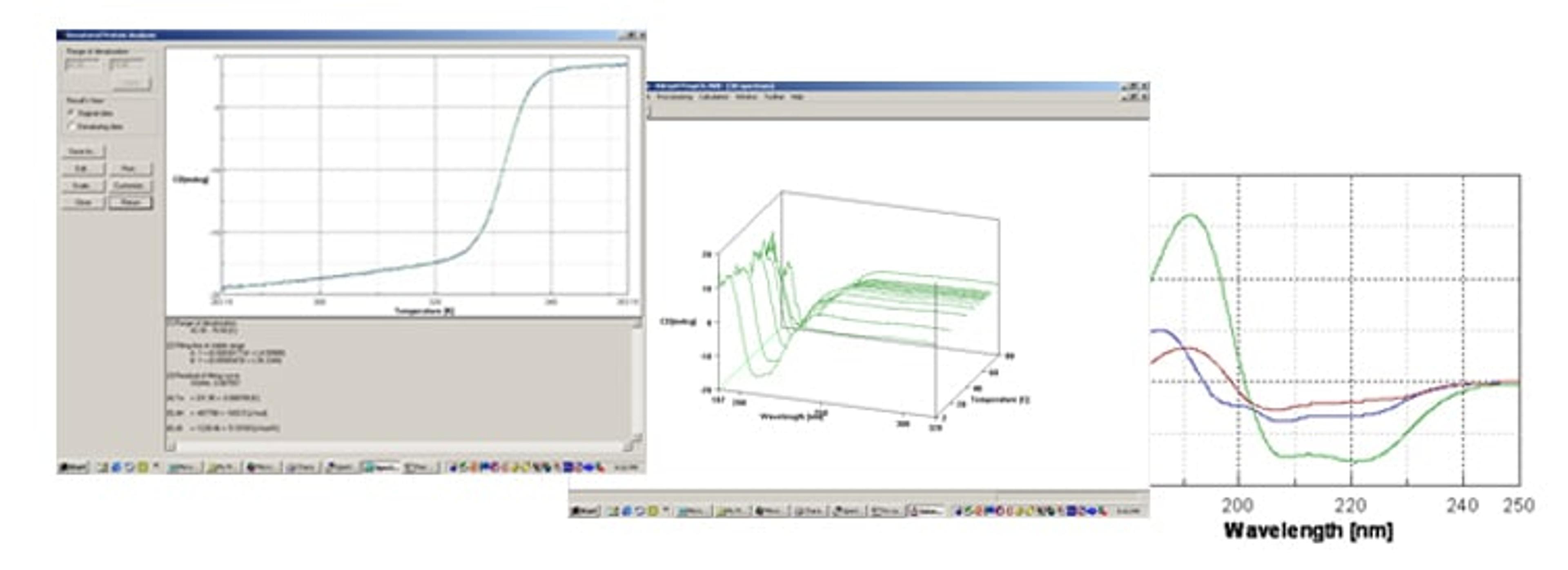
Spectra Manager II
JASCO (USA)Spectra Manager II is the latest version of the JASCO innovative cross-spectroscopy software platform.The approach of having a single platform for data analysis is a unique and powerful way to manipulate and display data from any JASCO spectroscopy system. UV/VIS/NIR, Fluorescence, FT/IR, CD, ORD, LD, Raman, FT-Raman Polarimeters and other types of data files can be directly compared, processed, and printed together. 32 bit Windows® environment running under Microsoft® Windows® 95, 98 or NT 4.0 Control of all JASCO spectroscopy products Control of multiple instruments from one computer Analysis of several types of spectral data in one package Users only need to be familiar with a single software package Flexible data display and publication quality printing Supports standard data formats such as ASCII, TXT and J-Camp for support to other software packages or operating systems such as Macintosh