Analysis of Protein Kinase AKT with an AMMP™ Assay in Cell Culture and Tumour Lysates

17 May 2011

In this application note by BioScale, inhibition of pSer473-Akt using both tissue culture and mouse xenografts is monitored. Activation of protein kinase AKT, through phosphorylation of both Thr308 and Ser473, promotes cell survival. A pair of commercially available monoclonal antibodies against both pSer473-Akt and pan-Akt was selected and each affinity tagged with either biotin or fluorescein. Using the ViBE™ Protein Analysis Platform with AMMP™ Assay technology, a standard curve was generated with in vitro phosphorylated (p473) recombinant Akt2. Using that derived standard curve a comparison of samples treated or untreated with PI3K inhibitors from either cell culture or xenograft tumor lysates was made using the ViBE™ BioAnalyzer with Li-Cor Western Blot analysis.

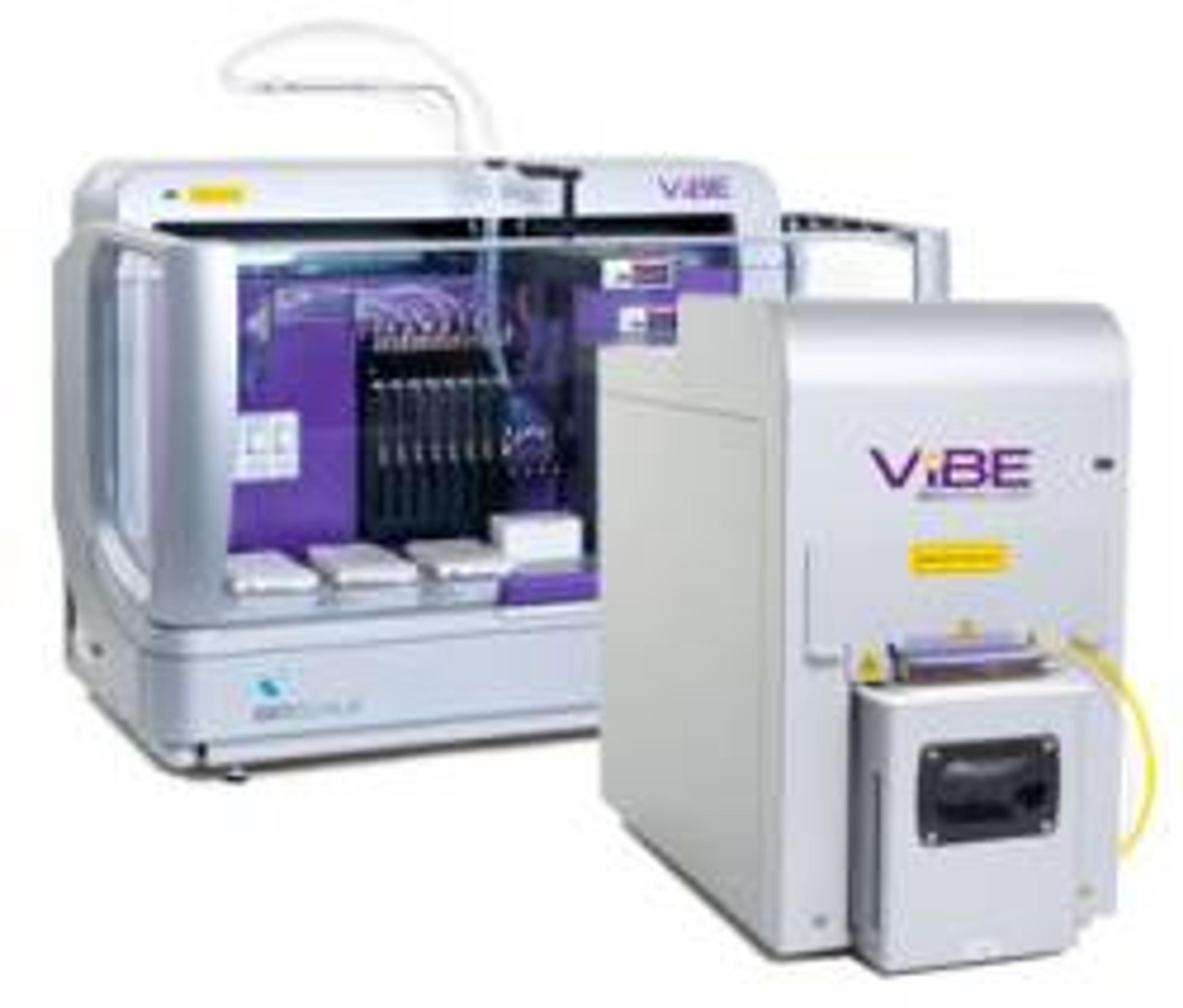
ViBE Protein Analysis Workstation

BioScale, Inc.

ViBE Protein Analysis PlatformPowered by AMMP Technology, the ViBE platform allows rapid design and configuration of protein assays to achieve highly-sensitive detection and quantitation of proteins in complex biological samples with real-time results. The ViBE platform …    •   Open assay design allows use of your own antibodies and the ability to define sensitivity, dynamic range, and speed requirements for efficient process workflow.    •   Simple yet sophisticated AMMP assay format is able to selectively separate your analyte from the “noise”.    •   Rapid design, configuration and ease of methods transfer reduce the time for assay validation.    •   In a hurry? The ViBE platform can provide ELISA-like results in 20 minutes for a quick screening assay.    •   Unlike automated ELISAs, ViBE products provide “real time” results.    •   Data output from the ViBE Software are easy to interpret. AMMP Assays—Simple. Sensitive. Sophisticated AMMP assays use a traditional homogeneous assay format with a proprietary detection technology providing confident results, fewer sample limitations, simple operation and fast assay development. AMMP is the unique integration of magnetic microparticles, a universal sensor and acoustic detection, creating a protein detection technique that is highly robust and versatile. Non-optical detection AMMP non-optical protein detection technology has proven correlation with optical measurements but with broader detection limits and less sample prep. Non-optical detection and mechanically amplified signal allows measurement of low expressing proteins otherwise lost in baseline noise and less baseline interference reduces the need for multistep dilutions especially in complex samples. Complex matrices without the complexity Non-optical AMMP detection, assay flexibility and enhanced sensitivity enable the ViBE platform to analyze proteins from a variety of complex matrices. The ViBE platform has shown superior results in tissue, tumor, plasma, serum, urine, stool and bioreactor samples at concentrations as low as pg/mL ViBE Technical Performance   •   Enhanced Sensitivity – down to the sub-picogram level    •   Exceptional Reproducibility-- 5-10% CVs plus outstanding instrument to instrument repeatability    •   3-log dynamic range

(0)

Links

Tags

Western BlottingWestern blotting equipment is used to transfer and identify specific proteins within a sample, reveal protein modifications, as well as give a semi-quantitative estimation of their concentration. Western blotting equipment includes all apparatus necessary to transfer proteins from gel to membrane and subsequent processing steps. Protein transfer can be performed by electroblotting with wet, semi-dry and dry transfer systems onto nitrocellulose and PVDF membranes. Blocking, washing and labeling of membranes follows, involving buffers, blocking reagents, blotting / incubation trays, labeling reagents, immunoblotting assays, antibodies and conjugates. Automated equipment for these steps is available to accelerate your lab workflow. Finally, detection and imaging of proteins can be conducted using gel documentation and imaging systems. Find the best western blotting equipment in our peer-reviewed product directory: compare products, check customer reviews and receive pricing direct from manufacturers.Cell / Tissue CultureCell culture or tissue culture is used to study the biology of cells or tissues and to isolate cellular products in an environment which can be manipulated and well defined. Accurately control your culture environment with bioreactors or culture incubators, bind your cells to a surface or together with an extracellular matrix. Distinguish cell types with differential media or proliferate cells with certain characteristics using selective media. Enrich your media with supplements such as growth factors, sera and vitamins. Find the best cell and tissue culture products, kits and equipment in our peer-reviewed product directory: compare products, check customer reviews and receive pricing direct from manufacturers.Cell Lines Stem Cells and Primary CellsPrimary cell cultures, established cell lines and stem cells are vital for <i>in vitro</i> and <i>ex vivo</i> experimentation. High-quality cells, optimized for your applications, alongside optimized cell substrates, growth medium and supplements, are critical for experimental success. Explore a range of cells suitable for your applications, including isogenic cell lines, competent cells, induced pluripotent stem cell (iPSC)-derived cell lines, fungal/bacterial/mammalian cell lines, stem cells and cancer cell lines. Find the best cells for your research in our peer-reviewed product directory: compare products, check customer reviews and receive pricing direct from manufacturers.Gel Doc / Image AnalysisGel documentation (gel doc) or gel imaging systems are used for the analysis of proteins, antibodies and nucleic acid immobilized in polyacrylamide or agarose gels, membranes or microarrays. Explore a range of a gel imaging systems, densitometers, scanners, transilluminators or UV lamp + CCD cameras for your image analysis solutions. Colorimetric, fluorescent and/or radioisotopic samples can be visualized and documented for further analysis. See gel doc / Image analysis software for quantitative 1D and 2D analysis of your samples. Find the best gel doc / image analysis products in our peer-reviewed product directory: compare products, check customer reviews and receive pricing direct from manufacturers.ADME-ToxicologyADME-toxicology (ADME-Tox) studies are used in pharmacology and pharmacokinetics to assess the activity/toxicity of drugs <i>in vivo</i> or <i>in vitro</i>. Find bioassays for absorption, distribution, metabolism, and excretion of drug molecules including cytotoxicity, transporter/permeability, metabolism and activity assays as well as hepatocytes and cell lines for ADME. Find the best ADME-toxicology products in our peer-reviewed product directory: compare products, check customer reviews and receive pricing direct from manufacturers.Assay AssemblyAssay Assembly is technique used in drug discovery to develop assays to test the cytotoxicity, genotoxicity, or other activities of a compound on a cell. Assay assembly requires chip assembly, a delivery system and a detection and analysis method. Beneficial features of assay kits or automated systems include high-throughput, high speed and sensitivity and low signal to noise ratio.Cell-Based AssaysCell-based assays are used to monitor the presence, quantity and activities of a desired cellular analyte including drug molecules or biomarkers. This can reveal information on cell health (apoptosis, cytotoxicity, viability and proliferation assays), cell metabolism, cell migration and cell signaling mechanisms. Find the best cell-based assay products, kits and equipment with our peer reviewed product directory: compare products, check customer reviews and receiving pricing direct from manufacturers.Protein PurificationProtein purification is a vital step in drug discovery, therapeutics, biotech and life science research. The purification process typically involves subcellular or membrane protein extraction with cell lysis kits, separation of proteins from cell debris by filtration or spin columns, and the isolation of proteins of interest from other proteins and impurities with affinity purification (including fusion protein tags and antibody binding proteins A, G and L), immunoprecipitation or chromatographic methods, such as ion exchange, size exclusion and immobilized metal affinity chromatography. All purification methods come in multiple formats for your laboratory needs, including agarose or magnetic beads, resins, columns and filter plates. Find the best protein purification equipment in our peer-reviewed product directory: compare products, check customer reviews and receive pricing direct from manufacturers.BiomarkersBiomarkers are biological markers which can be measured and evaluated to indicate a biological state. The use of biomarkers in research and diagnosis can indicate a normal or disease state or drug response of cells / tissues. Biomarkers include genetic markers, cell surface markers such as antigens, antibodies or receptors and secreted molecules such as cytokines. An assay system is required for identification of biomarkers. :Biopharmaceutical AdvancesBiopharmaceutical advances follow the development of pharmaceuticals derived from biotechnology, also known as biotechnology medicines. Biopharmaceuticals may be produced from cell lines, plants, or microbial cells. Important considerations of biopharmaceutical use include application, cost, production process and purification.
Analysis of Protein Kinase AKT with an AMMP™ Assay in Cell Culture and Tumour Lysates