
ResourceSpectroscopy
Analysis of Four Elements in Brine Using the Agilent 5100 ICP-OES
15 Oct 2017In this application note, the accuracy and robustness of the Agilent 5100 ICP-OES were evaluated for the determination of Ca, Mg, Sr and Si in brine. This technique can be used prior to the chloralkali process, an industrial process for the electrolysis of NaCl used to produce chlorine and sodium hydroxide (caustic soda), to ensure a high degree of purity in the sodium chloride solution.
Related products
Request Quote for All Products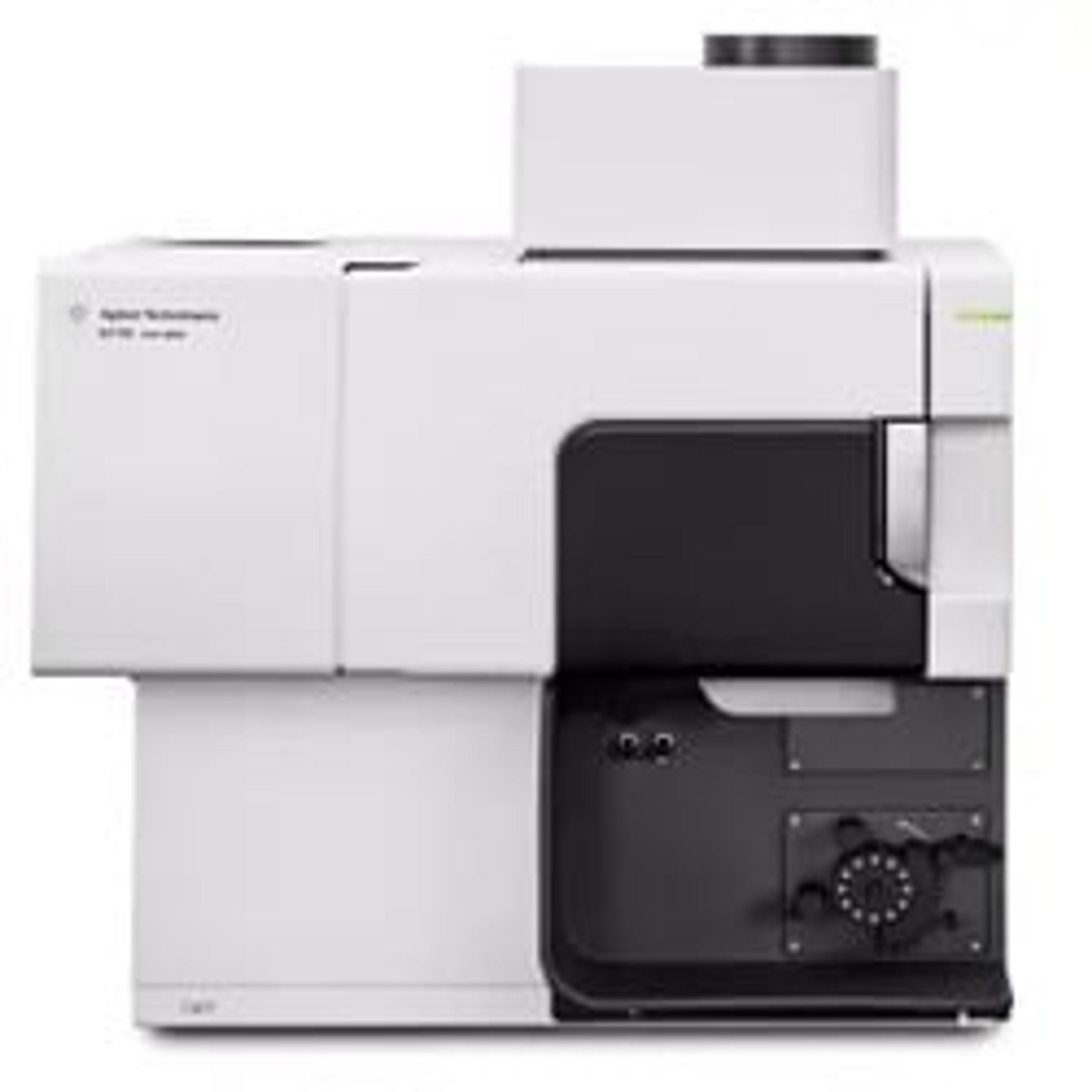
5110 ICP-OES
Agilent TechnologiesThe Agilent 5110 ICP-OES Instrument features unique Dichroic Spectral Combiner (DSC) technology that enables synchronous radial and axial measurements.
Links
Tags
Atomic Absorption / Emission SpectroscopyAtomic absorption spectroscopy (AAS) and atomic emission spectroscopy (AES) — also called optical emission spectroscopy (OES) — are used to detect the elemental constituents in samples. Both techniques involve the atomization of a sample. Atomic absorption spectrometers may use a flame or furnace to create an atomic vapor of the sample before irradiation with spectral light. Optical emission spectrometers may use a flame, inductively coupled plasma (ICP), microwave plasma (MP) or spark arcs to atomize and excite the sample. At higher excitation energies, electrons can be emitted instead of photons, which can be useful for samples that can’t be atomized and for surface analysis. Explore electron spectroscopy equipment such as Auger spectrometers and photoelectron spectrometers for surface elemental analysis of samples. Find the best atomic absorption, photoelectron and optical emission spectrometers in our peer-reviewed product directory: compare products, check customer reviews and receive pricing direct from manufacturers.Mass SpectrometryMass spectrometry (MS) is a powerful analytical technique used to identify and quantify molecules based on the mass-to-charge ratio of gas-phase ions. It provides detailed information about the structure, composition, and properties of compounds and is widely used across fields such as environmental monitoring, materials science, drug discovery and development, food and beverage testing, and wider chemical research. Key MS techniques include tandem mass spectrometry (MS/MS), liquid chromatography–mass spectrometry (LS-MS) and inductively coupled plasma (ICP-MS). Choosing from these wide range of techniques and technologies can be a daunting task, so keep up to date with scientific applications, performance expectations, and customer reviews here all in one place. Visit our product directory to receive quotes direct from the manufacturer.
Compound AnalysisCompound analysis is used to discover specific compounds that could be promising candidates for pharmaceutical use. This potential is identified when compounds have the desired effect, such as interaction with a target protein, during high throughput screening.CalciumElemental AnalysisElemental analysis involves determining the elemental composition of a sample, often used in environmental, pharmaceutical, and material sciences. Techniques like ICP-MS, X-ray fluorescence, and atomic absorption spectroscopy allow precise quantification of elements such as metals and nonmetals in complex matrices. Browse our peer-reviewed product directory to find the best elemental analysis tools, compare products, check reviews, and get pricing directly from manufacturers.MetalsMetal analysis is critical in various industries, including environmental monitoring, food safety, and pharmaceuticals. Techniques such as ICP-MS and atomic absorption spectrometry are commonly used to detect trace metals. Explore metal analysis tools in our peer-reviewed product directory; compare products, check reviews, and get pricing directly from manufacturers.Ion SeparationPittconPittcon is one of the largest conferences and exhibitions dedicated to laboratory science. It brings together professionals and innovators in analytical chemistry, physics, and biology, offering a platform to explore the latest scientific tools and technologies. From cutting-edge laboratory instruments to emerging research trends, Pittcon is a must-attend event for professionals in research and development.