ResourceSeparations

A Novel Method of M/Z Drift Correction for OA-TOF Mass Spectrometers Based on Construction of Libraries of ‘Matrix’ Components

2 May 2016

In this poster, a library of m/z and retention time is constructed for common components of a matrix and used to correct for m/z drift for subsequent analyses. This approach is compared with results from periodic external ‘lock mass’ correction. Orthogonal acceleration Time-of-Flight, accurate mass measurement is a well-established analytical technique. Compensation for temperature-dependent m/z drift is commonly performed by periodic measurement of internal or external reference peaks introduced using a purpose built interface.

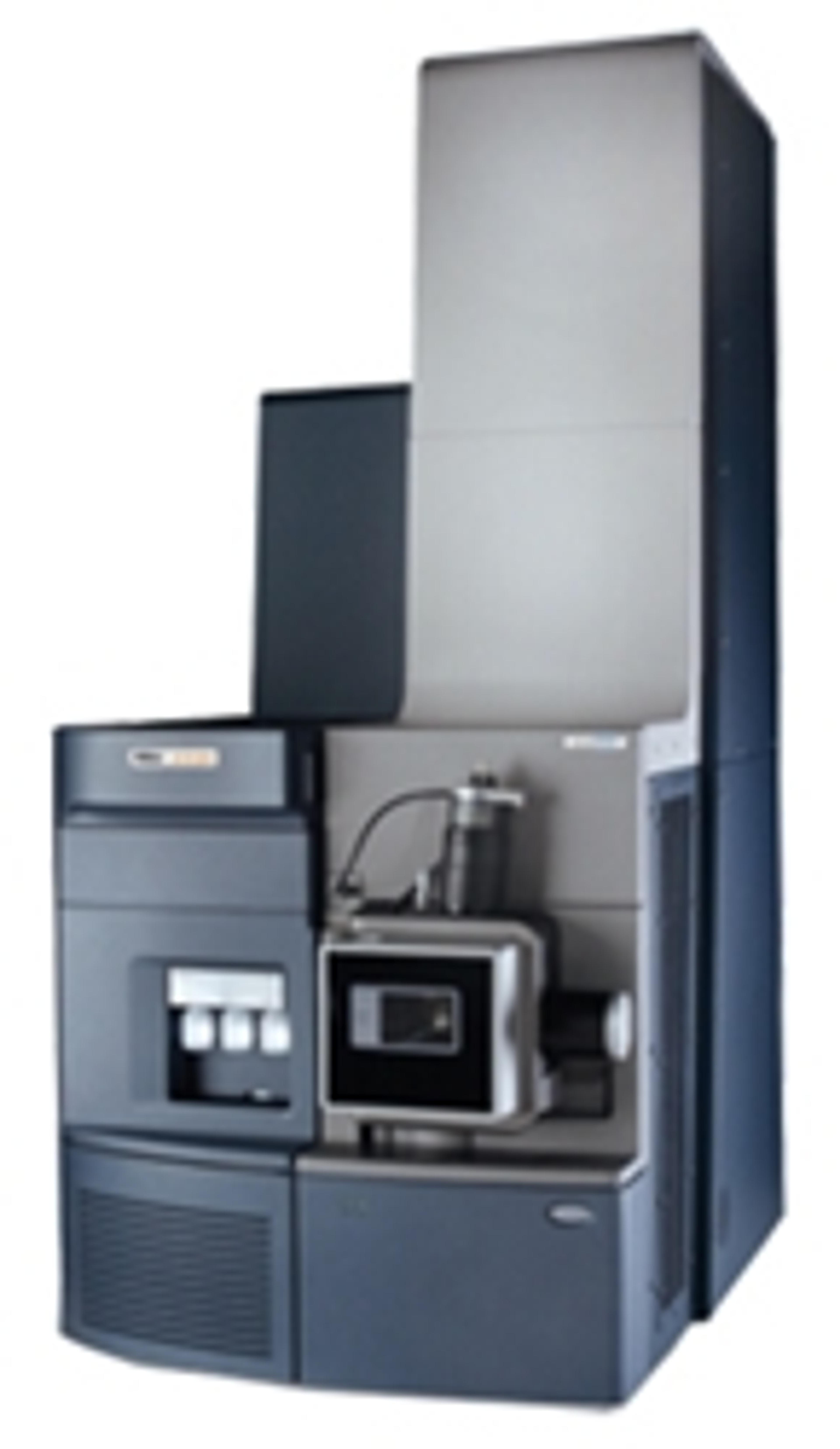
Xevo G2-XS QTof

Waters

Xevo G2-XS QTof - eXtreme Sensitivity, eXtraordinary Selectivity, eXceptional Solutions. For the scientist who needs to identify, quantify and confirm the broadest range of compounds in the most complex and challenging samples the Xevo G2-XS QTof provides maximum robustness with no compromise in performance, class-leading real-world quantitative sensitivity, the highest quality, most comprehensive qualitative information, flexibility to adapt to changing needs and is accessible to experts and non-experts alike.
(17)

ACQUITY UPLC HSS T3 Columns for Polar Compound Retention

Waters

ACQUITY UPLC® HSS (High Strength Silica) T3 Columns contain the first and only 100% silica particle designed, tested and intended for use in applications up to 15000 psi/1000 bar. The ACQUITY UPLC® HSS particle is not an HPLC particle. High pore volume HPLC particles do not possess the mechanical stability necessary to withstand the high column packing and operating pressures of UPLC® separations. The first ligand chemistry in this UPLC®-certified column family utilizes T3 bonding in order to retain and separate polar organic compounds. ACQUITY UPLC® HSS T3 columns possess the superior polar-compound retention, aqueous mobile phase compatibility and ultra-low MS bleed of Atlantis® T3 columns. Easier Method Transfer Since Atlantis® T3 HPLC and ACQUITY UPLC® HSS T3 columns utilize T3 bonding, LC methods can be transferred from HPLC to UPLC® separations. Because Atlantis® and HSS particles are different substrates, some method modification and/or optimization may be required. A compelling benefit of UPLC® technology is the ease and speed at which this method optimization can occur since UPLC® separations offer greater resolution in less time. Moving from XBridge™ HPLC to ACQUITY UPLC® BEH columns is nearly seamless, as the hybrid particle substrates differ only in particle size. However, because of T3 bonding it should be straightforward to make simple adjustments to successfully transfer a separation from an Atlantis® T3 HPLC column to an ACQUITY UPLC® HSS T3 column.

(13)

Links

Tags

Gas ChromatographyGas chromatography (GC) is an analytical technique used to separate and quantitate mixtures of small and volatile compounds. Gas chromatographs or GC systems include components such as GC columns, detectors, pumps and autosamplers. Choose from packed or capillary GC columns, flame ionization (FID), photoionization (PID) electron capture detectors and selective or non-selective detectors. Find the best gas chromatographs in our peer-reviewed product directory: compare products, check customer reviews and receive pricing direct from manufacturers.UHPLC and HPLCHigh performance liquid chromatography (HPLC) and ultra high performance liquid chromatography (UHPLC), also known as UPLC, are analytical techniques used to separate, identify and quantitate components of complex mixtures including biological samples such as proteins and lipids as well as chemical mixtures of pesticides, drugs and oils. Both techniques are liquid chromatographic methods but differ by operating pressures (HPLC < 6000 psi < UHPLC ). Components of HPLC and UHPLC systems include columns, detectors, pumps, autosamplers and column heaters. Explore a range of UHPLC and HPLC columns for your specific sample needs including reverse phase, normal phase, ion exchange, HILIC, ion exclusion and size exclusion columns. For more specialized HPLC, explore FPLC, countercurrent LC and simulated moving bed systems. Find the best UHPLC and HPLC equipment in our peer reviewed product directory: compare products, check customer reviews and receive pricing direct from manufacturers.Mass SpectrometryMass spectrometry (MS) is a powerful analytical technique used to identify and quantify molecules based on the mass-to-charge ratio of gas-phase ions. It provides detailed information about the structure, composition, and properties of compounds and is widely used across fields such as environmental monitoring, materials science, drug discovery and development, food and beverage testing, and wider chemical research. Key MS techniques include tandem mass spectrometry (MS/MS), liquid chromatography–mass spectrometry (LS-MS) and inductively coupled plasma (ICP-MS). Choosing from these wide range of techniques and technologies can be a daunting task, so keep up to date with scientific applications, performance expectations, and customer reviews here all in one place. Visit our product directory to receive quotes direct from the manufacturer. Compound LibrariesCompound libraries, or chemical libraries, are used in drug discovery for the identification of potential therapeutics compounds. Used in conjunction with high-throughput screening, the libraries of stored compounds are often generated for specific purposes as a drug target or disease model. Cheminformatics are commonly used when designing a compound library and software can be used to analyze the screening process.  Toxicology / Drugs of Abuse TestingToxicology and Drugs of Abuse Testing is the investigation into toxic and illegal substances found at the scene of a crime or from a suspect and / or victim associated with a scene of a crime. Analyzers, immunoassays and drugs of abuse test kits and presumptive test kits are an essential aspect of toxicology investigation.GC-MS GC-MS (gas chromatography-mass spectrometry) instruments and equipment are used to separate, quantify and identify mixtures of small and volatile compounds, such as polycyclic aromatics, fatty acids and alcohols. Often used in drug detection, forensic investigation and environmental analysis for pesticides and contaminants, GC-MS is a powerful addition to your lab’s analytical capabilities. GC-MS/MS instruments equipped with a qTOF or triple quadrupole analyzers can give greater sensitivity and resolution to your analysis. Find the best GC-MS instruments and equipment in our peer-reviewed product directory: compare products, check customer reviews and receive pricing direct from manufacturers.Library GenerationLibrary generation refers to the construction of NGS libraries from RNA and DNA sources.ChromatographyChromatography is a powerful technique used to separate and analyze components of mixtures based on their chemical properties. It is widely used in fields like biochemistry, pharmaceuticals, and environmental analysis. By exploiting differences in the interaction of substances with a stationary phase and a mobile phase, chromatography enables precise purification and quantification of compounds. Whether you're working with complex biological samples or industrial chemicals, chromatography is essential for obtaining high-quality results. Browse our peer-reviewed product directory to find the best chromatography systems, compare products, read customer reviews, and get pricing directly from manufacturers.Forensic ToxicologyForensic toxicology is used to determine cause of death, drug use and contaminations. Toxicological evaluations are commonly used in analytical chemistry, clinical, life sciences and forensics.Matrix EffectsUrineThe analysis of urine is important in medicinal, anti-doping, forensic and life sciences applications. The ability to evaluate what someone has ingested through their urine enables fast detection and diagnosis of certain illnesses.