ProductsLife Sciences
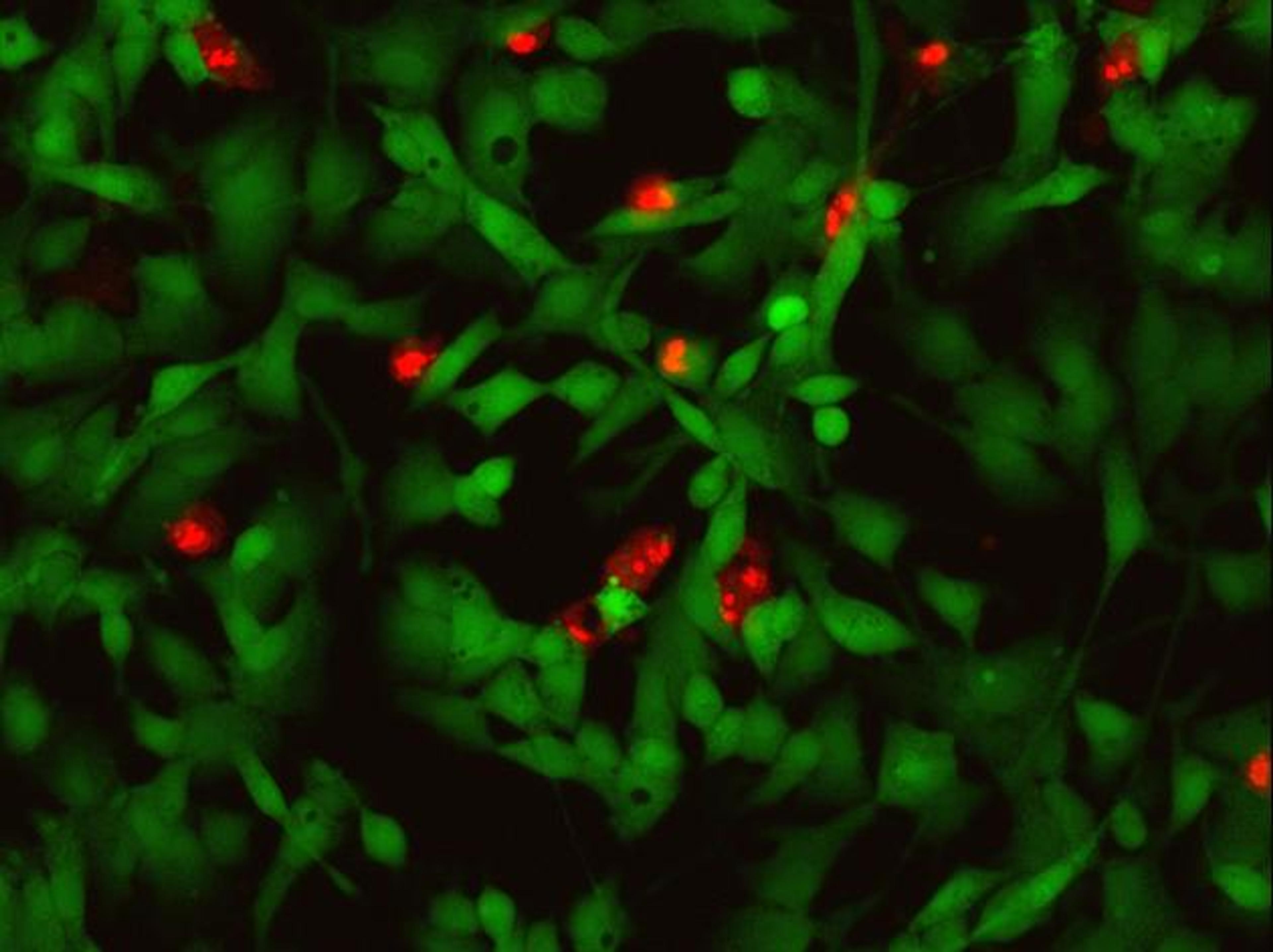
CAS-MAP Pan Caspase (VAD-FMK) Utrabright Green Apoptosis Detection Kit
Vergent BioscienceGreen Flourescent Pan Caspase Cell death assay for cell based assays

Green Flourescent Pan Caspase Cell death assay for cell based assays
Green Flourescent Caspase 1 Cell death assay for cell based assays
Green Flourescent Poly Caspase Cell death assay for cell based assays
Green Flourescent Pan Caspase Apoptosis assay for live cell assays
Green Flourescent Caspase 9 Apoptosis assay for cell based assays
Cellecta’s 80K Single-module Human Genome-Wide CRISPR Library was designed to be small enough (~80,000 constructs) to enable convenient genome-wide “dropout viability” screens with most standard human cell modules. With 4 sgRNAs targeting each gene, all of which have been designed using the latest criteria for effective guides described by Doench, et al. and containing the Cellecta-designed HEAT sgRNA structure which we hav…
Binding buffer for use with Annexin-V FITC kit for apoptosis
Membrane-exclusion, DNA binding dye to detect dead and/or necrotic cells
Fluorescein active Caspase-3 staining kit for apoptosis
Fluorescein active Caspase-3 staining kit for apoptosis
Fluorescein active Caspase-8 staining kit for apoptosis
Fluorescein active Caspase-8 staining kit for apoptosis
Sensitive two-color fluorescence cell viability assay optimized for FITC and Texas Red filters
Room temperature-stable, ready-to-use cell viability assay
Room temperature-stable, ready-to-use cell viability assay
High-affinity DNA stain for studying cell viability and cytotoxicity
JC-1 is a membrane permeable dye widely used for determining mitochondrial membrane potential in flow cytometry and fluorescent microscopy. This dye can selectively enter the mitochondria where it reversibly changes coloras membrane potentials increase (over values of about 80-100 mV). When excited at 488 nm, the emission shift goes from 530 nm (monomeric JC-1) to 590 nm (aggregate JC-1), which are easily detected using filter…
CellEvent Caspase-3/7 Green Ready Flow Reagent enables the flow cytometric detection of activated caspase-3 and caspase-7 in apoptotic cells. The product includes 2 reagents: the novel fluorogenic substrate CellEvent Caspase-3/7 Green Detection Reagent and SYTOX™ AADvanced™ Dead Cell Stain.FeaturesStable at room temperatureConvenient, ready-to-use format—no need to dilute, weigh, or pipetteExceptionally bright green fluorescen…
The Click-iT EdU Alexa Fluor 647 Flow Cytometry Assay Kit provides a simplified, more robust assay for analyzing DNA replication in proliferating cells as compared to traditional BrdU methods. The Click-iT EdU Flow Cytometry Assay Kits rely on EdU (5-ethynyl-2´-deoxyuridine), a thymidine analog which is incorporated into DNA during active DNA synthesis, which is then detected using click chemistry, a copper catalyzed covalent…
The Click-iT EdU Alexa Fluor 488 Flow Cytometry Assay Kit provides a simplified, more robust assay for analyzing DNA replication in proliferating cells as compared to traditional BrdU methods. The Click-iT EdU Flow Cytometry Assay Kits rely on EdU (5-ethynyl-2´-deoxyuridine), a thymidine analog which is incorporated into DNA during active DNA synthesis, which is then detected using click chemistry, a copper catalyzed covalent…
The Click-iT Plus EdU Pacific Blue Flow Cytometry Assay Kit provides a simplified, more robust assay for analyzing DNA replication in proliferating cells as compared to traditional BrdU methods. The Click-iT EdU Flow Cytometry Assay Kits rely on EdU (5-ethynyl-2´-deoxyuridine), a thymidine analog which is incorporated into DNA during active DNA synthesis, which is then detected using click chemistry, a copper catalyzed covalen…
The Click-iT Plus EdU Alexa Fluor 350 Flow Cytometry Assay Kit provides a simplified, more robust assay for analyzing DNA replication in proliferating cells as compared to traditional BrdU methods. The Click-iT EdU Flow Cytometry Assay Kits rely on EdU (5-ethynyl-2´-deoxyuridine), a thymidine analog which is incorporated into DNA during active DNA synthesis, which is then detected using click chemistry, a copper catalyzed cova…