Raptor™ Biphenyl LC Column
With Raptor™ LC columns, Restek chemists became the first to combine the speed of superficially porous particles (also known as SPP or “core-shell” particles) with the resolution of highly selective USLC® technology. This new breed of chromatographic column allows you to more easily achieve peak separation and faster analysis times without expensive UHPLC instrumentation.

Receive your quote directly from the manufacturer.
With Raptor™ LC columns, Restek chemists became the first to combine the speed of superficially porous particles (also known as SPP or “core-shell” particles) with the resolution of highly selective USLC® technology. This new breed of chromatographic column allows you to more easily achieve peak separation and faster analysis times without expensive UHPLC instrumentation.
SPP core-shell columns commonly employ traditional phenyl-hexyl stationary phases, but the innovative Biphenyl ligand, developed by Restek’s chemists, is the next generation of phenyl column chemistry. It provides greater aromatic selectivity than commercially available phenyl-hexyl columns[1] and a greater degree of dispersion than conventional phenyls. As a result, the Raptor™ Biphenyl allows you to more easily separate bioanalytical compounds like aromatics, which elute early or are hard to separate on C18 or other phenyl chemistries.
One of the greatest advantages of an SPP column is the ability to achieve fast, efficient separations by operating at higher linear velocities than are possible with a conventional fully porous particle column. However this can also result in higher back pressures. Raptor™ columns were designed to handle the increased pressures needed to achieve Selectively Accelerated, and handle it far better than other SPP columns on the market.
Raptor™ Biphenyl LC Column Features & Benefits:
- Higher efficiency for drastically faster analysis times.
- Better selectivity for substantially improved resolution.
- Increased sample throughput with existing HPLC instrumentation.
- Ideal for bioanalytical testing applications like drug and metabolite analyses.
- Heightened selectivity and retention for compounds that are hard to resolve or elute early on C18 and other phenyl chemistries.
- Limits ionization suppression and allows simple, MS-friendly mobile phases.
- Restek's most popular LC stationary phase applied to Raptor™ SPP core-shell silica.
Column Details:
- Stationary Phase Category: Phenyl (L11)
- Ligand Type: Biphenyl
- Particle: 2.7um SPP
- Pore Size: 90 Å
- Surface Area: 150 m2/g
- Length: 30 - 150 mm
- ID: 2.1, 3.0, 4.6 mm
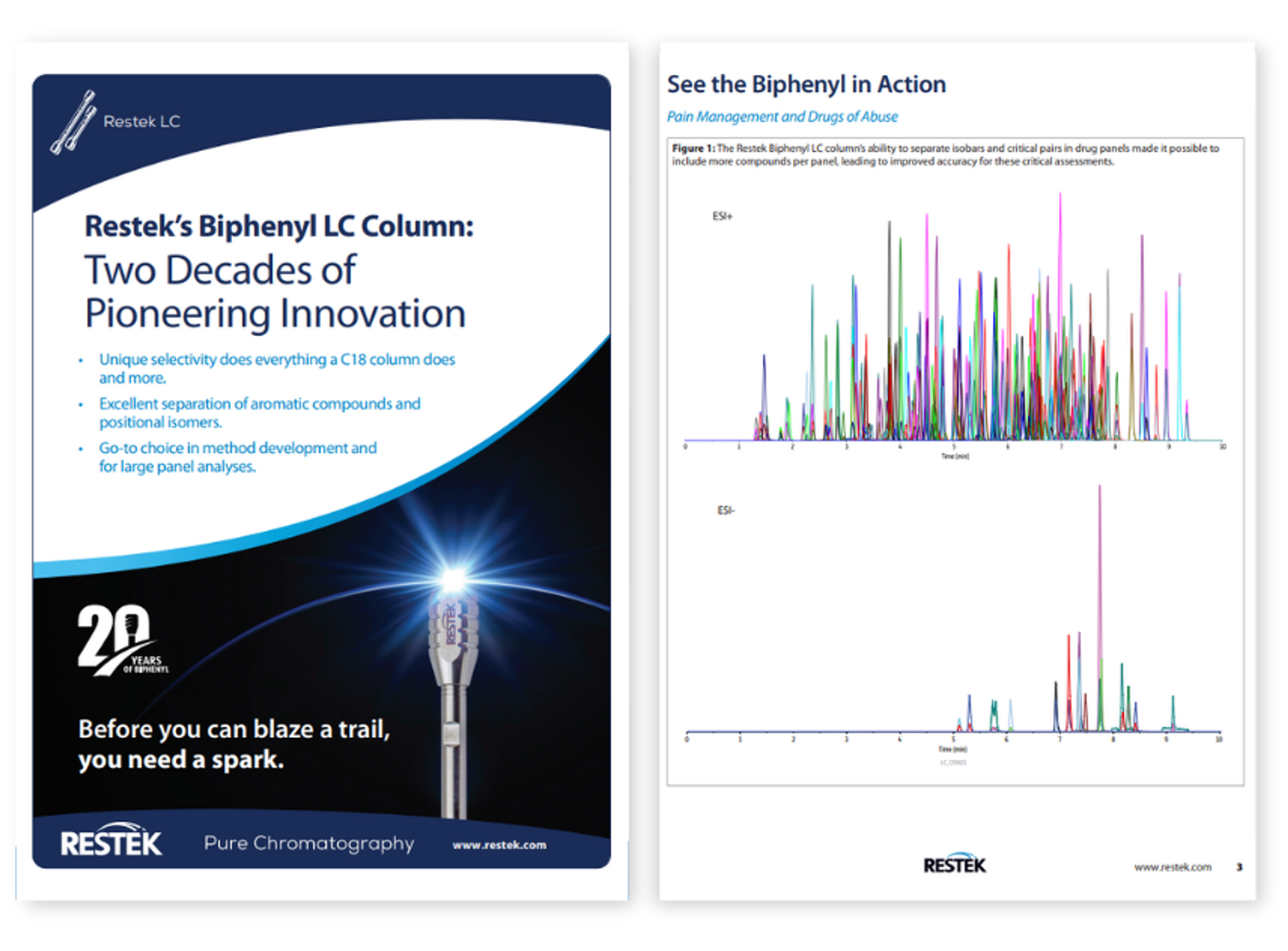
Two decades of pioneering innovation with Restek’s biphenyl LC column
Achieving reliable separations in complex analyses has long challenged chromatographers, especially when working with early-eluting or closely related compounds. Traditional phases often fall short, requiring intricate mobile phases that complicate MS detection.
Learn how enhanced selectivity and robust performance can simplify method development, accelerate separations, and support confident results, even in the most demanding LC-MS workflows.
Why biphenyl is replacing C18 in HPLC
Tuesday, November 18, at 16:00 GMT | 17:00 CET | 11:00 EST | 8:00 PST
Developing a new HPLC method often follows a familiar routine in many laboratories: select a C18 column, run a few test injections, and hope for sufficient retention and separation. While C18 remains a widely trusted and globally adopted stationary phase, this webinar introduces a fresh perspective on what’s often considered a 'generic' choice.
Join Application Scientist, Samantha Herbick as she explores the retention profiles of various C18 columns, highlighting that not all C18 phases are created equal, and examines the structural modifications permitted within the USP L1 classification.
She will also introduce biphenyl phase and compare it to C18, showcasing how its unique ligand chemistry offers alternative retention mechanisms that can reshape your approach to method development.
Key learning objectives:
- Explore an overview of the retention mechanisms at play with various C18 column types
- Discover how biphenyl columns retain, how they differ from C18, and how you can benefit from these differences
- Uncover the best practices for successful utilization of biphenyl columns in LC methods
- Hear examples of biphenyl chromatography in applied solutions, with contrast against C18 in the same application
Who should attend?
- Analysts, method development specialists, research chemists, lab managers, and anyone interested in LC-MS.
Certificate of attendance
If you attend the live webinar, you will automatically receive a certificate of attendance, including a learning outcomes summary, for continuing education purposes.
If you view the on-demand webinar, you can request a certificate of attendance by emailing editor@selectscience.net.