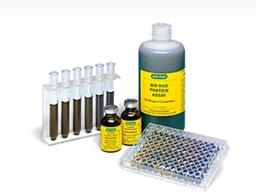
Bio-Rad Bradford Protein Assays
based on the dye-binding properties of Coomassie Blue G-250


The supplier does not provide quotations for this product through SelectScience. You can search for similar products in our Product Directory.
The Bradford assay is based on the use of the dye Coomassie Brilliant Blue G-250, which is frequently abbreviated as Coomassie G-250 or Coomassie Blue. This is one of two Coomassie dyes that are often confused. Coomassie R-250 is used to stain protein gels but is not used in protein assays. In addition to being used in the Bradford assay, Coomassie G-250 can also be used to stain protein gels, although it is less sensitive than Coomassie R-250.
Under acidic conditions, Coomassie G-250 is cationic, mainly doubly protonated, and is red, whereas in neutral conditions the dye is green, and the anionic form is blue. The Bradford reagent is an acidified solution of Coomassie G-250; the dye is thus primarily protonated and red.
The basis for the Bradford assay is that in order for the Coomassie dye to bind stably to protein, it needs to be doubly protonated. When the dye comes in contact with protein, the first electron is donated to charged groups on the protein. This disrupts the structure of the protein, resulting in exposure of hydrophobic pockets. The dye binds to these pockets, with the sulfonic acid groups binding to positive amines. In addition, there is attraction due to Van der Waals forces. The stably bound Coomassie G-250 is the blue, unprotonated form.