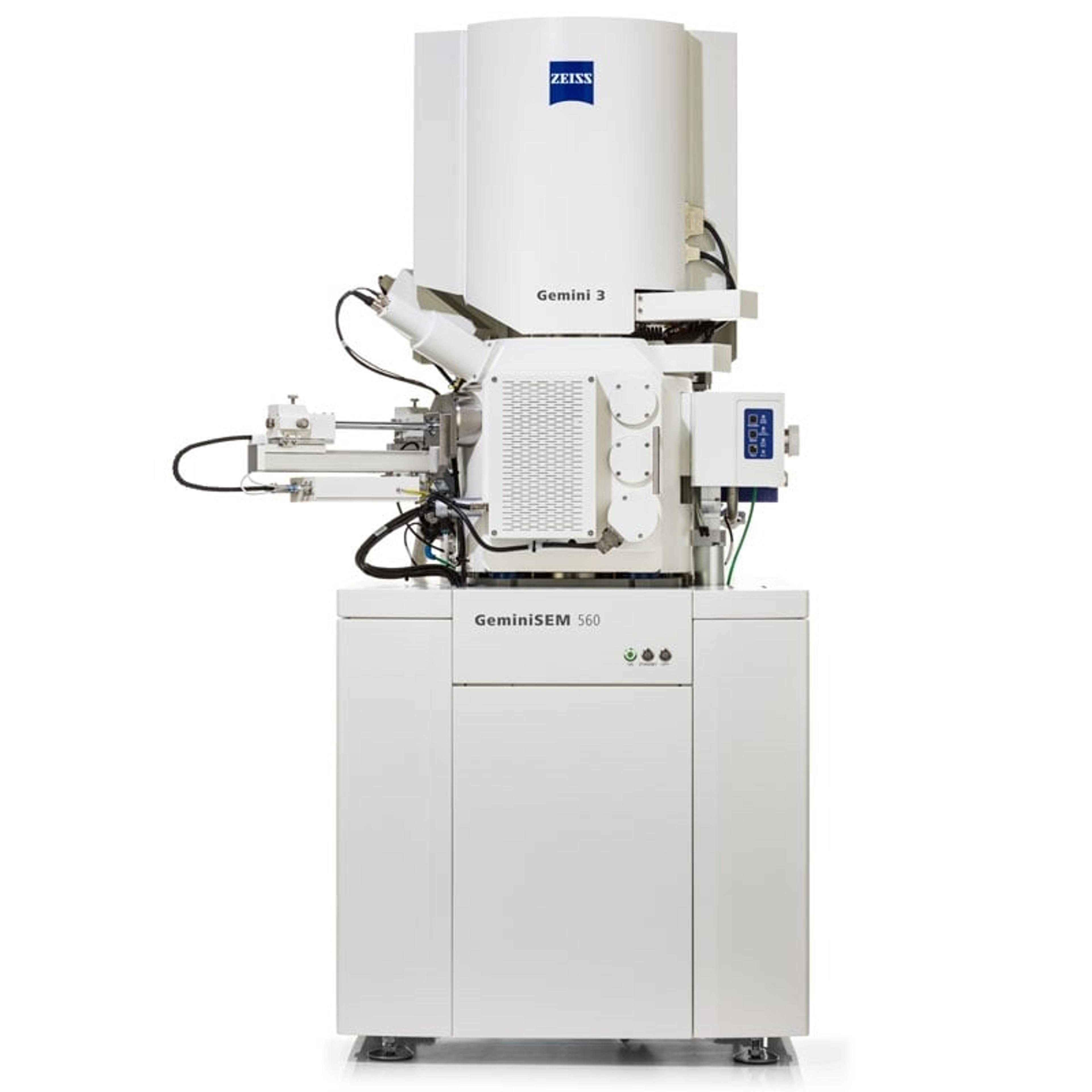
ZEISS Introduces Latest FE-SEM Technology: GeminiSEM 450

19 Apr 2018
Han Yin
Administrator / Office Personnel

Product news

ZEISS has introduced its new field emission scanning electron microscope (FE-SEM) ZEISS GeminiSEM 450. The instrument combines ultrahigh resolution imaging with the capability to perform advanced analytics while maintaining flexibility and ease-of-use.

With ZEISS GeminiSEM 450, users benefit from high resolution, surface sensitive imaging and an optical system that ideally supports them in obtaining the best analytical results – especially when working with low voltages. High-throughput electron backscatter diffraction (EBSD) analysis and low voltage X-ray spectroscopy (EDS) deliver excellent results due to ZEISS Gemini 450’s ability to precisely and independently control spot size and beam current. With the Gemini 2 design, it is possible to always work under optimized conditions as the user can switch seamlessly between imaging and analytical modes at the touch of a button. This makes ZEISS GeminiSEM 450 the ideal platform for the highest demands in imaging and analytical performance.

Click here to find out more about the latest products from ZEISS >>

In addition, ZEISS GeminiSEM 450 has been designed to cater for a broad variety of sample types from classical conductive metals to beam sensitive polymers. In particular the variable pressure technology of ZEISS GeminiSEM 450 reduces charging on non-conductive samples without compromising In-lens detection capabilities and at the same time enables high resolution EDS analysis by minimizing the skirt effect. Based on this design, ZEISS GeminiSEM 450 provides a flexible instrument suited to a broad variety of applications in materials science, industrial labs and life sciences.

“With ZEISS GeminiSEM 450 we have introduced a new FE-SEM flagship for highest performance analytics and ultrahigh resolution. In addition to this product launch, we are also rolling out significant enhancements to both the ZEISS GeminiSEM and ZEISS Sigma families. As an example, the ZEISS Sigma family now benefits from the introduction of the high-resolution gun mode that has previously only been available on the ZEISS Gemini series” says Dr. Michael Albiez, head of electron microscopy at ZEISS.

Do you use the GeminiSEM series from ZEISS? Write a review today for your chance to win a $400 Amazon voucher.

Links

Tags

Robotic InstrumentsRobotic instruments can be used for high-throughput automation of many lab processes. Such processes use instruments for assays like cell based assays and ELISA, for sample preparation like shakers, centrifuges and incubators, and for analysis such as sequencing and western blot analyzers. Useful features of robotic instruments include speed, reproducibility, barcode readers, software and automation.Robotic WorkstationsRobotic workstations are automated platforms enabling the user to perform high-throughput, multi-application processes, from sample preparation tasks such as PCR set-up, DNA purification and NGS library preparation, to integrated sample prep and analysis workstations. Automation makes processes consistent, fast, precise and fully walk-away. Find the best robotic workstations in our peer-reviewed product directory: compare products, check customer reviews and receive pricing direct from manufacturers.Software PlatformsSoftware platforms are useful for various stages of laboratory experiments from data collection to data storage and processing. For instance lab software is available for system control, data management, data analysis and qualification / validation.Electron MicroscopyElectron microscopes (EM) are used to create high-resolution images of samples at the nanoscale by means of an accelerated beam of electrons as a source of illumination. Types of electron microscope include scanning electron microscopes (SEM), transmission electron microscopes (TEM), scanning transmission electron microscopes (STEM) and cryo-electron microscopes. Focused ion beam (FIB) microscopes are useful for modifying or milling a sample surface with nanometer precision, as well as imaging. Find the best electron microscopes in our peer-reviewed product directory: compare products, check customer reviews and receive pricing direct from manufacturers.AutomationAutomation in laboratories and manufacturing processes enhances efficiency, precision, and scalability by reducing the need for manual intervention. It plays a critical role in improving productivity, minimizing human error, and accelerating workflows in fields like diagnostics, drug development, and industrial testing. Automation technologies include robotic systems, automated liquid handlers, and process control systems that streamline complex tasks and ensure consistent, reproducible results. Explore our peer-reviewed product directory to discover the best automation solutions, compare options, read user reviews, and get prices directly from manufacturers.ImagingImaging techniques are essential for obtaining visual representations of samples to understand structures, processes, and function in biological, chemical, and physical research. These tools range from traditional light microscopy to advanced imaging modalities like MRI and electron microscopy, providing researchers with valuable data for diagnostics, drug discovery, and material analysis. Explore imaging solutions in our peer-reviewed product directory to compare products, check reviews, and get pricing directly from manufacturers.SpectroscopySpectroscopy is a technique that analyzes the interaction of light with matter to study molecular properties, concentrations, and structural information. Widely used in chemical, pharmaceutical, and environmental analysis, spectroscopy offers insights into molecular composition and helps identify unknown compounds. It plays a key role in quality control, research, and diagnostics. Browse our peer-reviewed product directory to compare spectroscopy tools, read reviews, and get prices directly from manufacturers.SEMScanning Electron Microscopy (SEM) is a technique that uses a focused electron beam to scan a sample and create high-resolution images. It is widely used in materials science, nanotechnology, and biological research. Explore SEM systems in our peer-reviewed product directory; compare products, check reviews, and get pricing directly from manufacturers.