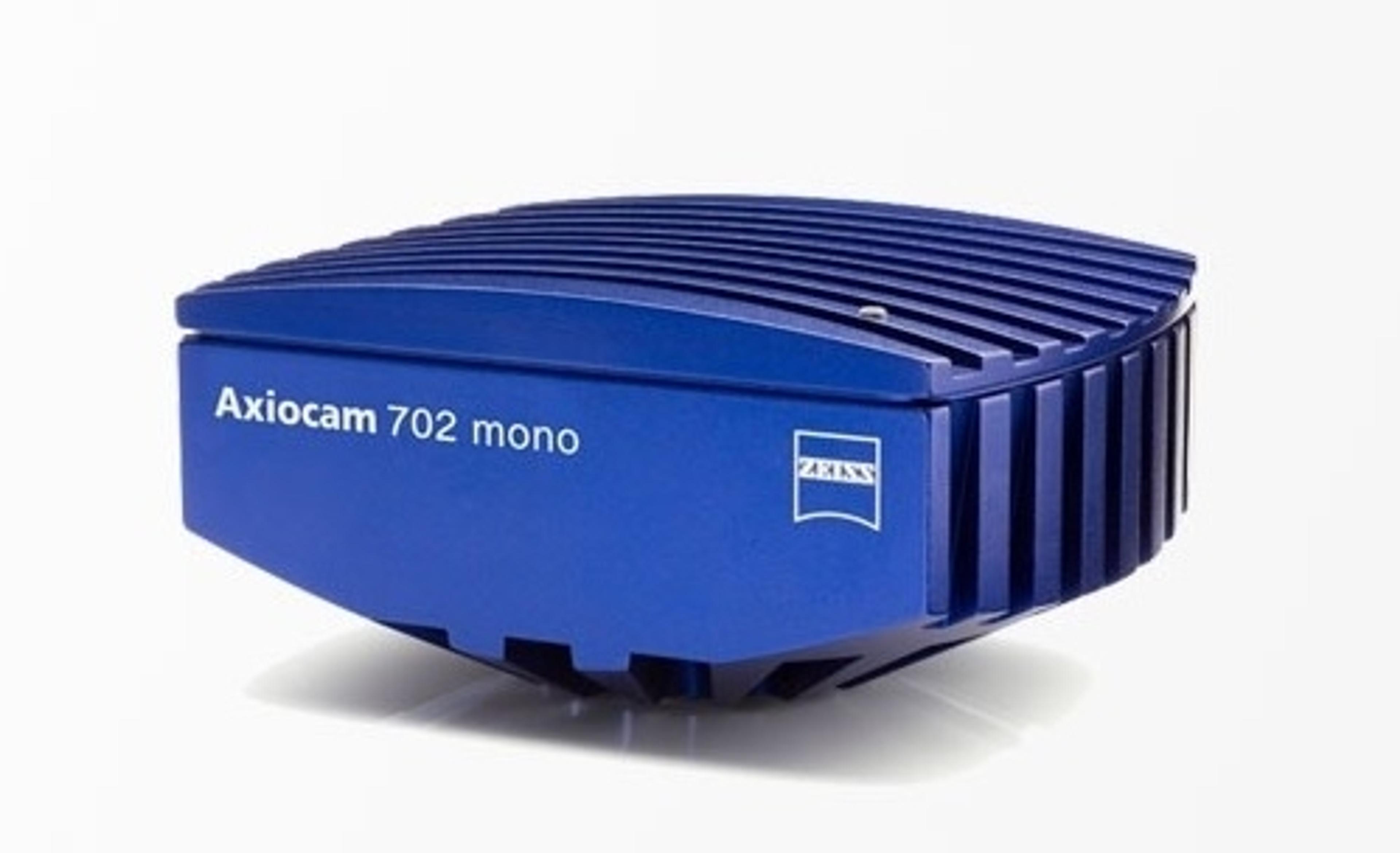
ZEISS expands its portfolio of microscope cameras

Four new ZEISS Axiocam models are introduced for light microscopy applications

22 Nov 2019
Laura Sisman
Administrator / Office Personnel

Product news

ZEISS has introduced four new high-quality CMOS cameras for digital imaging in light microscopy. These cameras complete the portfolio of proven ZEISS Axiocam models which stand for excellent performance in demanding microscopy applications.

The new microscope cameras ZEISS Axiocam 705 color and 712 color deliver the best possible image quality for histology, pathology or material research and analysis, thanks to excellent color rendition and greatly improved dynamic range. ZEISS Axiocam 705 mono and 712 mono are ideal for demanding fluorescence live-cell imaging with fast frame rates and high dynamic range. Also, their extended near-IR sensitivity allows for deeper insights into sample structures.

New high-quality sensors are boosting the cameras’ performance
Demanding microscopy applications call for a combination of excellent contrast, resolution, dynamic range, sensitivity and readout speed. In all these aspects, the performance of the four new ZEISS Axiocam microscope cameras benefits greatly from their new high-quality CMOS sensors. Small 3.45 µm pixels and low noise levels in combination with the fast USB 3.0 platform enable researchers to carry out extremely fast imaging experiments while maintaining excellent signal quality. Also, the new cameras’ global shutter architecture allows capturing dynamic samples without creating motion artifacts.

ZEISS Axiocam 705 mono and ZEISS Axiocam 705 color are 5-megapixel cameras optimized for fast speed and high dynamic range. ZEISS Axiocam 712 mono and ZEISS Axiocam 712 color are ideal for the acquisition of large samples with 12 megapixels, thereby greatly reducing the need for stitching.

Do you use Zeiss products in your lab? Write a review today for your chance to win a $400 Amazon gift card>>

Links

Tags

Cellular PathologyCellular Pathology deals with the microscopic analysis of tissue samples and cells. Sample preparation and processing includes fixation, staining, sectioning and slide mounting, using equipment such microtomes and cryostats. In choosing immunohistochemistry and immunocytochemistry kits, consider chromogens, staining method, antibodies, microscopes and imaging.Light MicroscopyLight microscopes or optical microscopes are used to visualize microscale objects under magnification, including cells, clinical specimens and materials. Lab equipment for light microscopy includes confocal microscopes, fluorescence microscopes, zoom and stereo microscopes. Microscope slides and imaging reagents are available for visualizing samples, as well as various microscope stages and incubators for large or temperature-sensitive samples. Find the best light microscopes in our peer-reviewed product directory: compare products, check customer reviews and receive pricing direct from manufacturers.Digital MicroscopyDigital microscopy involves using digital cameras and sensors to capture high-resolution images of samples for analysis. It offers enhanced imaging capabilities compared to traditional optical microscopy and is widely used in biological and material science research. Explore digital microscopy systems in our peer-reviewed product directory; compare products, check reviews, and get pricing directly from manufacturers.Digital PathologyDigital pathology involves the use of digital imaging and computational tools to analyze pathology slides. It is transforming diagnostics, research, and education by offering enhanced image storage and analysis. Explore digital pathology solutions in our peer-reviewed product directory; compare products, check reviews, and get pricing directly from manufacturers.Histology ProcessingMicroscopyMicroscopy is a technique used to observe small objects in detail, from cells to materials, using light or electron microscopes. It enables researchers to examine structures with high resolution, aiding in fields such as biology, medicine, and materials science. With advanced microscopy techniques, scientists can gain insights into cellular processes, tissue structures, and material properties. Explore the best microscopy solutions in our peer-reviewed product directory, compare products, read customer reviews, and get pricing directly from manufacturers.Digital ImagingDigital imaging is a technique that captures images of biological and chemical samples in high resolution, often using advanced cameras and sensors. This technology is crucial in microscopy, diagnostics, and quality control. Explore digital imaging systems in our peer-reviewed product directory; compare products, check reviews, and get pricing directly from manufacturers.
ZEISS expands its portfolio of microscope cameras