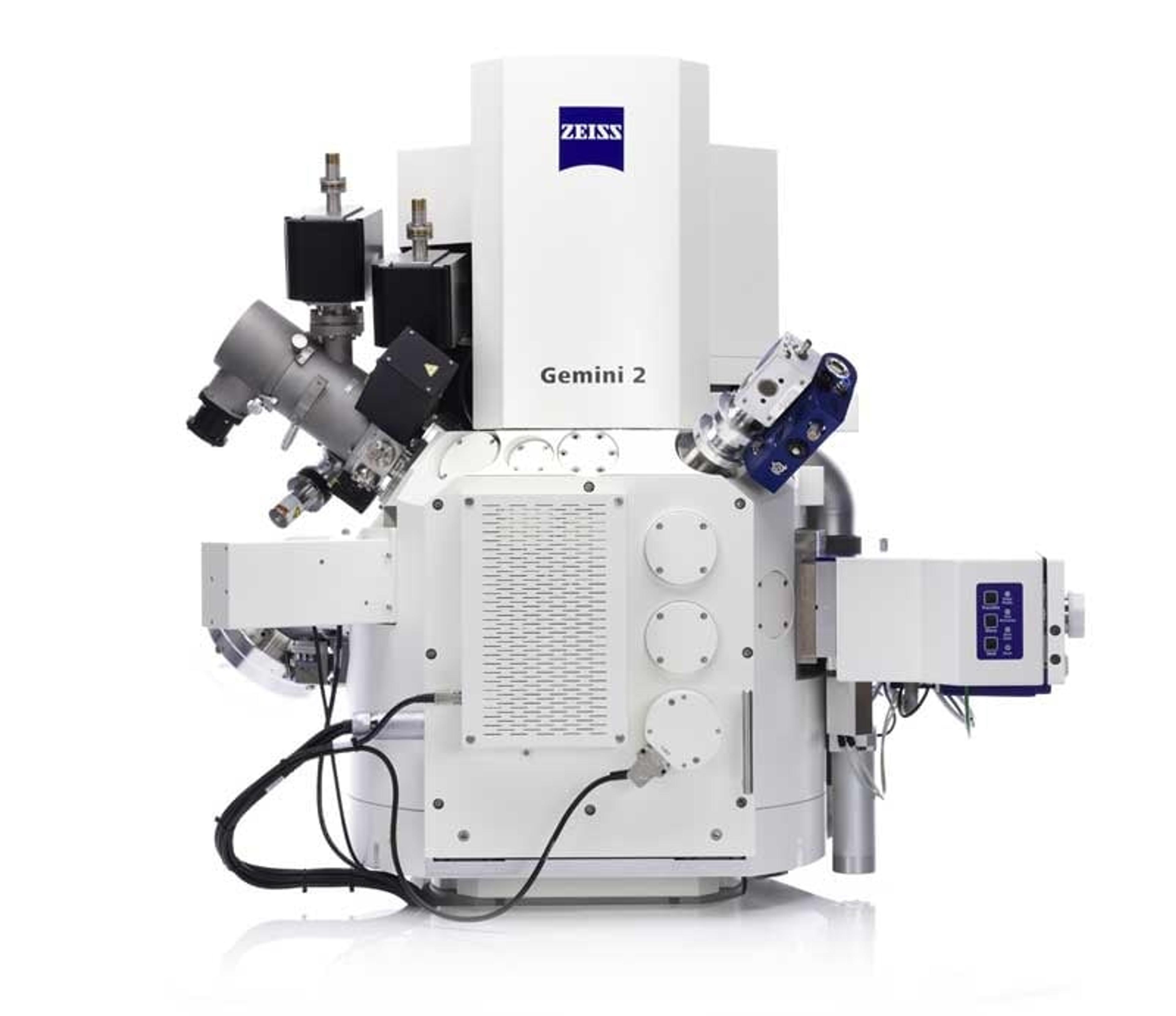
ZEISS Crossbeam 550 Sets New Standards in 3D Analytics and Sample Preparation

Enhanced resolution and faster FIB material processing for maximum efficiency

11 Sept 2017
Abigail Berry
Administrator / Office Personnel

Product news

ZEISS presents a new generation of focused ion beam scanning electron microscopes (FIB-SEMs) for high-end applications in research and industry. ZEISS Crossbeam 550 features a significant increase in resolution for imaging and material characterization and a speed gain in sample preparation.

Nanostructures such as composites, metals, biomaterials or semiconductors can be investigated with analytical and imaging methods in parallel. ZEISS Crossbeam 550 allows simultaneous modification and monitoring of samples, resulting in fast sample preparation and high throughput e.g. for cross-sectioning, TEM lamella preparation or nano-patterning.

See the latest news in Materials here >>

ZEISS Crossbeam 550 provides best image quality in 2D and 3D. The new Tandem decel mode enables enhanced resolution together with a maximization of image contrast at low landing energies. The pioneering Gemini II electron optics delivers optimum resolution at low voltage and high probe current simultaneously. The FIB column combines the highest available FIB current of 100 nA with the new FastMill mode, allowing for highly precise and more efficient material processing and imaging in parallel. Additionally, the new process for automated emission recovery increases the user-friendliness and optimizes the FIB column for reproducible results during long-term experiments.

Material scientists profit from excellent 3D analytical properties, especially thanks to the also new, fully integrated module for 3D EDS analyses with ZEISS Atlas 5. In the life sciences, ZEISS Crossbeam 550 convinces with its enhanced resolution at low voltages and an outstanding stability for long-term 3D tomography. Moreover, it is possible to optimally integrate the new workstation into correlative workflows and to combine it with light, X-ray or ion beam microscopy.

ZEISS Crossbeam 550 replaces its predecessor ZEISS Crossbeam 540 and is available in a variation with a large chamber for the first time. Selected product features can be upgraded for existing ZEISS Crossbeam 540 owners.

A webinar on May 4, 2017 provides information on the advantages of ZEISS Crossbeam 550.

Have you used ZEISS products? Leave a review here

ZEISS Crossbeam Family

ZEISS Research Microscopy Solutions

Within ZEISS Crossbeam Family you have the choice between Crossbeam 340 or Crossbeam 550. Exploit the variable pressure capabilities of Crossbeam 340. Or use Crossbeam 550 for your most demanding characterizations and choose the chamber size, standard or large, that best suits your samples.

(4)

ZEISS Atlas 5

ZEISS Research Microscopy Solutions

Large area imaging for SEM, FE-SEM & FIB-SEM ATLAS combines a 16 bit scan generator and dual super-sampling signal acquisition hardware with image processing and control software for your ZEISS electron microscope. Acquire images up to 32 k x 32 k pixels, with dwell times from 100 ns to > 100 s, adjustable in 100 ns increments. Save your images with eight or sixteen bits of intensity. With the ATLAS “Mosaic Tool” you create large image montages, automatically moving from image tile to tile, and mosaic site to site, resulting in an “Extreme Field of View” image, at SEM nanometer scale resolution. ATLAS provides • reduced number of tiles to acquire, reducing stage motion delay and areal fraction of each image “lost” to overlap • reduced number of overlap “seams”, leading to less beam damage and degradation of the sample • reduced computational complexity

(0)

Links

Tags

X-Ray Diffraction and SpectroscopyX-Ray diffraction & spectroscopy are used in material characterization to discern the structure and elemental composition of a sample. X-Ray diffractometers (XRD) are superior instruments in elucidating the dimensional atomic structure of crystalline materials, including powders, thin films and single crystals. For large unit cells or ordered macromolecules, consider small-angle X-ray scattering (SAXS). X-ray spectroscopic techniques include X-ray fluorescence (XRF) and X-ray photoelectron spectroscopy (XPS), both providing simple and accurate methods for determining the elemental composition of a material. Energy dispersive (EDXRF) and wavelength dispersive (WDXRF) XRF spectrometers are available, as well as handheld/portable devices. High-resolution, 3D microstructure characterization of materials can be achieved with X-ray microscopes combining sub-micron resolution imaging with 3D computed tomography. Find the best XRD and XRF spectrometers in our peer-reviewed product directory: compare products, check customer reviews and receive pricing direct from manufacturers.NanotechnologyNanotechnology, or nanotech, is an engineering technique using molecular scale functional systems. Applications of nanotechnology include medicine and medical devices, electronics, air and water purification, food science and energy production.Non-Destructive TechniquesNon-destructive techniques (NDT) describes a variety of analytical techniques used to evaluate the properties of a material. Common methods include ultrasonic, magnetic-particle, liquid penetrant, radiographic, remote visual inspection (RVI), and eddy-current testing. NDT is regularly used in forensic engineering, civil engineering, mechanical engineering, electrical engineering, systems engineering, aeronautical engineering, and medicine.Light MicroscopyLight microscopes or optical microscopes are used to visualize microscale objects under magnification, including cells, clinical specimens and materials. Lab equipment for light microscopy includes confocal microscopes, fluorescence microscopes, zoom and stereo microscopes. Microscope slides and imaging reagents are available for visualizing samples, as well as various microscope stages and incubators for large or temperature-sensitive samples. Find the best light microscopes in our peer-reviewed product directory: compare products, check customer reviews and receive pricing direct from manufacturers.Electron MicroscopyElectron microscopes (EM) are used to create high-resolution images of samples at the nanoscale by means of an accelerated beam of electrons as a source of illumination. Types of electron microscope include scanning electron microscopes (SEM), transmission electron microscopes (TEM), scanning transmission electron microscopes (STEM) and cryo-electron microscopes. Focused ion beam (FIB) microscopes are useful for modifying or milling a sample surface with nanometer precision, as well as imaging. Find the best electron microscopes in our peer-reviewed product directory: compare products, check customer reviews and receive pricing direct from manufacturers.Polymeric MaterialsPolymeric materials are widely used in industries ranging from biomedical devices to packaging and electronics. Research into these materials focuses on their properties, including strength, flexibility, and degradation. Advances in polymer science have enabled the development of more sustainable and high-performance materials. Explore the best polymeric material products in our peer-reviewed product directory; compare products, check reviews, and get pricing directly from manufacturers.High ThroughputHigh throughput experiments allow the simultaneous processing of several samples. This parallelization reduces the cost per experiment and increases reproducibility and output volume of data.3D Imaging3D imaging technologies allow for the visualization and analysis of three-dimensional structures at high resolution. These systems are used in fields like molecular biology, material science, and medical diagnostics. 3D imaging can be applied to visualize cells, tissues, and organs, providing valuable insights into their structure and function. Browse our peer-reviewed product directory to find the best 3D imaging solutions, compare products, check reviews, and get pricing directly from manufacturers.MicroscopyMicroscopy is a technique used to observe small objects in detail, from cells to materials, using light or electron microscopes. It enables researchers to examine structures with high resolution, aiding in fields such as biology, medicine, and materials science. With advanced microscopy techniques, scientists can gain insights into cellular processes, tissue structures, and material properties. Explore the best microscopy solutions in our peer-reviewed product directory, compare products, read customer reviews, and get pricing directly from manufacturers.SemiconductorsNanomaterialsNanomaterials such as carbon nanotubes, fullerenes and nanoparticles are a group of materials that measure between 1-1000nm for a single unit. Analysis techniques include AFM, electron microscopy and super resolution microscopy.