
Your Questions about DNA/RNA Quantification Answered
Learn about sample contaminant detection, an important step towards nucleic acid quantification
16 Sept 2020
Expert insights
Experimental techniques such as PCR, qPCR, cloning, sequencing, and transfection require samples of known concentration and purity. The success of an experiment depends in part on the accurate evaluation of the nucleic acid sample. Absorbance at 260nm is the most popular method for DNA and RNA quantification. However, residual chemicals from the nucleic acid extraction process as well as co-purified cell components can affect the A260 concentration result and the purity ratios (260/280, 260/230) don’t tell the whole story about sample purity.
In this SelectScience® webinar, Dr. Voula Kodoyianni, product manager for NanoDrop at Thermo Fisher Scientific, discusses how contaminants in DNA and RNA samples affect absorbance at 260 nanometers and concentration results. She goes on to explain how the NanoDrop™ One's Acclaro™ Sample Intelligence technology uses powerful mathematical algorithms to identify contaminants such as phenol, protein and guanidine salts and deliver accurate sample concentration.
Dr Kodoyianni was joined by Patrick Brown, from the NanoDrop technical support team, for a Q&A session after the talk. You can watch the webinar on demand here. Read on to discover the highlights from the live Q&A event.
Watch Webinar NowQ: When seeing purity ratios that are higher than 2.2, what does this mean about my DNA sample?
VK: Usually, it means that the solution that you used to blank the instrument has higher absorbance at 230 nm than the sample. It may mean that you blanked on a dirty pedestal. Patrick, do you want to add more detail to that?
PB: Absolutely. The A260/A230 ratio is right around 2 in most cases, and so that's due to the trough at 230 nm which has roughly half the absorbance as the peak at 260 nm. During the measurement, the absorbance of the blank is subtracted from the sample absorbance. This means that if you do have high absorbance near 230 in your blank, A260/A230 ratio will be high.
Q: Recently, I had a sample that gave me an upside-down spectrum. What does that mean?
VK: An “upside-down” or inverted spectrum means that you have negative absorbance. In other words, that your sample absorbs less than your blank. Again, I will let Patrick give us more detail on this.
PB: Exactly. When the absorbance spectrum looks upside down, there is a valley at 260 instead of the peak that you're expecting. Since the blank spectrum is subtracted from the sample spectrum, like Voula said, negative absorbance means that there's more absorbance in the blank than in the sample. High blank absorbance can be due to a pedestal that was dirty during the blank measurement or perhaps there is a contaminant in the blank solution. Whenever we see negative absorbance, we recommend cleaning the pedestals, making a fresh blank solution, blanking the instrument again, and repeating the measurement.
Q: How is Acclaro calibrated and how many samples can it measure before it has to be calibrated?
VK: The Acclaro Sample Intelligence technology software does not need to be calibrated at all, ever. Acclaro Software uses mathematical algorithms that rely on a reference library of spectra. This software contains a library of contaminant spectra and compares your sample to the library. When the software identifies a sample spectrum that matches one in its library, it will to identify the contaminant, subtract the contribution of the contaminant to A260 and provide you a corrected analyte concentration.
Find out more on this topic by watching the full webinar on demand>>
SelectScience runs 3-4 webinars a month across various scientific topics, discover more of our upcoming webinars>>
Related products
Request Quote for All Products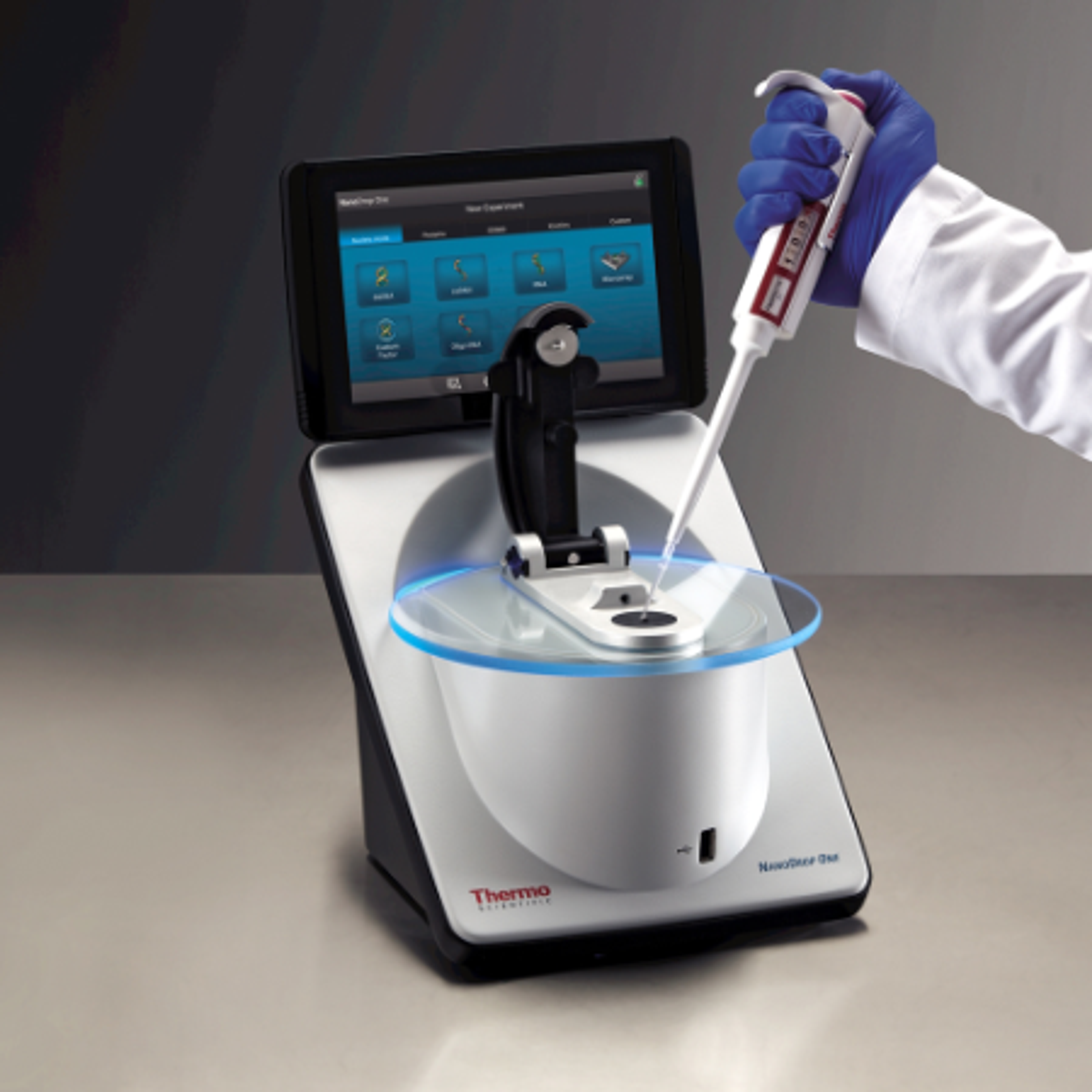
Thermo Scientific™ NanoDrop™ One/OneC Microvolume UV-Vis Spectrophotometer with Wi-Fi
Thermo Fisher ScientificPowerful auto-range pathlength technology facilitates accurate measurements for concentrated samples with no need for dilutions