Years on, the Nucleus Still Looks its Best in Red

21 Nov 2018

Finn Price
Administrator / Office Personnel

Product news

The far-red cell permeant DNA dye DRAQ5™ is now cited in more than 7600 peer-reviewed articles, heavily represented by top-ranked journals. Specifically, it has been widely used as a nuclear counterstain in high content screening (HCS) and associated drug discovery and development for more than a decade across Pharma’, CRO and academic labs and is backed by 200 independent customer reviews, as moderated by SelectScience.

To provide a new resource, the most recent of these papers have now been reviewed to include a brief snapshot of the topic, the platform used and details of the technique relevant to the use of DRAQ5™. Additionally, the resource signposts to useful book chapters. The resource can be found here: https://biostatusblog.blogspot.com/2018/11/DRAQ5DDrefs2017-2018.html

If you can’t find what you’re looking for there, BioStatus prides itself on providing front-to-back technical support, based on its many years of interactions with the drug discovery community and its own R&D programme, accessible directly from the website.

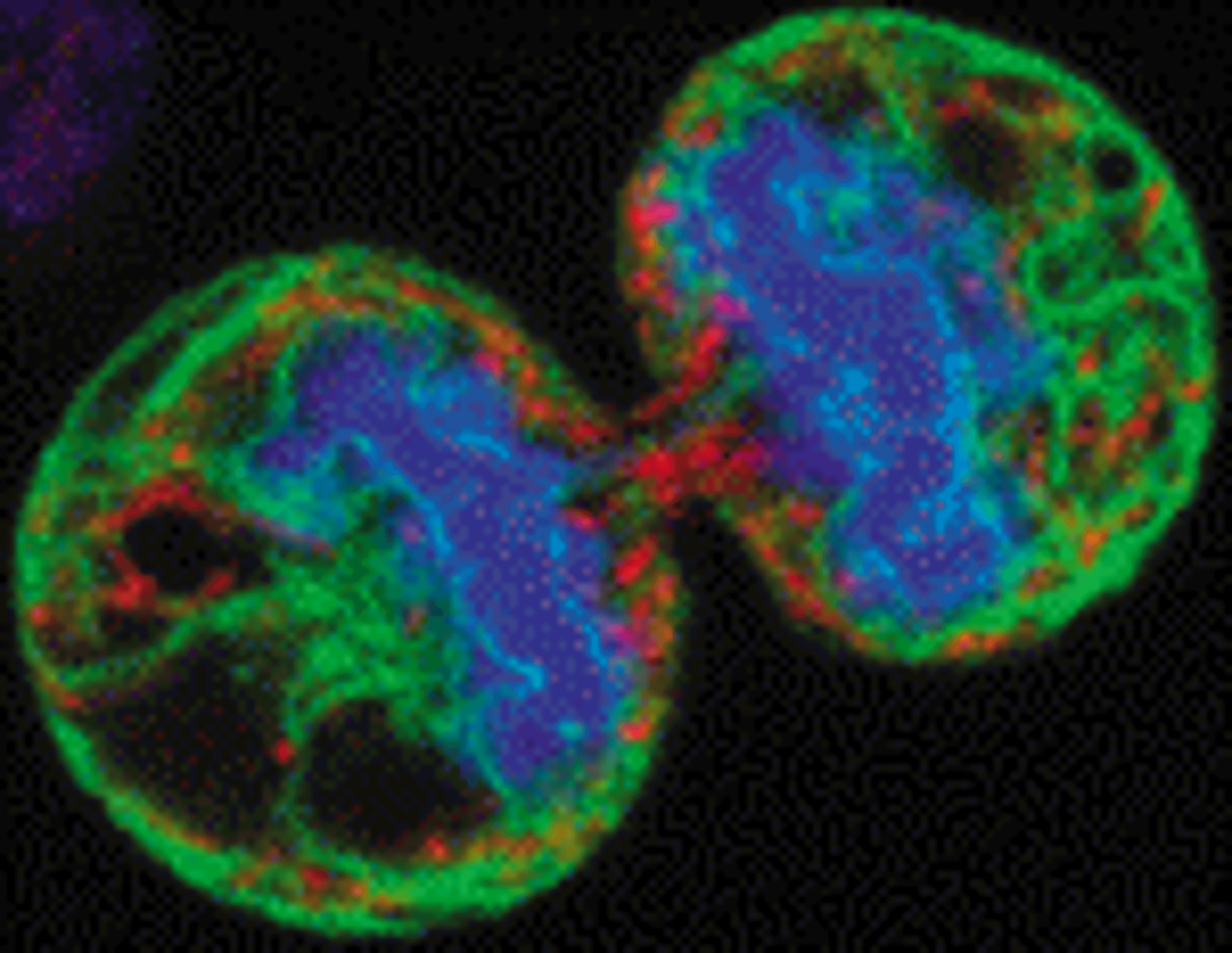
DRAQ5™ gives clear nuclear segmentation but also a useful secondary cytoplasmic signal for demarcation of the cytoplasmic envelope based on the real signal rather than reliance upon pixel dilation from the nuclear mask which aids signal quantification and observations of translocation events and morphometric indication of idiosyncratic toxicology. It can be used in both live- or fixed-cell endpoints and is spectrally separated from GFP and most vis-range chromophores. Because it is not excited by the UV wavelengths problems of compound interference are avoided. Remarkable chemical and photo- stability permit longer unattended operation on an automation deck in full-library screens. Importantly too, DRAQ5™ is cross-platform compatible for HCS imaging platforms, flow cytometers, imaging flow cytometers and fluorescence microscopes to simplify assay validation and transfer from bench-scale. A 1 ml pack of DRAQ5™ is sufficient for 100,000 wells (1536-mtp) or 33,000 wells (384-mtp) meaning its many benefits come at a small investment per datapoint.

Have you used DRAQ5 in your research? Write a review today for your chance to win a $400 Amazon Gift Card.

DRAQ5

Biostatus Limited

The proven far-red probe for live or fixed cells, spectrally compatible with UV / Vis-range fluors.

(267)

Links

Tags

Cell / Tissue CultureCell culture or tissue culture is used to study the biology of cells or tissues and to isolate cellular products in an environment which can be manipulated and well defined. Accurately control your culture environment with bioreactors or culture incubators, bind your cells to a surface or together with an extracellular matrix. Distinguish cell types with differential media or proliferate cells with certain characteristics using selective media. Enrich your media with supplements such as growth factors, sera and vitamins. Find the best cell and tissue culture products, kits and equipment in our peer-reviewed product directory: compare products, check customer reviews and receive pricing direct from manufacturers.Cell-Based AssaysCell-based assays are used to monitor the presence, quantity and activities of a desired cellular analyte including drug molecules or biomarkers. This can reveal information on cell health (apoptosis, cytotoxicity, viability and proliferation assays), cell metabolism, cell migration and cell signaling mechanisms. Find the best cell-based assay products, kits and equipment with our peer reviewed product directory: compare products, check customer reviews and receiving pricing direct from manufacturers.Flow Cytometry / Cell CountingFlow cytometers are used to count, sort and examine multiple characteristics of cells. Other cell analysis equipment includes image cytometers, cell counters, fluorescence-activated cell sorters (FACS), magnetic-activated cell sorters (MACS), and a range of flow cytometry assay kits. Flow cytometers can reveal information on cell viability, cell proliferation, apoptosis and cell cycle progression, as well as identify cell populations and intracellular or cell-surface molecules. Additionally, some flow cytometers, known as FACS, have an additional sorting function after analysis. Cell counters and image cytometers count live and dead cell populations and can also conduct cell proliferation assays. Find the best flow cytometers, cell counters and cell sorters in our peer-reviewed product directory: compare products, check customer reviews and receive pricing direct from manufacturers.FluorescenceThe emission of fluorescence occurs when a photon of energy is supplied to a fluorescent chemical compound by an external source, causing it to become excited. Fluorescence can be detected and measured for different purposes using microplate readers, fluorescence microscopes, fluorescence scanners, and flow cytometers.AutomationAutomation in laboratories and manufacturing processes enhances efficiency, precision, and scalability by reducing the need for manual intervention. It plays a critical role in improving productivity, minimizing human error, and accelerating workflows in fields like diagnostics, drug development, and industrial testing. Automation technologies include robotic systems, automated liquid handlers, and process control systems that streamline complex tasks and ensure consistent, reproducible results. Explore our peer-reviewed product directory to discover the best automation solutions, compare options, read user reviews, and get prices directly from manufacturers.Cell ImagingCell imaging can be achieved using a number of techniques including confocal microscopy, transmission electron microscopy, atomic force microscopy, and light sheet microscopy.ImagingImaging techniques are essential for obtaining visual representations of samples to understand structures, processes, and function in biological, chemical, and physical research. These tools range from traditional light microscopy to advanced imaging modalities like MRI and electron microscopy, providing researchers with valuable data for diagnostics, drug discovery, and material analysis. Explore imaging solutions in our peer-reviewed product directory to compare products, check reviews, and get pricing directly from manufacturers.High Content ImagingHigh content imaging is a method combining two or more fluorescent microscopy experiments to identify substances that alter a cell’s phenotype in a desired manner. The process is adapted to multi-well plates and both the image acquisition and analysis are automated.Drug DiscoveryDrug discovery is the process of identifying potential new medications, involving stages such as target identification, compound screening, and preclinical development. It relies on cutting-edge technologies like high-throughput screening, artificial intelligence, and molecular modeling to accelerate the identification of drug candidates. Drug discovery plays a pivotal role in developing new therapies for diseases ranging from cancer to rare genetic disorders. Browse our peer-reviewed product directory to find the latest drug discovery technologies, compare options, check customer feedback, and get pricing directly from manufacturers.PharmaceuticalsPharmaceuticals are medicinal drugs used in healthcare to diagnose, prevent, cure and treat illnesses. Pharmaceuticals that are excreted after use appear in wastewater and can have detrimental effects on the environment.ScreeningUsing robotics, data processing and control software, liquid handling devices and sensitive detectors, screening allows a researcher to quickly conduct millions of chemical, genetic or pharmacological tests.GFPCell CultureCell culture involves growing cells under controlled conditions, typically outside of their natural environment, to study cellular behavior, drug response, and disease models. Cell culture is crucial in biotechnology and biomedical research. Explore cell culture products in our peer-reviewed product directory; compare products, check reviews, and get pricing directly from manufacturers.Drug Discovery & Development Screening
Years on, the Nucleus Still Looks its Best in Red