Webinar Highlights: Overcoming Sample Prep Challenges in Clinical Research

Phenomenex’s sample preparation product manager shares his expert advice on preparing challenging biological sample matrices for LC-MS/MS

7 Nov 2017

Finn Price
Administrator / Office Personnel

Expert insights

Sample preparation of biological samples for LC-MS/MS

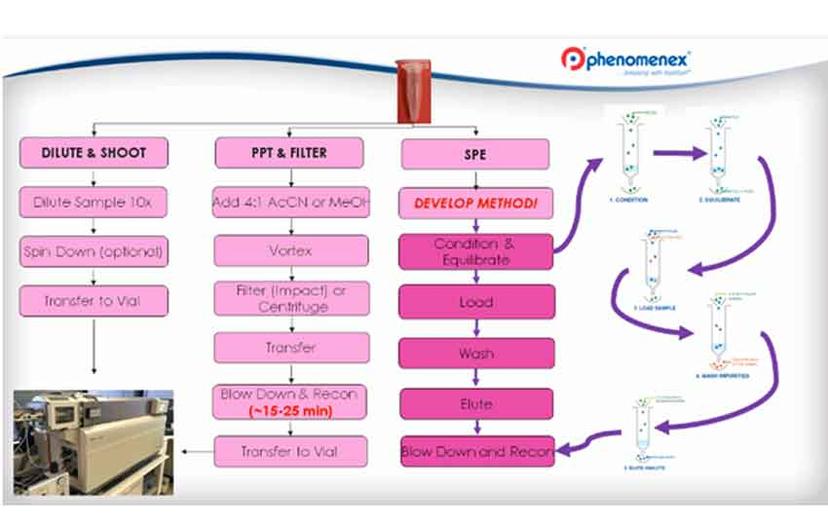
In this recent webinar, Matt Brusius, Sample Preparation Product Manager at Phenomenex, presented a comprehensive guide to method development for difficult analytes and matrices. He also presented three case studies covering specific sample preparation challenges and how to overcome them. In clinical research it is important to prepare samples for LC-MS/MS analysis. Preparing some biological samples can be difficult and time consuming. However, preparing these samples improves the quality of chromatography, concentrates the analyte of interest and switches the analyte into a better solvent for analysis.

Matt Brusius, Sample Preparation Product Manager, Phenomenex

Read on for highlights from the webinar Q&A session or watch the webinar on demand.

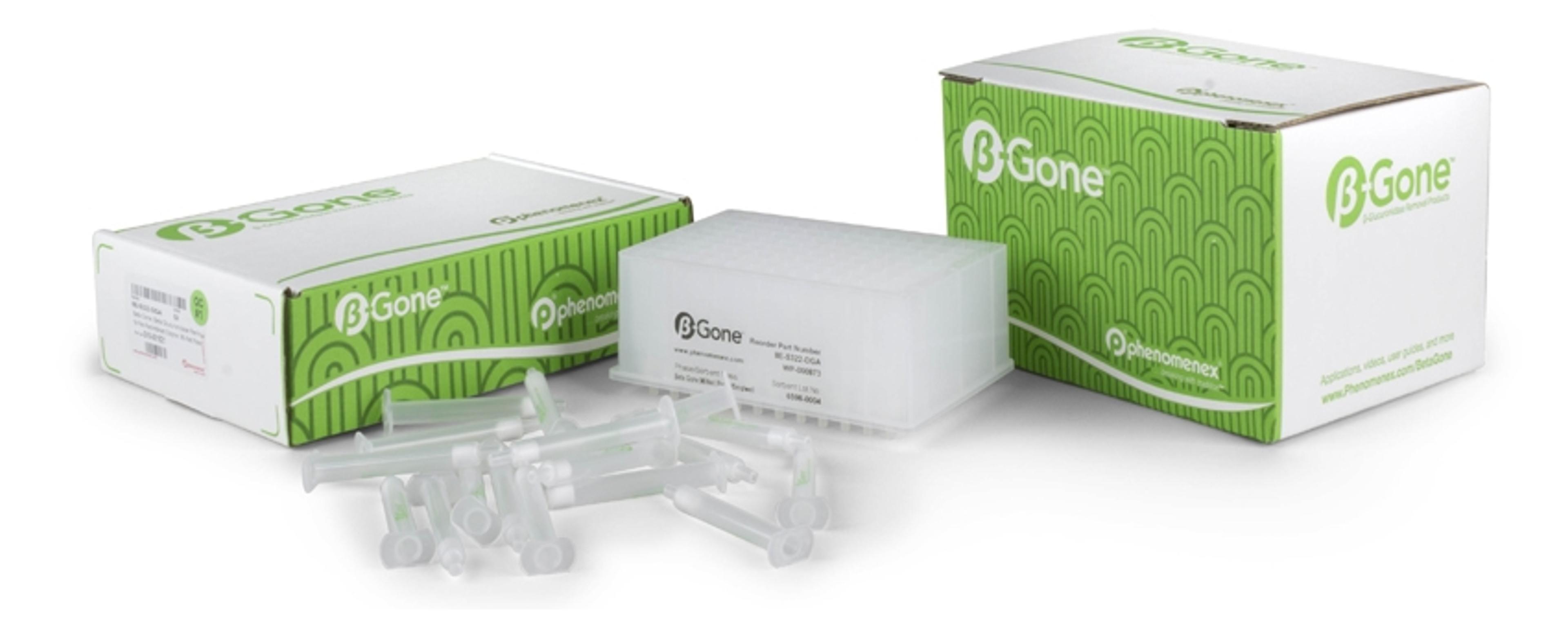
If ß-Gone is a shorter and easier protocol with better sensitivity for a full panel, why would I consider SPE as a sample prep option?

MB: I would consider SPE as an option as it will give you a cleaner sample. It depends on how much time you have for method development and what is important to you. If you want the absolute cleanest sample, and you want the peace of mind that you are going to get 20,000 injections in your column, SPE can provide peace of mind for you in comparison to ß-Gone. ß-Gone is a step above the protein precipitations and dilute and shoots of the world, but if you have the time to develop the SPE method, it’s always going to be cleaner. You can also concentrate up your sample – you can’t actually concentrate your sample with the ß-Gone phase, it’s a chemical filter, there is no concentration effect, whereas SPE has a concentrating effect, if you’re doing GC-MS you have to do SPE to hit the detection limit.

Does the Phree phospholipid removal product also do SPE? Would there be any need to do additional SPE?

MB: Not typically. That’s not really the goal of doing phospholipid removal. Phree can be helpful as a way of replacing SPE. You could do it before SPE, but I think it would be overkill. It really depends on the SPE method – are you doing a large panel? How much are you washing with? How effective is your SPE method at removing phospholipids? If you’re doing protein precipitation followed by SPE, for example, and your SPE step for the sample is only a 5% wash, there’s a good chance that if you’re only doing a 5% wash and you’re eluting off with 100% organic solvent you’re going to catch the phospholipids onto your cartridge and then elute them back off. So, if SPE method doesn’t have a lot of washing to it, using a phospholipid removal device beforehand could be useful. I would personally just try to use the phospholipid removal device as a standalone option but you can stack them if you want to, depending on what the other stipulations are.

What kind of suggestions do you have on removing surfactant from samples?

MB: Surfactants can be really difficult. Often, they require a very specific amount of washing. I’m not sure of the context of the question – oral fluid collection devices contain a significant amount of surfactant. If you’re able to do an SPE with them, then an ethyl acetate wash usually does a pretty good job of removing most of the surfactant. That’s one way you can get them out of your sample. If you’re doing full blown SPE, if there are other problems with or other things associated with it – I’d have to look at that method in particular. But ethyl acetate usually does a good job of solubilizing the surfactant enabling it to be removed prior to elution.

Watch the full webinar on demand or find out more about Phenomenex’s sample preparation solutions

Do you use any of the technologies mentioned in this webinar? Write a review today for your chance to win an Amazon voucher worth $400 or an iPad.
Links

Tags

LC-MSLC-MS (liquid chromatography-mass spectrometry) systems and equipment are used for separation and quantitative analysis of complex mixtures, combining liquid chromatography and mass spectrometry. Quantify proteins, contaminants, pesticides or screen for drug metabolites with a high level of sensitivity. LC-MS systems and equipment include reverse phase, normal phase and specialized columns integrated with various MS detectors such as time-of-flight (TOF), quadrupole, orbitrap or ion trap mass analyzers. LC-MS/MS instruments equipped with a qTOF or triple quadrupole analyzer give greater sensitivity and resolving power to your analysis. Find the best LC-MS equipment in our peer-reviewed product directory: compare products, check customer reviews and receive pricing direct from manufacturers.Mass SpectrometryMass spectrometry (MS) is a powerful analytical technique used to identify and quantify molecules based on the mass-to-charge ratio of gas-phase ions. It provides detailed information about the structure, composition, and properties of compounds and is widely used across fields such as environmental monitoring, materials science, drug discovery and development, food and beverage testing, and wider chemical research. Key MS techniques include tandem mass spectrometry (MS/MS), liquid chromatography–mass spectrometry (LS-MS) and inductively coupled plasma (ICP-MS). Choosing from these wide range of techniques and technologies can be a daunting task, so keep up to date with scientific applications, performance expectations, and customer reviews here all in one place. Visit our product directory to receive quotes direct from the manufacturer. Clinical MicrobiologyMicrobiology is the study of microorganisms including protists, prokaryotes, fungi, and, often, viruses. Microorganisms are a useful research tool as genetic vectors and, in immunology, for antibiotic susceptibility testing, cellular biology and genetics. Microorganisms commonly grow readily in incubators with microbial culture media; this can contain chromogenic supplements to differentiate between cell lines. Estimate your culture’s density of microorganisms with colony counters, or screen and select colonies for desirable clones with automated colony pickers. Additionally, equipment is available to monitor environments for the presence of microbes and identify with microbial identification instruments. Find the best microbiology products in our peer-reviewed product directory: compare products, check customer reviews and receive pricing direct from manufacturers.Sample PreparationSample preparation can improve the quality and speed of separation techniques. Products to assist sample preparation include filtration equipment, evaporators, membranes and sieves.Chromatography Method DevelopmentChromatography method development is the process of designing and optimizing chromatographic techniques to separate and analyze complex mixtures. This includes selecting appropriate stationary and mobile phases, determining flow rates, and optimizing detection methods. Successful method development is essential for high-quality results in fields like pharmaceuticals, food safety, and environmental analysis. Explore chromatography method development tools in our peer-reviewed product directory; compare products, check reviews, and get pricing directly from manufacturers.Method DevelopmentMethod development is the process of creating and optimizing experimental techniques and protocols to achieve reliable, reproducible results. This is essential in various fields, including pharmaceuticals, environmental science, and diagnostics. Browse our peer-reviewed product directory to find the best method development solutions, compare products, check reviews, and get pricing directly from manufacturers.Solid Phase Extraction (SPE)Solid phase extraction (SPE) is a sample preparation technique used to separate and concentrate analytes from complex mixtures. It is widely used in environmental, pharmaceutical, and clinical analysis. SPE provides higher sensitivity and selectivity compared to traditional liquid-liquid extraction methods, making it essential for accurate and reproducible results. Explore SPE tools and systems in our peer-reviewed product directory; compare products, check reviews, and get pricing directly from manufacturers.MicrobiologyLC-MSLiquid Chromatography-Mass Spectrometry (LCMS) is a powerful analytical technique that combines the separation power of liquid chromatography with the detection capabilities of mass spectrometry. It is widely used for qualitative and quantitative analysis of complex mixtures in pharmaceuticals, proteomics, and environmental studies. Browse our peer-reviewed product directory to find the best LCMS systems, compare products, check reviews, and get pricing directly from manufacturers.