
Waters to Showcase Full Spectrum Molecular Imaging System at ASMS
18 May 2015Product news
The full spectrum molecular imaging system is the first system ever to allow scientists to access enhanced matrix-assisted laser desorption ionization (MALDI) and desorption electrospray ionization (DESI) with ion mobility separation (IMS) in a single mass spectrometry platform.
Based on the Waters SYNAPT® G2-Si mass spectrometer, the imaging capabilities of the new full spectrum molecular imaging system enable research laboratories to pinpoint with greater specificity the distribution of large and small molecules within tissue samples. Information derived from imaging experiments can greatly benefit cancer, cardiovascular and neuro-degenerative research by measuring the distribution of molecules in cells and tissues. MS imaging also allows researchers to identify different tissue types based on their molecular composition.
Many applications demand the maximum amount of information from the minimum of sample. The non-destructive nature of DESI means that a single tissue section can be analyzed multiple times, for example at different spatial resolutions or in different polarities, without significant degradation of signal or modification of chemical signature. Following multiple DESI analyses, the same tissue section can then be used for further analysis, for example histological staining or analysis by MALDI MS imaging.
Unlike UPLC/MS, MS imaging does not involve any form of separation prior to ionization. The resulting data are often highly complex due to the level of detail observed and the potential for background interferences. SYNAPT HDMS enables the powerful combination of MALDI and DESI imaging with ion mobility-mass spectrometry. This allows the gas phase separation of ions by compound class and charge in an MS imaging experiment, providing a level of selectivity that would not be possible with mass resolution alone. The result of this is cleaner imaging data, allowing the more precise visualization of molecular distributions in the presence of background.
For more information visit Booth # 160
Oral Presentation:
Main Session: Imaging: Instrumentation & Method Development
Room 123/124
8:50am - 9:10am
Enhancing the analytical capabilities of DESI imaging using ion mobility separation- providing superior insights of biological samples
Emmanuelle Claude1 ; Emrys A Jones(1, 3) ; Mark Towers1 ; Karolina Skraskova2 ; Ron M.A. Heeren2 ; Jim Langridge1
1 Waters Corporation, Wilmslow, United Kingdom; 2 Maastricht University, Maastricht, NL; 3 Imperial College London, London, UK
Related products
Request Quote for All Products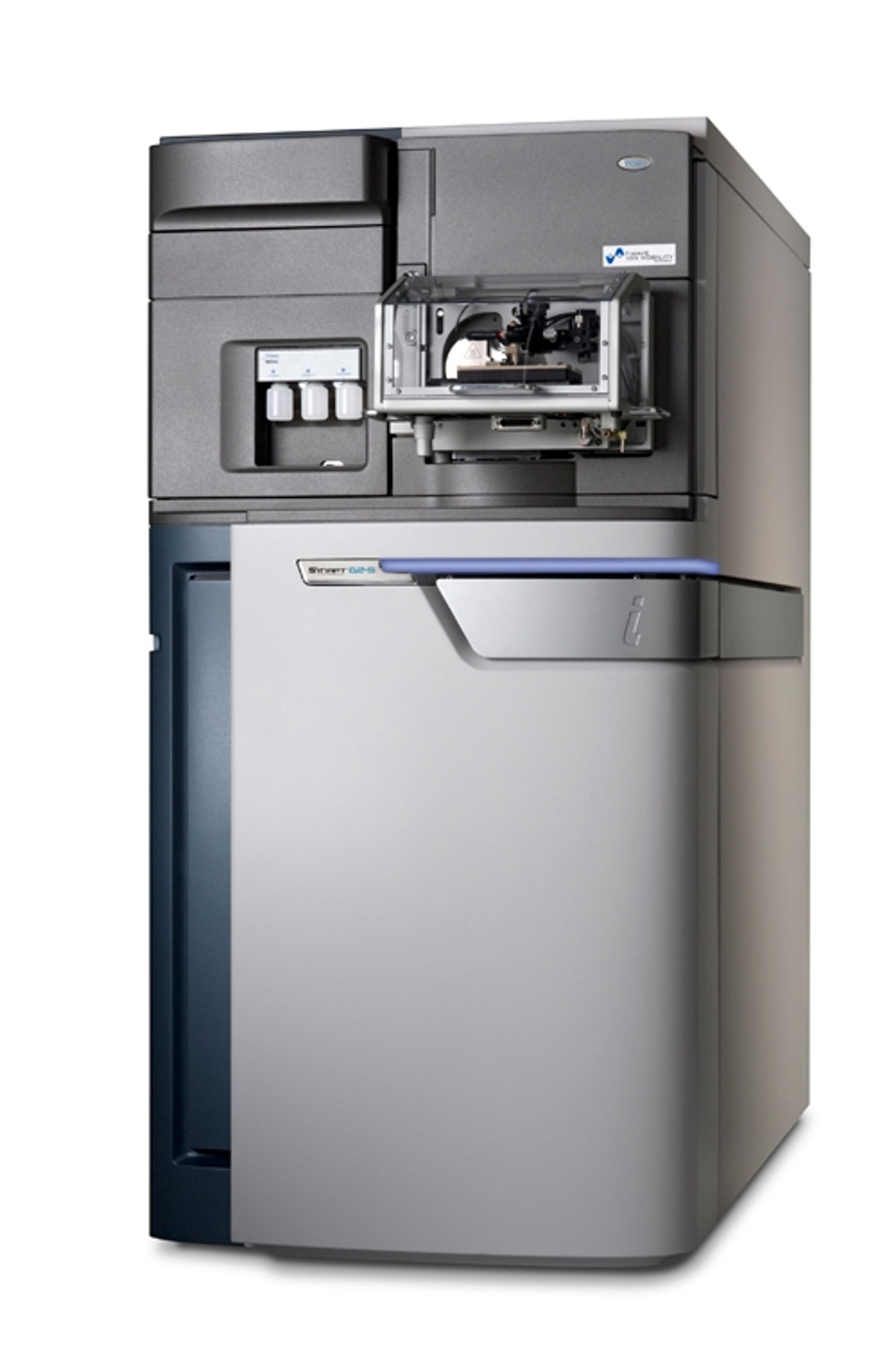
Waters Full Spectrum Molecular Imaging System
WatersA combination of advanced MS imaging technologies including MALDI, DESI and ion mobility.