
Versatile high-resolution mass spectrometer expands Thermo Scientific Orbitrap platform
Thermo Scientific Orbitrap Exploris 240 mass spectrometer drives discovery and identification with quantitative precision and accuracy to meet customers' specific analytical requirements
28 May 2020
Product news
A new generation, high resolution mass spectrometer (MS) is designed to give proteomics, metabolomics, biopharmaceutical characterization and small-molecule scientists the analytical performance required for research and high-throughput analyses. The new system will help drive discovery and identification with increased accuracy for confident scale-up while operational simplicity and speed streamline time to results.
The Thermo Scientific Orbitrap Exploris 240 mass spectrometer expands the proven Orbitrap Exploris platform and delivers mass accuracy, sensitivity and resolving power across a wide dynamic range. With new-generation system architecture and instrument control software, the system provides simple yet powerful data acquisition capabilities, addressing the most demanding analytical challenges for small- and large-molecule applications. The system offers positive/negative mode switching for comprehensive sample coverage, fast scan speeds and functionalities including Thermo Scientific AcquireX intelligent data acquisition workflow that enable greater automation.
"Scientists are seeking technologies that can streamline and speed proteomics studies to clinical applications, reduce time to market for candidate biotherapeutics and address the growing challenge of characterizing novel chemical entities in small-molecule studies," said Iain Mylchreest, vice president, research and development, analytical instruments, Thermo Fisher Scientific. "As part of our expanded portfolio of new-generation instruments, the Orbitrap Exploris 240 mass spectrometer delivers the high performance and versatility needed to drive productivity across multiple applications."
Dr. Timothy Garrett, associate professor, department of pathology, immunology and laboratory medicine, co-director of the Southeast Center for Integrated Metabolomics, University of Florida, said, "Using the Orbitrap Exploris 240 mass spectrometer has been extremely user friendly, with one-click calibration and method templates for fast instrument setup. The system reproducibility in mass accuracy and peak integrated area over several sample batches and several days of acquisition has been impressive. This is very important for our large-scale metabolomics projects enabling minimum post-acquisition data manipulation to yield high quality results."
The Thermo Scientific Orbitrap Exploris portfolio of high-resolution, accurate-mass (HRAM) systems, which launched in 2019 with the Thermo Scientific Orbitrap Exploris 480 mass spectrometer, now includes two new, highly capable instruments, the Thermo Scientific Orbitrap Exploris 240 and Thermo Scientific Orbitrap Exploris 120 mass spectrometer, allowing customers to easily transfer knowledge and methods from research and discovery to routine testing. The Orbitrap Exploris 480 and 240 mass spectrometers are fully compatible with the Thermo Scientific FAIMS Pro interface to achieve enhanced identification of proteins and peptides. Improved quantitative performance for translational proteomics and high-throughput studies will enable researchers to accelerate the translation of discoveries into clinical applications.
Dr. Jonathan Bones, principal investigator, National Institute for Bioprocessing Research and Training, said, "The Orbitrap Exploris 240 mass spectrometer is a reliable and flexible solution for high-performance biopharmaceutical characterization and achieves impressive sensitivity for native MS analyses. With the Thermo Scientific Vanquish Duo UHPLC systems running in tandem mode, there is no more waiting during column equilibration; the mass spectrometer constantly acquires valuable data with all the available features of the Thermo Scientific Chromeleon Chromatography Data System (CDS) software. The system is a must-have instrument for analytical and characterization laboratories supporting biopharmaceutical development and manufacture."
Performance of the Orbitrap Exploris 240 mass spectrometer is further enhanced with access to powerful new software functionality to improve data acquisition and processing:
- Proteomics scientists will benefit from the latest artificial intelligence (AI) technology with Thermo Scientific Proteome Discoverer 2.5 software. The new release utilizes deep learning tools to provide a more accurate prediction of mass spectra, improving confidence in peptide identification.
- Supporting scientists developing new biopharmaceuticals, Thermo Scientific BioPharma Finder 4.0 software delivers enhanced flexibility for the analysis of intact proteins, sub-unit mass analysis, peptide mapping and oligonucleotide analysis. Direct transfer of data processing parameters to Thermo Scientific Chromeleon Chromatography Data System (CDS) software enables compliance-ready analysis for peptide monitoring and quantitation of proteins.
- With Thermo Scientific Compound Discoverer 3.2 software, small-molecule researchers are supported through extensive characterization capabilities, access to multiple mass spectral fragmentation library and structural database sources. Access to the large Thermo Scientific mzCloud mass spectral fragmentation library enhances connectivity and characterization for small molecule applications to help identify compounds.
- The launch of Thermo Scientific Xcalibur 4.4 software brings the AcquireX intelligent data acquisition workflow to the Orbitrap Exploris family of mass spectrometers, allowing greater automation for structural identification and characterization of small molecules.
Do you use Thermo Fisher Scientific products in your lab? Write a review today for your chance to win a $400 Amazon gift card>>
Related products
Request Quote for All Products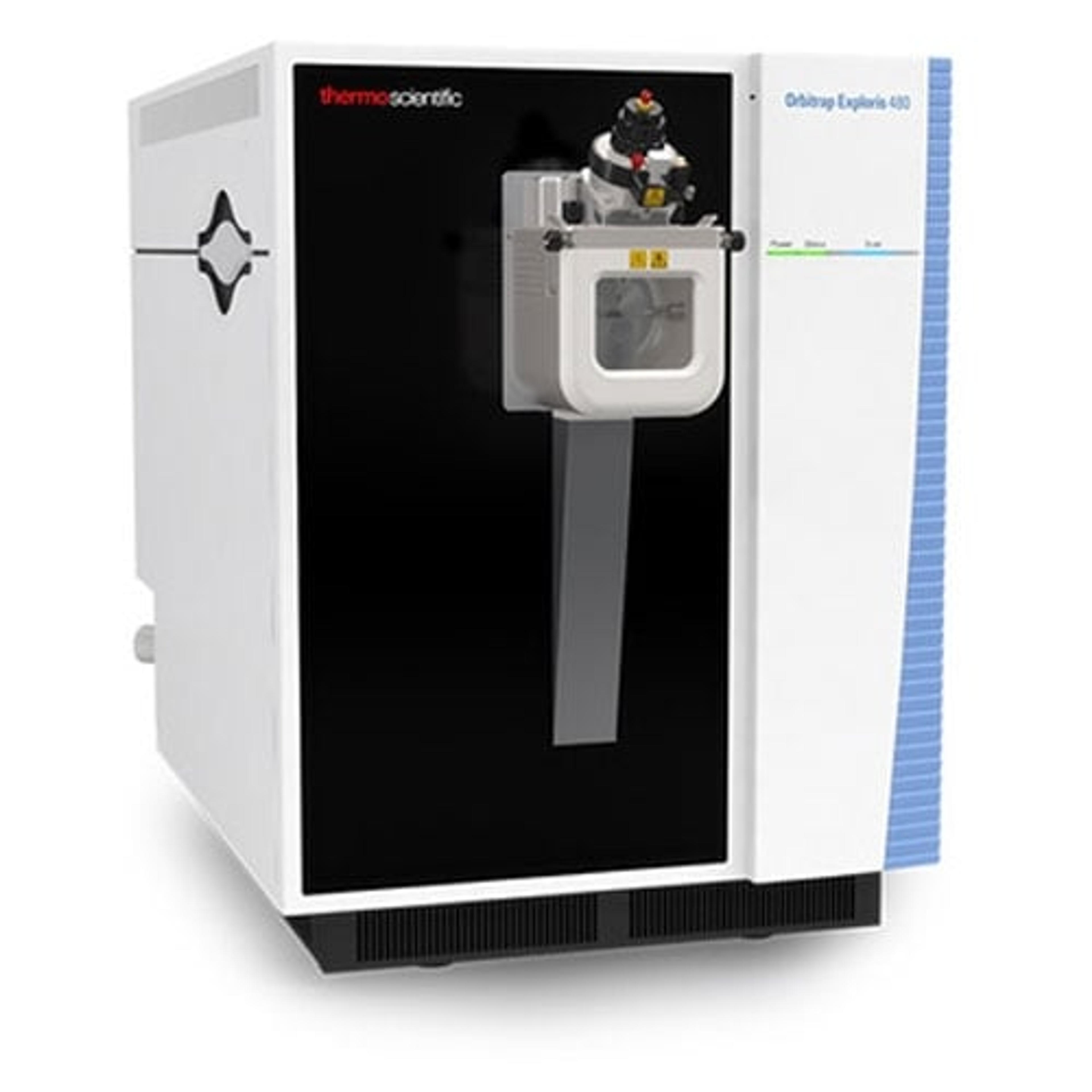
Thermo Scientific™ Orbitrap Exploris™ 480 mass spectrometer
Thermo Fisher ScientificEmpowering life science researchers to translate each step to a new level of insight with a next generation ownership experience coupled with an intelligence-driven experimental approach. With the Thermo Scientific Orbitrap Exploris 480 mass spectrometer you'll find market leading quantitative performance to solve your most complex challenges with ease, and the proven qualitative performance you expect.

Thermo Scientific™ Proteome Discoverer™ Software
Thermo Fisher ScientificIdentify and quantify proteins in complex biological samples using Thermo Scientific™ Proteome Discoverer™ software. Proteome Discoverer software simplifies a wide range of proteomics workflows, from protein and peptide identification to PTM analysis to isobaric mass tagging and both SILAC and label-free quantitation. It supports multiple database search algorithms (SEQUEST, Z-Core, Mascot, and Byonic) and multiple dissociation techniques (CID, HCD, ETD, and EThcD) for more comprehensive analyses.
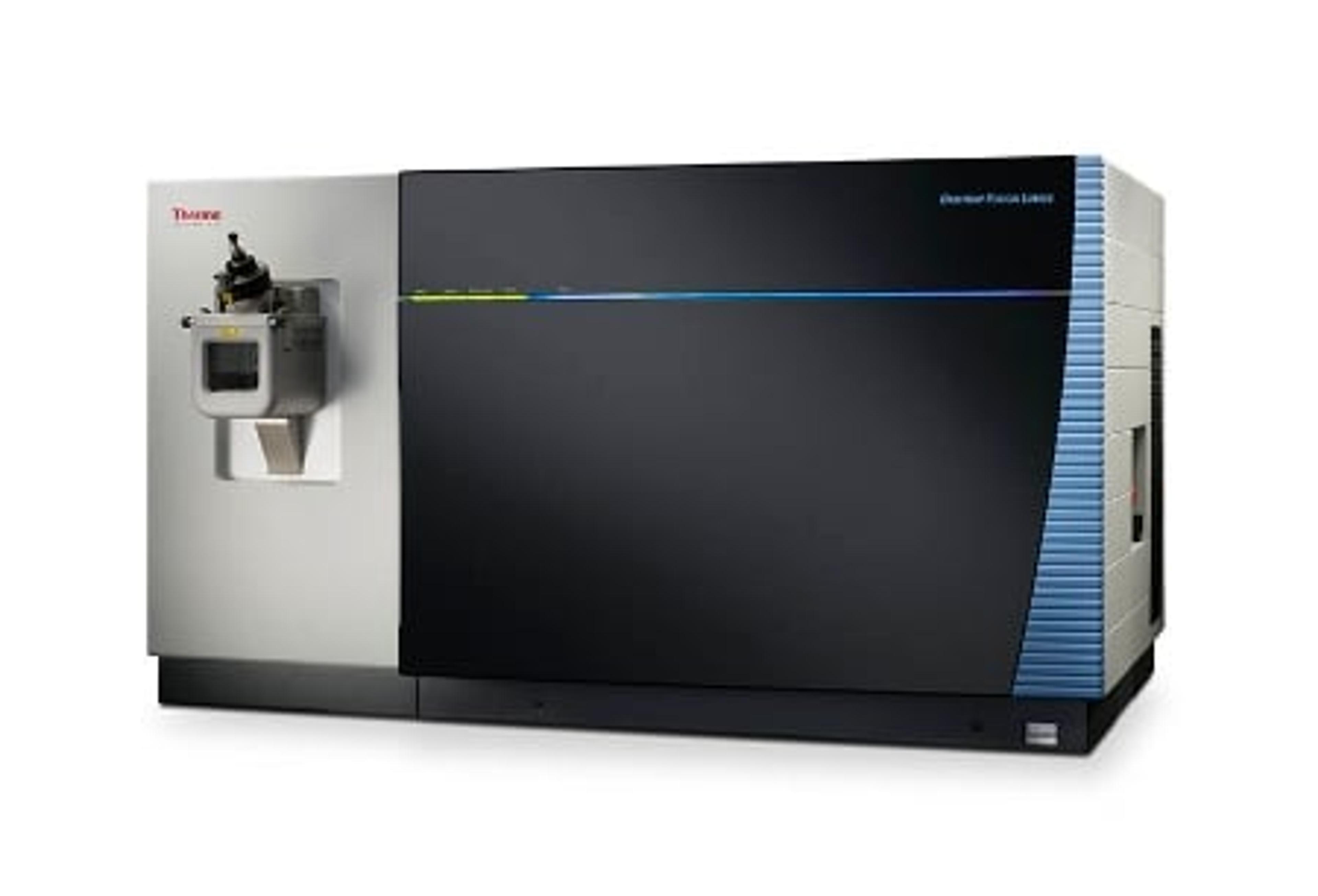
Thermo Scientific™ Orbitrap Fusion™ Lumos™ Tribrid™ Mass Spectrometer
Thermo Fisher ScientificTest new limits of detection, characterization and quantitation with the latest Tribrid™ mass spectrometer. The Thermo Scientific™ Orbitrap Fusion™ Lumos™ Tribrid™ Mass Spectrometer is designed to expand performance in advanced proteomics, biopharma and metabolomics applications, including quantitation using isobaric tags, low level PTM analysis, data independent acquisition (DIA), and top down proteomics. The new instrument features enhanced sensitivity resulting in improved analyte detection, characterization and quantitation, enabling scientists to perform more comprehensive sample analyses faster and with better accuracy than ever before. Novel Orbitrap Fusion Lumos MS Features: Novel high-sensitivity API interface combines a High Capacity Transfer Tube and an Electrodynamic Ion Funnel for increased ion flux and lower limits of detection Advanced Active Beam Guide prevents neutrals and high velocity clusters from entering the resolving quadrupole Advanced Quadrupole Technology combines high selectivity and efficiency of transfer for selected ions symmetrically across the isolation window Advanced Vacuum Technology improves transmission of high molecular weight ions to the Orbitrap analyzer Novel ETD HD—high dynamic range ETD provides significantly increased fragment ion coverage Established Tribrid MS Features: Tribrid architecture — includes quadrupole mass filter, linear ion trap and Orbitrap mass analyzers Ultrahigh resolving power up to 500,000 FWHM, with isotopic fidelity up to 240,000 FWHM at m/z 200 Acquisition rates of up to 20 Hz for both Orbitrap and linear ion trap MSn analyses Full parallelization of MS and MSn analyses with intelligent ADAPT™ (All Dynamically Available Parallelizable Time) technology Synchronous Precursor Selection (SPS) for MS and MSn experiments significantly increases the number of peptides and proteins identified and improves quantitative accuracy when using isobaric mass tags Flexibility of fragmentation — CID, HCD and optional ETD and EThcD available at any stage of MSn with detection in either the Orbitrap or linear ion trap detector enables detailed structure determination of metabolites, glycans and other small molecules Universal Method provides maximal peptide identifications without method optimization for samples of unknown concentration, reducing sample and instrument time requirements for routine peptide identifi cation experiments Intuitive and flexible drag-and-drop user interface simplifies method development and enables unique and complex workflows