
Vector Laboratories Introduces First Effective Reagent for Autofluorescence Quenching
14 Nov 2017
Product news
Vector Laboratories, a leader in the development and manufacture of labeling and detection reagents for biomedical research, has introduced the TrueVIEW™ Autofluorescence Quenching Kit, offering the first effective technique for removing unwanted fluorescence in formalin-fixed paraffin embedded (FFPE) tissue samples, blood cells and structural elements such as collagen and elastin.
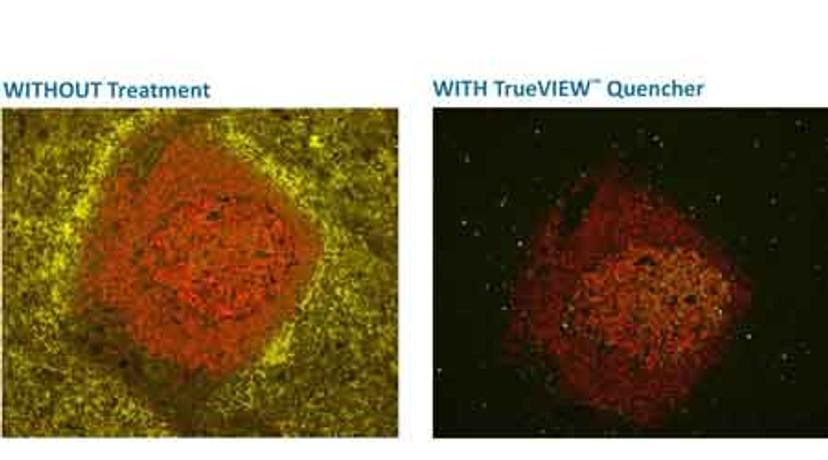
Autofluorescence often impairs or prevents the use of immunofluorescence assays when the specific stained antigen cannot be distinguished from the interfering background signal. This is particularly problematic with tissue samples preserved using the FFPE method. TrueVIEW specifically targets background autofluorescence, and retains the intended specific fluorescent staining. TrueVIEW is effective across the spectral range from blue to far red and is compatible with commonly used fluorophores. This new quenching reagent enables researchers to identifyspecific markers that cannot be seen without removing the background noise of autofluorescence.
“Other approaches to removing tissue autofluorescence have been ineffective, laborious and can even reduce the immunofluorescence signal of the sample. With our new TrueVIEW Kit, we improve the signal-to-noise ratio,” explains Craig Pow, Ph.D., director of technical services for Vector Laboratories. “We anticipate that this new reagent will benefit researchers using immunofluorescence with FFPE samples, particularly those studying spleen, pancreas or kidney tissue. We also expect that the ability to remove background noise will expand the use of immunofluorescence in archived cancer, histopathology, neurobiology and cell biology research specimens.”
Applying TrueVIEW to sections is fast, requiring just five minutes for incubation. Ethanol steps and dilution are not required. The Vector TrueVIEW kit includes VECTASHIELD HardSet Antifade mounting media and contains enough reagent for between 100 and 150 tissue sections.
Do you use Vector Laboratories products in your research? Review their products here