Uniqsis launches a new high intensity photochemistry light source

New Borealis LED light source has shown to accelerate photoredox catalysis

16 Feb 2024

Jessica Calvey
Product and Reviews Admin Assistant

Product news

High intensity Borealis™ LED light source

Uniqsis has launched a new high intensity Borealis™ LED light source which has been shown to significantly increase the rate of metal-catalysed photoredox reactions. Available in activation wavelengths from 365 nm up to 525 nm the Borealis LED light source is a proven device for performing photochemical reactions in both batch and flow modes.

The new version uses high-output LEDs that, being more efficient than the original chip-on-board (COB) LEDs, produce a higher light output for the same power consumption.

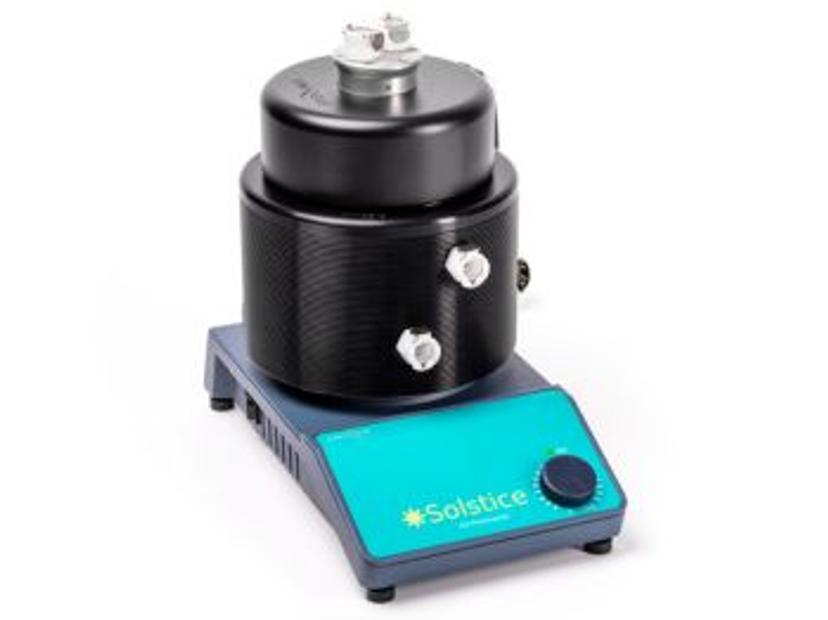
Described in a new application report, two time-studies were performed in a Uniqsis Solstice 12-position multi-tube batch photoreactor varying only the version of 420 nm Borealis LED lamp. In each case, the LED light source was connected to a 180 W Borealis digital power supply. The results illustrate how the increased photon flux provided by the new 420 nm 180 W Borealis LED lamp significantly increased the rate of a metal-mediated photoredox decarboxylative arylation (Macmillan reaction) when compared to the original Mk1 version.

Want the latest science news straight to your inbox? Become a SelectScience member for free today>>

Links

Tags

Combinatorial ChemistryCombinatorial chemistry, also known as combichem, is a technique used in drug discovery to create libraries of structurally related compounds. A library is generated by synthesis with a chemical reactor system or by computer-based modeling of compound combinations. When undertaking combinatorial chemistry consider reagents, buffers, resins and standards.Process ChemistryProcess chemistry is an important stage of drug development for scaling-up drug production or chemical synthesis reactions. It is useful for optimizing economical and efficient drug production. Process chemistry uses reactors and pump systems as well as reagents, standards and buffers.LEDFlow ChemistryFlow chemistry describes a chemical reaction being carried out continuously rather than in a batch process. The reagents are pumped through a pipe and forced together at a mixing junction, where they are allowed to combine until the reaction is stopped.
Uniqsis launches a new high intensity photochemistry light source