TR-FRET readout now available with the Transcreener cGAMP cGAS Assay

With this addition, researchers can more easily screen for small molecule modulators of cGAS

26 Jan 2021

Diane Li
Assistant Editor

Product news

Launched in November 2019, the Transcreener cGAMP cGAS Assay has generated a great deal of interest in the drug discovery community. While fluorescence polarization (FP) readouts offer a stable and robust option, some researchers prefer time-resolved Förster-resonance-energy-transfer (TR-FRET) readouts for large screens. After months of development, BellBrook Labs is pleased to announce the addition of a TR-FRET readout to the Transcreener cGAMP cGAS Assay family.

Cyclic GMP-AMP synthase, or cGAS, is an enzyme recently identified as an innate immunity target. The cGAS-STING pathway has been shown to play a role in innate immune response, inflammation, tissue repair, infectious disease, and viral persistence. Investigating cGAS signaling events may lead to the discovery of small molecule modulators of this pathway for therapeutic intervention. High Throughput Screening is a powerful tool for cGAS discovery. In combination with Transcreener cGAMP cGAS Assay, researchers can use HTS to screen thousands of chemical compounds and discover active molecules, targeting the cause of inflammatory diseases. Upon detection of a positive hit in the HTS assay, the candidate compound can be advanced into functional and biochemical studies further to explore its potential as a novel therapeutic lead molecule.

BellBrooks customers provide a driving force to produce assays that enable quality data to accelerate their discovery efforts. Developing multiple fluorescent readouts allows researchers more tools for discovery. TR-FRET is one preferred option by many in drug discovery, especially in high throughput screening where time-gated measurements can help eliminate interference from the fluorescence of test compounds. The Transcreener cGAMP cGAS TR-FRET Assay is a simple mix-and-read format that provides excellent Z’ of greater than 0.7 at cGAMP ranges between 0.5 µM and 100 µM. It employs a far-red ATTO 647 tracer that further minimizes interference from fluorescent compounds and light scattering.

BellBrook Labs is a world leader in small molecule HTS research tools – our technology enables researchers to measure enzyme activity in a simple, high-throughput manner. Before the development of this assay, there were few options available for monitoring cGAS activity. Now, with Transcreener’s combination of two highly-sensitive fluorescent assays with robust high throughput capabilities, researchers can more easily screen for small molecule modulators of cGAS.

Do you use BellBrook Labs products in your lab? Write a review today for your chance to win a $400 Amazon gift card>>

Transcreener® cGAMP cGAS Assay

BellBrook Labs

The Transcreener® cGAMP cGAS Assay Kit offers mix-and-read fluorescent detection of cGAMP—the product of cGAS activity—with no coupling enzymes required. Available in FP or TR‑FRET readouts (far-red tracers minimize interference), it’s HTS-ready (Z’ ≥ 0.7), automation-compatible, and validated on 96‑, 384‑, and 1536‑well formats for enzyme kinetics, SAR, and inhibitor screening.
(0)

Transcreener® GDP GTPase Assays

BellBrook Labs

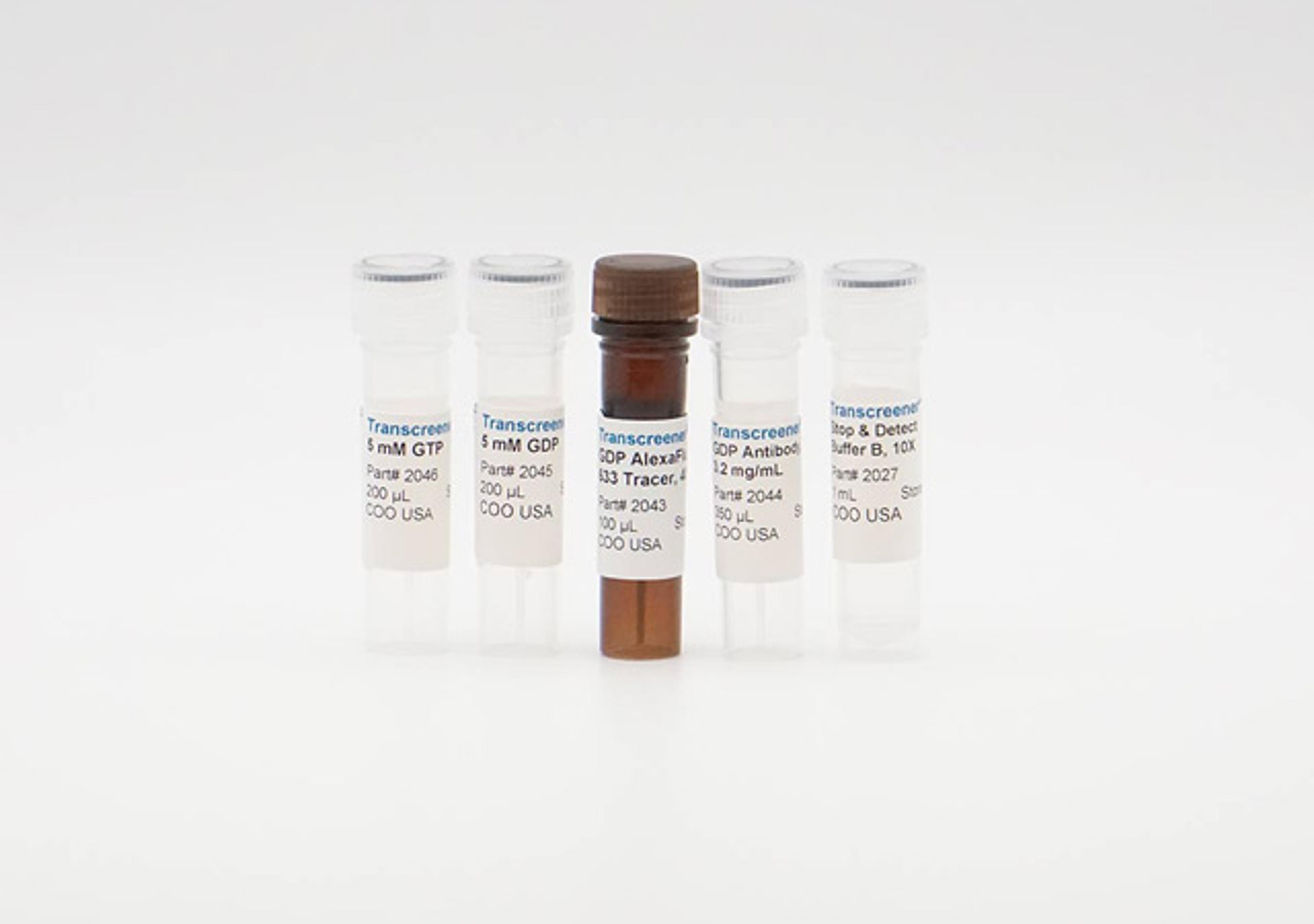
The Transcreener® GDP GTPase Assay Kit directly measures GDP produced during GTP hydrolysis in a homogeneous mix‑and‑read format—no coupling enzymes needed. Compatible with GTPases, GAPs, and GEFs, it supports FP, FI, and TR‑FRET readouts using far‑red tracers to reduce interference. HTS‑ready with excellent sensitivity (Z′ ≥ 0.7), it streamlines screening and profiling workflows.

(0)

Transcreener® ADP² Kinase Assays

BellBrook Labs

The Transcreener® ADP² Kinase Assay Kit universally detects ADP produced by any kinase or ATPase using a direct mix‑and‑read format, eliminating coupling steps. Available in FP, FI, and TR‑FRET formats with far‑red tracers to minimize interference, it's HTS-ready across 96‑, 384‑, and 1536‑well plates with robust Z' ≥ 0.7 performance.

(3)

Links

Tags

Cell Adhesion AssaysCell adhesion assays are used to quantitate attachment and analyze the molecular mechanisms for extracellular matrix adhesion, cell migration and sensitivity to inhibitors. Find the best cell adhesion assay equipment in our peer-reviewed product directory: compare products, check customer reviews and receive pricing direct from manufacturers.Assay AssemblyAssay Assembly is technique used in drug discovery to develop assays to test the cytotoxicity, genotoxicity, or other activities of a compound on a cell. Assay assembly requires chip assembly, a delivery system and a detection and analysis method. Beneficial features of assay kits or automated systems include high-throughput, high speed and sensitivity and low signal to noise ratio.ImmunologyImmunological techniques measure and characterize immune responses. Immunology kits and analysis systems often use techniques such as ELISA, radioimmunoassay (RIA) and immunodiffusion assays, Immunohistochemistry, and flow cytometry. Immunologists use equipment such as flow Cytometers, plate readers, plate washers and fluorescent microscopes.Cell-Based AssaysCell-based assays are used to monitor the presence, quantity and activities of a desired cellular analyte including drug molecules or biomarkers. This can reveal information on cell health (apoptosis, cytotoxicity, viability and proliferation assays), cell metabolism, cell migration and cell signaling mechanisms. Find the best cell-based assay products, kits and equipment with our peer reviewed product directory: compare products, check customer reviews and receiving pricing direct from manufacturers.High-Content ScreeningHigh-content screening (HCS), also known as high-content analysis (HCA), is a high-throughput technique used in drug discovery to identify substances that alter the phenotype of cells. HCS uses fluorescent microscopic imaging and automated image analysis to investigate cellular events such as apoptosis, cell viability, GPCR activation, oxide production, neurite outgrowth, and cell signaling. Find the best fluorescent labeling reagents, cellular assays, and high-content imaging systems in our peer-reviewed product directory: compare products, check customer reviews and receive pricing direct from manufacturers.FluorescenceThe emission of fluorescence occurs when a photon of energy is supplied to a fluorescent chemical compound by an external source, causing it to become excited. Fluorescence can be detected and measured for different purposes using microplate readers, fluorescence microscopes, fluorescence scanners, and flow cytometers.Fluorescence Based AssayFluorescence based assays are widely used in life science research and high-throughput screening to measure a broad range of cellular activities.High ThroughputHigh throughput experiments allow the simultaneous processing of several samples. This parallelization reduces the cost per experiment and increases reproducibility and output volume of data.Targeted ScreeningInhibitorsAssay DevelopmentThe process of proving an assay to be sensitive with respect to the target is known as assay development. The assay should be able to characterize novel compounds and measure the potency of these compounds against a validated biological target.ImmunotherapyImmunotherapy is a treatment approach that utilizes the body�s immune system to fight diseases, especially cancer. It includes therapies such as monoclonal antibodies, checkpoint inhibitors, and CAR-T cell therapy. Immunotherapy is a rapidly growing area of research in oncology and autoimmune diseases. Browse our peer-reviewed product directory to find the best immunotherapy tools, compare products, check reviews, and get pricing directly from manufacturers.ScreeningUsing robotics, data processing and control software, liquid handling devices and sensitive detectors, screening allows a researcher to quickly conduct millions of chemical, genetic or pharmacological tests.Drug DiscoveryDrug discovery is the process of identifying potential new medications, involving stages such as target identification, compound screening, and preclinical development. It relies on cutting-edge technologies like high-throughput screening, artificial intelligence, and molecular modeling to accelerate the identification of drug candidates. Drug discovery plays a pivotal role in developing new therapies for diseases ranging from cancer to rare genetic disorders. Browse our peer-reviewed product directory to find the latest drug discovery technologies, compare options, check customer feedback, and get pricing directly from manufacturers.