
Top Pharma, Biotechs and CRO choose ambr250 Automated Mini Bioreactor System
23 Apr 2014
Product news
TAP Biosystems (now part of the Sartorius Stedim Biotech Group), a leading supplier of innovative cell culture and fermentation systems for life science applications, today announced that its new ambr250™ automated mini bioreactor system has already been chosen by a number of major pharmaceutical, biotech and CRO firms as a high-throughput, scale-down bioreactor model for their process development and optimisation programmes.
The automated ambr250 system, which has independent parallel control of 12 or 24, single-use 250 mL bioreactors, is being sited at the R&D centres of the top Pharma companies across the US and Europe. The system has also been chosen for the Chinese R & D centre of a major European biopharm; a major CRO in the UK and a UK-based biotech company. The majority of these systems will be used to accelerate mammalian and microbial process development and optimisation of antibody and other protein-based therapeutics. However, three of the systems will be utilised in rapidly developing process optimisation for the production of vaccines.
High-throughput flexibility
The companies have chosen the ambr 250 because the high-throughput system has the flexibility to culture mammalian lines including CHO or microbial cells such as Pichia pastoris and E.coli in single-use, stirred bioreactors and utilises continuous pumped feeds, making it possible to fully evaluate the process characteristics of large scale bioreactors and fermenters.
Mwai Ngibuini, ambr250 Product Manager at TAP Biosystems said: “The bioprocessing industry is looking for a realistic scale-down model to accelerate process development and optimize scale-up of cell culture manufacturing processes. The ambr250 system has been rigorously tested by the top pharma firms and it is our expectation that it will be widely adopted across the industry.”
Pharma, CRO and Biotech
Ngibuini added: “These pharma as well as, CRO and biotech firm installations demonstrate that ambr250 is well-validated, and has universal appeal as an efficient, high-throughput method of scalable process development for a range of industrial cell culture and fermentation applications.”
Related products
Request Quote for All Products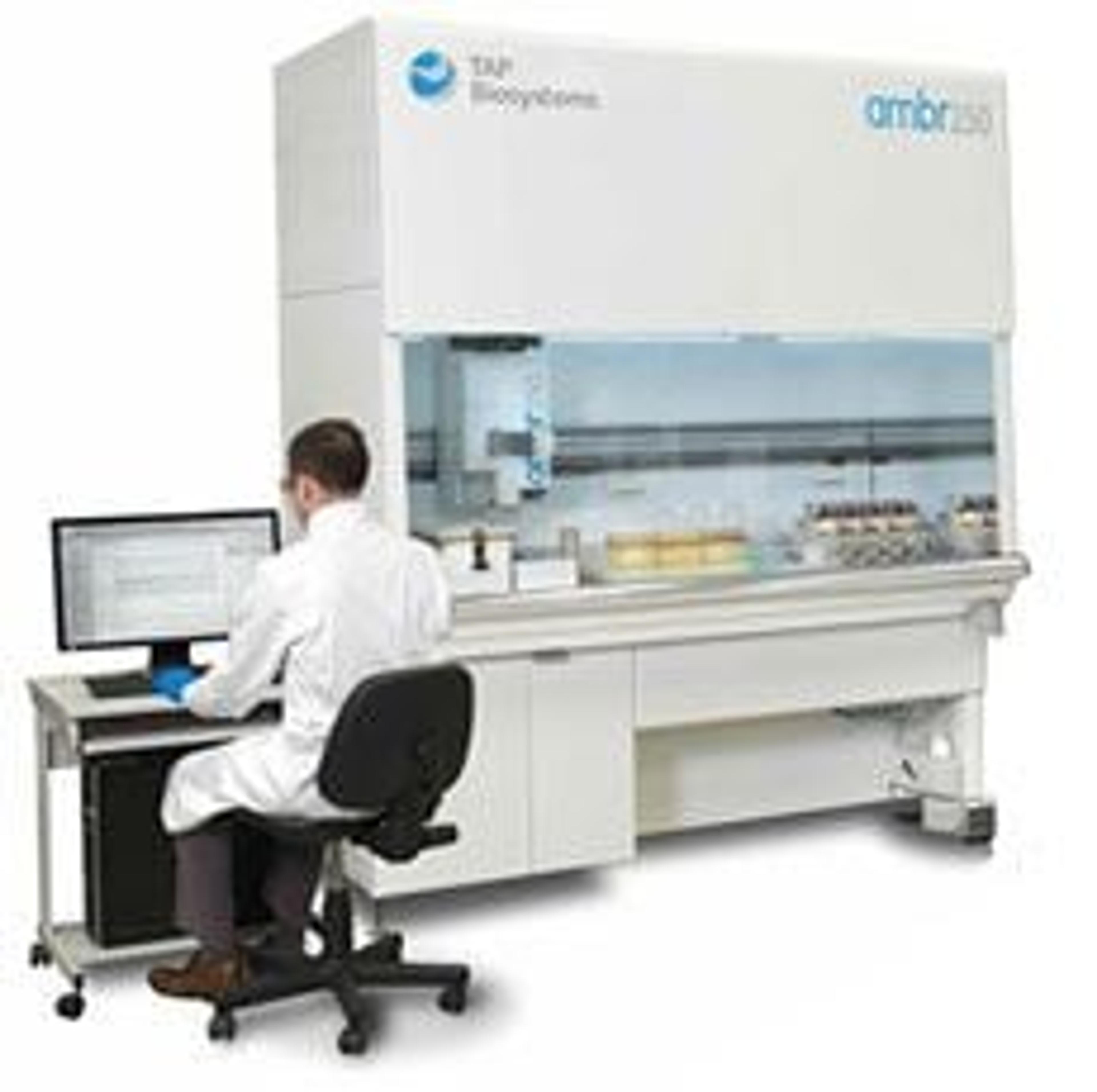
ambr 250 - Bioreactor System
TAP Biosystemsambr 250™ is a new bioreactor system for parallel fermentation using single-use bioreactors controlled by an automated workstation. The new system, developed with two major industrial partners, builds on TAP’s successful microbioreactor technology, adding increased fermentation volumes, as well as individual bioreactor temperature and impeller control. ambr 250 provides an efficient, high throughput scale-down model for process development.New, single use 100-250ml reactor vessels have been developed for use with the system – avoiding the need to clean reactors and sensors between runs. The design includes a novel “easy connect” process enabling all gas, liquid and sensor connections to be made, quickly and simply, for fast turnaround between experiments.ambr 250 - Bioreactor System Benefits: Fully automated system - media fill, inoculation, sampling and feeding Individual control for each bioreactor vessel - temperature, impeller speed, pH and DO Integrated control of multiple bioreactors (12 or 24) A better tool for process development of microbes Rapid evaluation of a wide range of conditions and cell line/strain performance Excellent scalability to large-scale, bench top bioreactors Process development for biopharma and industrial biotech Process robustness experimentation in support of QbD studies Automation of DOE approaches to process automation