‘To truly understand science, is to collaborate with others’

Samer Sansil shares his inspiration to pursue cancer research and highlights why working together and learning from others is key to advancement

19 Feb 2023

Diane Li
Assistant Editor

Editorial article

Reviewer in the Spotlight Banner
Samer
Samer Sansil oversees pharmacokinetic services in the Cancer Pharmacokinetics & Pharmacodynamics Core at Moffitt Cancer Center

Lab product reviews can change the world by helping other scientists find the best equipment to accelerate their vital work. Here at SelectScience®, we are dedicated to promoting peer-to-peer communication that will make the difference - but we couldn't do it without our esteemed reviewers. In this regular new feature, we put the spotlight on some of our most dedicated and impactful reviewers and find out what inspires them to keep sharing their knowledge with the global scientific community.

In this week’s Reviewer in the Spotlight, Samer Sansil, core staff scientist at Moffitt Cancer Center, tells us about his motivations, the huge importance of collaboration in science, and why he thinks unbiased lab equipment reviews on SelectScience play a vital role in scientific progress.

Tell us about your role and your current research

I am a core staff scientist at Moffitt Cancer Center, Tampa, Florida, a top cancer hospital in the nation ranked by the US News and World Report. I oversee pharmacokinetic services in the Cancer Pharmacokinetics & Pharmacodynamics Core, part of the shared resources here at Moffitt. I work on drug quantitation of novel and standard chemotherapy agents in pre-clinical and early phase human clinical trials.

What inspired you to get into the world of science?

My father is my biggest inspiration. Growing up, education (and the knowledge acquired by it) was instilled in our home. This coupled with my father’s leadership and drive to help others in need has guided me on this path. Not just to learn how avenues of science can help impact the world, but to utilize that knowledge and create meaningful impact to help uncover mechanisms to combat a terrible disease, such as cancer.

Why is communication vital in science?

To truly understand science, is to collaborate with others. To learn from other scientists' and researchers’ successes and failures and help improve upon current technologies to further expand the limitations of our time. The greatest example is happening now, with the COVID-19 pandemic. When the whole world can join forces and put their knowledge and resources together, we can produce a vaccine for a virus in a historic time.

Samer Sansil Lab
Samer Sansil works with HPLC technology

Why do you think lab equipment reviews are important?

Lab equipment reviews give a real, unbiased representation of equipment, techniques and technologies that fellow researchers can utilize to impact their own laboratory needs. Being able to read a review and make an informed decision about a product is vital in the purchasing world. Researchers need a place to gather feedback on different equipment before making a costly purchase that can negatively affect their funding.

What is your favorite piece of lab equipment?

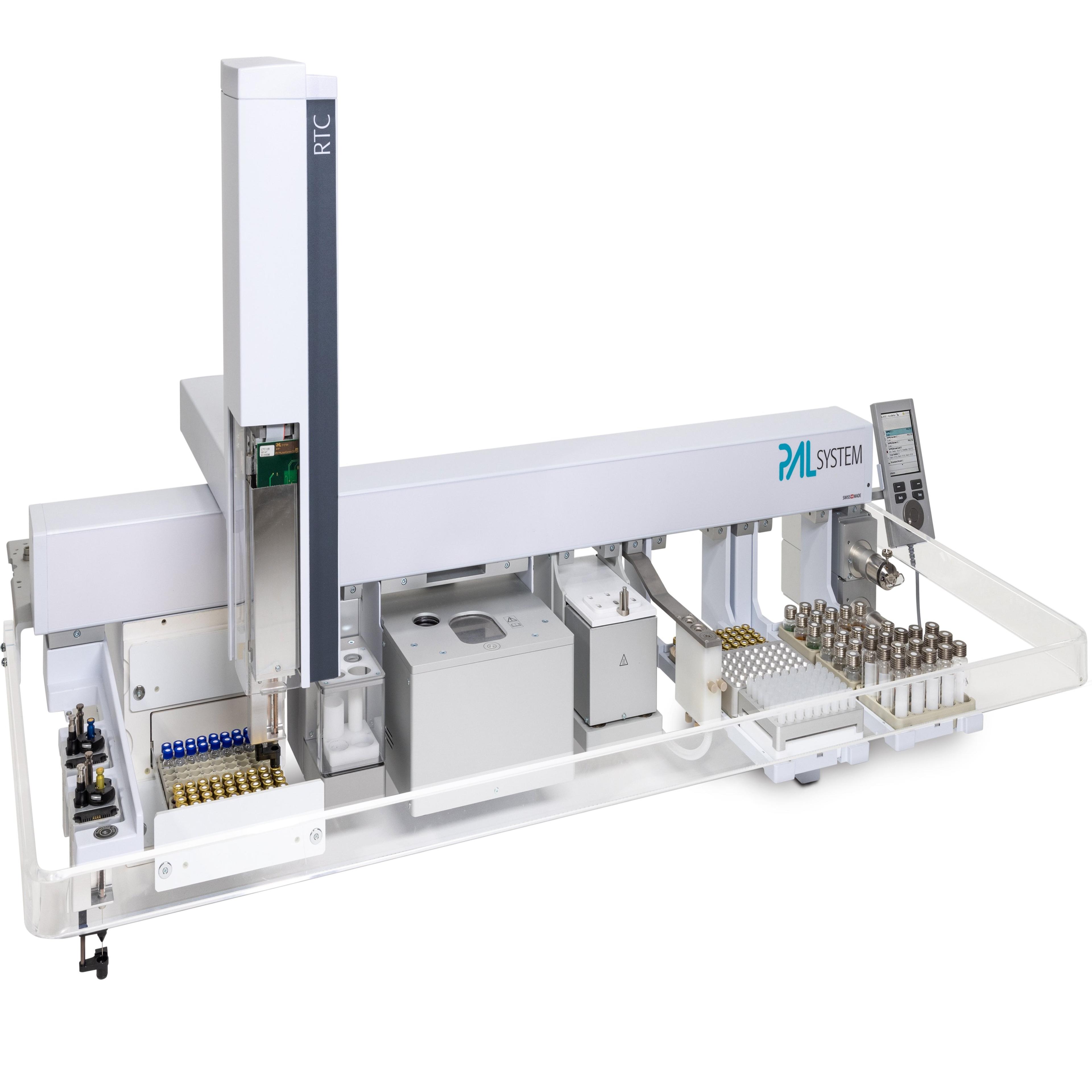
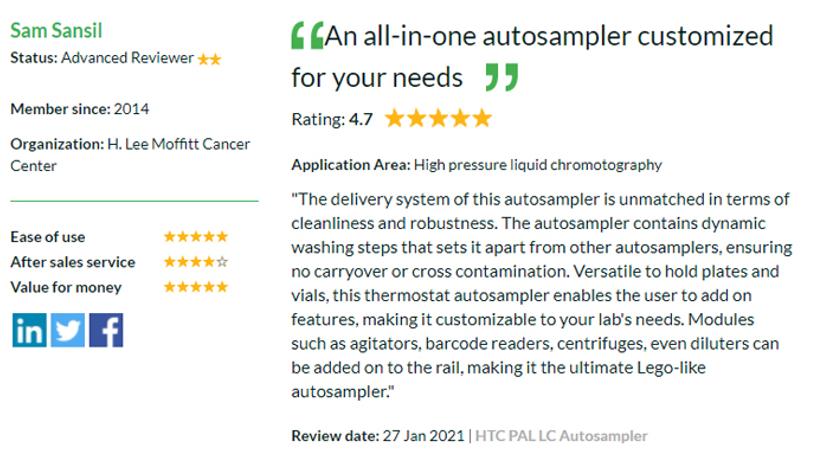
In my HPLC world surrounded by mass spectrometers and diode array detectors, my favorite technology is the CTC PAL open autosampler. The ingenuity of this autosampler coupled with the dynamic washing setup makes this an ideal tool to deliver my samples from my vials or well plate and inject them into the HPLC with little concern over carryover or contamination.
Samer Sansil review

How do SelectScience reviews help you with your research?

SelectScience is an excellent tool to help me gather reviews from the application and bench scientists who can offer constructive criticism or helpful insight on sample preparation, chromatography columns, and brand name mass detectors.

What would you like to achieve in your work?

Any way I can contribute to help aid in the prevention and cure of cancer. In current projects, I am hoping to continue to provide investigators, clinicians, and basic scientists the measurements and analysis they need to help the team combat this disease.

Samer shares his top 5 lab instruments

1. Thermo Scientific™ TSQ Quantiva Triple Quadrupole Mass Spectrometer

"Robust, rapid, and reproducible."

2. Sirocco Protein Precipitation Plate by Waters

"My go-to plate for PPT."

3. Waters Positive Pressure-96 Processor by Waters Corporation

"This product is reliable and highly encouraged for your sample preparation needs."

4. HTC PAL LC Autosampler by CTC Analytics AG

"An all-in-one autosampler customized for your needs."

5. LabDoctor 12 Mini Centrifuge by MIDSCI

"Small footprint with great value."

Would you like to feature in our Reviewer Spotlight? Write your review here to be in with a chance >>

Links

Tags

AutosamplersAutosamplers are automated sample loaders used with a number of separation and analytical techniques. HPLC autosamplers use automated partial or full-loop injection systems and place samples in vials or microplates for analysis. Autosamplers can also be used for elemental analysis. Features to consider include repeatability, syringe capacity, footprint and temperature controls.  UHPLC and HPLCHigh performance liquid chromatography (HPLC) and ultra high performance liquid chromatography (UHPLC), also known as UPLC, are analytical techniques used to separate, identify and quantitate components of complex mixtures including biological samples such as proteins and lipids as well as chemical mixtures of pesticides, drugs and oils. Both techniques are liquid chromatographic methods but differ by operating pressures (HPLC < 6000 psi < UHPLC ). Components of HPLC and UHPLC systems include columns, detectors, pumps, autosamplers and column heaters. Explore a range of UHPLC and HPLC columns for your specific sample needs including reverse phase, normal phase, ion exchange, HILIC, ion exclusion and size exclusion columns. For more specialized HPLC, explore FPLC, countercurrent LC and simulated moving bed systems. Find the best UHPLC and HPLC equipment in our peer reviewed product directory: compare products, check customer reviews and receive pricing direct from manufacturers.Mass SpectrometryMass spectrometry (MS) is a powerful analytical technique used to identify and quantify molecules based on the mass-to-charge ratio of gas-phase ions. It provides detailed information about the structure, composition, and properties of compounds and is widely used across fields such as environmental monitoring, materials science, drug discovery and development, food and beverage testing, and wider chemical research. Key MS techniques include tandem mass spectrometry (MS/MS), liquid chromatography–mass spectrometry (LS-MS) and inductively coupled plasma (ICP-MS). Choosing from these wide range of techniques and technologies can be a daunting task, so keep up to date with scientific applications, performance expectations, and customer reviews here all in one place. Visit our product directory to receive quotes direct from the manufacturer. AntibodiesAntibodies are used in techniques such as confocal and fluorescence microscopy, flow cytometry, ELISA, ELISPOT, immunohistochemistry, western blotting and immunopreciptation. Select specific antigen reactivity, high specific affinity, low non-specific binding, monoclonal or polyclonal, primary or secondary antibodies and associated conjugates such as an enzyme or dye for visualization.ImmunologyImmunological techniques measure and characterize immune responses. Immunology kits and analysis systems often use techniques such as ELISA, radioimmunoassay (RIA) and immunodiffusion assays, Immunohistochemistry, and flow cytometry. Immunologists use equipment such as flow Cytometers, plate readers, plate washers and fluorescent microscopes.Cellular PathologyCellular Pathology deals with the microscopic analysis of tissue samples and cells. Sample preparation and processing includes fixation, staining, sectioning and slide mounting, using equipment such microtomes and cryostats. In choosing immunohistochemistry and immunocytochemistry kits, consider chromogens, staining method, antibodies, microscopes and imaging.Point-of-CarePoint-of-Care Testing (POCT) or Near Patient Testing (NPT) products are available for urine, blood and other clinical chemistry analyses. POCT includes: blood glucose testing, blood gas and electrolytes analysis, rapid coagulation testing (PT / INR), rapid cardiac markers diagnostics, drugs of abuse screening, urine strips testing, pregnancy testing, fecal occult blood analysis, food pathogens screening, hemoglobin diagnostics, infectious disease testing and cholesterol screening.Biopharmaceutical AdvancesBiopharmaceutical advances follow the development of pharmaceuticals derived from biotechnology, also known as biotechnology medicines. Biopharmaceuticals may be produced from cell lines, plants, or microbial cells. Important considerations of biopharmaceutical use include application, cost, production process and purification.Clinical ChemistryBiochemistry (or clinical chemistry) involves the analysis of bodily fluids using chemical tests. Techniques used include HPLC, chromatography, spectroscopy, mass spectrometry, immunochemical, electrophoresis, turbidometric / spectrophotometric assay, MRI and ISE analysis. Tests are often carried out on plasma or serum but urine (urinalysis) and fecal specimens are also processed.Clinical GeneticsMolecular Genetics covers the analysis of hereditary genetic disease and chromosomal abnormalities. Genetics can be analysed using DNA, RNA, and protein microarrays, PCR, RT PCR and DNA sequencing. Genetic equipment includes genetic workstations, thermal cyclers, cooling blocks and electrophoresis products. Diagnostic kits are used for DNA / RNA extraction and purification.Cancer DiagnosticsThere are a wide variety of diagnostic tests for cancer available, and this range continues to expand as our knowledge of cancer improves. Current diagnostic methods include biopsy, imaging and blood tests for known biomarkers. New methods in research development include liquid biopsies and cancer breathalyzers.Active PharmaceuticalsThe Active Pharmaceutical Ingredient (API) of a drug is the component that causes the direct effect of the product. The remaining inactive components are known as excipients.HPLC Method DevelopmentIt is important to develop and validate HPLC methods in order to identify, quantify or purify compounds of interest in the most efficient way. Effective method development ensures optimization, quality control and cost effectiveness.PharmacokineticsPharmaceuticalsPharmaceuticals are medicinal drugs used in healthcare to diagnose, prevent, cure and treat illnesses. Pharmaceuticals that are excreted after use appear in wastewater and can have detrimental effects on the environment.