
Tips for Selecting a Centrifuge That Best Meets Your Needs
by John Collings, Global Product Manager, General Purpose Centrifuges at Thermo Fisher Scientific
6 Oct 2015
Editorial article
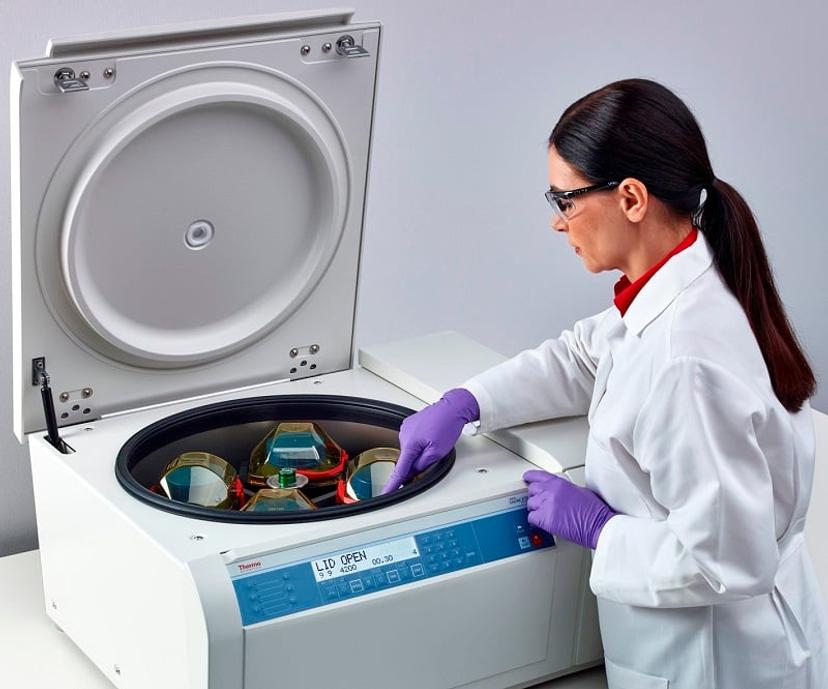
Tips for selecting a centrifuge that best meets your needs
Separations are a critical step in most workflows, making the centrifuge a vital piece of equipment in virtually all laboratories. Multi-purpose centrifuges are one of the most popular types of centrifuge and can support a wide range of processing needs, offering versatility in a compact footprint. As centrifuges are a long-term investment, it is important that your requirements are well defined to ensure you choose the centrifuge that best accommodates your laboratory’s current and future needs.
The following are key basic questions that should be considered to help identify the centrifuge best suited to your requirements:
- What types of samples are you spinning?
- What are the maximum relative centrifugal forces (RCFs) (xg) required for each type of sample, and what type of rotor is needed (swinging or fixed angle rotors)?
- What is the maximum, typical and minimum throughput required per run?
- Is refrigeration needed to reduce sample degradation or to improve reproducibility?
- Will biocontainment be required?
- What space is available in the lab?
Once you have answered these questions around system requirements, consider your application needs further. When going through the selection process, you should not only consider your current needs, but try to envision future requirements or make a selection that is adaptable. Also, it’s important to consider if your current application could run quicker with a higher RCF to help save time.
Depending on the applications undertaken within the laboratory, here are some specific considerations and helpful features.
Multi-Application Laboratories
These multi-user environments have a wide variety of applications being completed. As such, you want to ensure you choose a centrifuge that offers the greatest flexibility. While you may not require it immediately, research needs can pivot quickly and it is important that your centrifuge is able to meet future requirements.
For example, a benchtop centrifuge should not just be considered for swing-out rotor purposes, as there are a greater variety of fixed angle rotors available. Great improvements over the last few decades in centrifuge rotor design and materials now means many more applications can be completed on benchtop centrifuges than ever before. The Thermo ScientificTM FiberliteTM F14-6x250 LE carbon fiber rotor is one example of advanced rotors that have expanded fixed benchtop centrifuge capacities and speed to 6 x 250 mL at up to 18,533 x g.
When selecting a centrifuge for a multi-application lab, we recommend looking for compatibility with a wide variety of rotor types and tube adapters, high speeds to increase application flexibility and ease-of-use features.
Tip 1: Choose centrifuges with a tool-less rotor exchange system for quick and safe exchange of rotors when changing applications. Thermo ScientificTM Auto-LockTM rotor exchange, for example, offers secure push-button rotor exchange in as little as three seconds.
Tip 2: Consider floor-standing versions of multi-purpose centrifuges, which can save space and be moved quickly and easily around labs to help maintain workflow optimization and lab flexibility.
Tip 3. Look for powerful performance, high-speed rotors that can help reduce spin times considerably and can increase the number of applications that can be completed.
Tip 4: Consider the rotor’s warranty and lifetime to help reduce future rotor replacement costs. Aluminium rotors typically have a one to five year warranty and a seven-year maximum life, where as carbon fiber rotors, such as Thermo ScientificTM FiberliteTM rotors, can have up to a 15-year warranty with no specified retirement age.
Clinical Laboratories
Clinical laboratories utilize centrifuges for pre-analytical processing of human samples—usually blood, urine or sputum. Daily and peak hour throughput requirements will usually define the number and size of centrifuge(s) required, and as such, you want to ensure that future predicted throughput rates are considered. Rotor capacities typically vary from 32 to 196 blood tubes per rotor. Often a mix of centrifuge sizes is optimal for the varying demand throughout a 24-hour period. According to the April 2015, “The Market for Clinical Chemistry,” market intelligence report from Kalorama Information, clinical laboratories’ throughput requirements have grown greatly over the last few years. Therefore, centrifuge durability and ergonomics are increasingly important features to consider in the decision-making process.
Tip 1: Choose refrigerated centrifuges as they are designed to maintain a constant sample temperature and avoid heating samples during high use, which could lead to sample degradation. They also reduce noise level by up to six decibels helping to improve the working environment.
Tip 2: Choose models with fast acceleration and deceleration times to facilitate quick results for emergency samples. Acceleration/deceleration times can vary by more than one minute between differing manufacturers.
Tip 3: Select certified biocontainment lids to reduce the risk of laboratory acquired infections in the case of bottle failures or tube leakage. Look for lids with a simple design, such as Thermo ScientificTM ClickSealTM biocontainment lids, which do not require highly repetitive screw actions that could lead to repetitive strain injuries.
Tip 4: Consider floor-standing multi-purpose centrifuges, which offer improved ergonomics for the technician’s comfort (<90cm) and a reduced footprint helping to save valuable space.
Cell Culture Laboratories
Pure cell culture laboratories require centrifuges exclusively for pelleting cells. Cultured mammalian cells are extremely delicate and need to be kept viable, which is why they are often spun at very low speeds in conical tubes or microplates with their media. Consistency and reproducibility of speed, time, temperature and deceleration rates are key to eliminating variation in processing, and to ensure that consistent results are obtained every time. A centrifuge with minimal vibration and highly controllable deceleration rates is therefore required.
Tip 1: Choose a refrigerated centrifuge such as the ones found in the portfolio of Thermo ScientificTM general purpose centrifuges, as they help ensure reproducibility. More importantly, they minimize air movements around the centrifuge to reduce particles (and possible contamination) in the air of the culture suite.
Tip 2: Select a swinging bucket rotor and buckets that are able to accept both conical tubes and microplates for maximum flexibility, such as the Thermo ScientificTM TX-1000 rotor, as it eliminates the need to change buckets while helping to reduce overall cost. Larger, heavier rotors and buckets are less susceptible to vibration through deceleration and may help with the integrity of the formed pellet.
Tip 3: Consider a floor-standing model with lockable castors to ensure the centrifuges can be moved easily for cleaning purposes to help reduce contamination risk. Some floor-standing models can be used close to biological safety cabinets for added convenience while helping to reduce the time cells are outside of the incubator.
Tip 4: Ensure that the interface between the bucket and the rotor cross moves freely by choosing a rotor with anti-friction finish, such as Thermo ScientificTM Slide CoatTM anti-friction finish, or regularly cleaning and greasing the area. This helps to prevent micro-imbalances and associated vibration during deceleration which can impact pellet quality.
Tip 5: Look for centrifuges with calculated sample temperatures. These help to ensure improved temperature management and reproducibility. Traditional temperature management systems can show a wide variation in displayed temperature and the temperature of the sample.
Molecular Biology
DNA, RNA, and protein research laboratories usually rely on a variety of commercially available purification kits. However, the requirements in a molecular biology lab can vary greatly depending on the volumes required and the throughput needed. High speed fixed angle processing is often required of microtubes and 15/50 mL conical tubes. Powerful refrigeration is needed to maintain sample temperature and minimize degradation.
Tip 1: Choose a centrifuge with a pre-cool function to ensure the centrifuge bowl and rotors are at the specified temperature before the run starts. Select a centrifuge that calculates sample temperature rather than the bowl air to maximize temperature accuracy and prevent variation between runs.
Tip 2: Ensure microliter rotors are compatible with DNA preparation kits. These rotors usually have extended necks to ensure the extra space required by the filter column can be accommodated. Otherwise, prep kits may not fit or you will have a much-reduced capacity. The Thermo ScientificTM MicroClick 30 x 2 rotor is an example of a rotor with an extended neck.
Tip 3: Choose a centrifuge with an at-speed timing function, as some kit manufacturers require a run time based on time at the recommended RCF, rather than a total run time. This helps eliminate variations based on acceleration time between rotors and centrifuges.
Scientific processes in the lab continue to evolve and centrifuge and rotor technology has advanced greatly in the last 10 to 15 years, significantly widening the application scope available on these products. Therefore, careful consideration must be made during the selection process. To help inform your decision-making, you can access the Thermo Scientific Benchtop Centrifuge Guide, with interactive tour and product selector.
What products do you use in your research? Share your expertise with our community of scientists and write a review today!