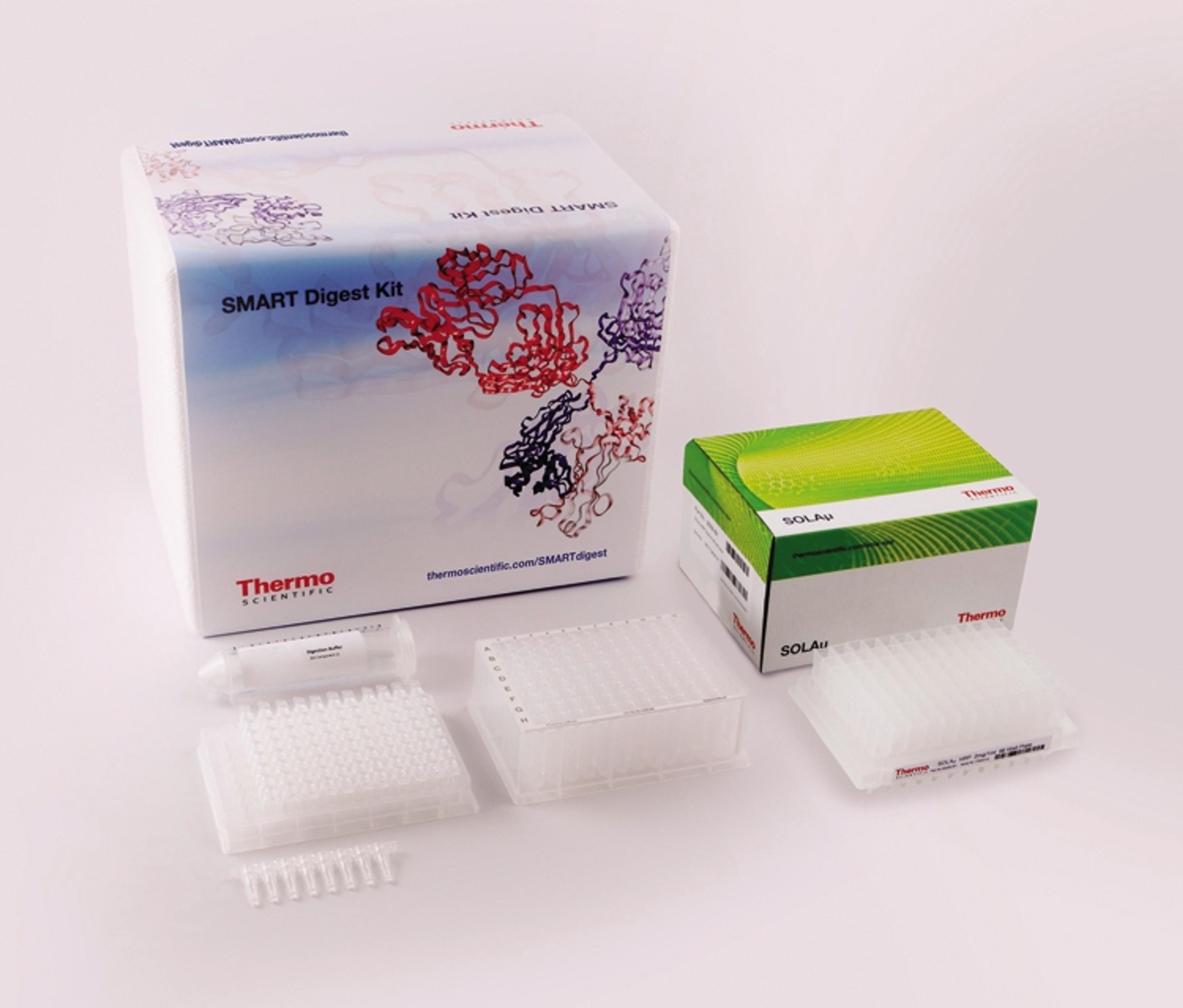
Thermo Scientific SMART Digest kit at HPLC 2015

Immobilized trypsin design optimizes compatibility with high-throughput applications

22 Jun 2015

Lois Manton-O'Byrne, PhD
Executive Editor

Product news

A new tool for protein digestion is designed to substantially reduce preparation times and associated errors, facilitating fast and reliable analytical results for biopharmaceutical and protein research applications.

Current protein digestion techniques are comprised of complex procedures that require the determination of protein concentration, followed by sample reduction and alkylation steps prior to digestion with trypsin. This multifaceted preparation protocol can take up to 24 hours and is prone to both irreproducibility and poor sensitivity.

To improve upon this process, the Thermo Scientific SMART Digest kit uses a simple three-step, easy-to-implement process that can be automated. Its immobilized trypsin design is formulated for high-quality data with a significantly reduced sample preparation time compared to traditional in-solution digestion methods

The SMART Digest kit will be exhibited at the 42nd International HPLC Conference in Geneva, Switzerland, Booth 14, June 21-25.

“Sample preparation that requires protein digestion can be a laborious and time-consuming task, particularly when performing high-throughput applications,” said Kevin Doolan, product line director, Chromatography Columns and Consumables, for Thermo Fisher Scientific. “Our new SMART Digest kit is designed to simplify this process, providing higher reproducible, sensitive analyses of protein digests in a fraction of the time, which is especially valuable for both biopharma and research labs.”

The increased reproducibility of digestion possible with this kit should enable users to implement generic, fast and robust methods for high throughput processing of samples. Furthermore, the SMART Digest kit is designed to provide higher sequence coverage, while reducing both chemically induced post-translational modifications and the number of chemicals in the final sample. This design makes the SMART Digest kit accurate and sensitive, capable of generating high-quality data at high throughputs.

Thermo Scientific™ SMART Digest™ Kits

Thermo Fisher Scientific

Obtain high quality analytical results from protein digests by using Thermo Scientific™ SMART Digest™ Kits. A significant advance in sample preparation for biopharmaceutical and protein research, the kits provide fast and simple protein digestion with high reproducibility, high sensitivity, and high levels of data quality in a format that's compatible with automation. The SMART Digest Kits are a significant improvement over current in-solution protein digestion technologies, which are not reproducible, have poor sensitivity, and employ protracted methodologies not amenable to automation.   Features: Easy and simple Significantly increased speed of sample processing. 3-step sample preparation. Easily automate entire protocol for high-throughput processing. Reliable results Increased reproducibility over existing protocols. Higher sensitivity. Higher data confidence.

(2)

Links

Tags

High-Throughput ScreeningHigh-throughput screening (HTS) is an automated drug discovery technique for identification of active compounds against a compound library. Use HTS readers and integrated assay preparation / analysis workstations to screen your compounds. Identify active compounds against various HTS libraries, including membranes, proteins and peptides and HTS cell lines. Find the best high-throughput screening products in our peer-reviewed product directory: compare products, check customer reviews and receive pricing direct from manufacturers.Labware and Lab SuppliesLabware and lab supplies include various forms of glassware, plasticware, reagents and personal protective equipment (PPE) and are used across all scientific laboratories, enabling daily tasks to be performed. Explore a range of flasks and beakers, petri dishes, carboys and storage bottles. Labware such as condensers, desiccators and burettes are also available for more specific tasks. Find the best labware and lab supplies in our peer-reviewed product directory: compare products, check customer reviews and receive pricing direct from manufacturers.High-Content ScreeningHigh-content screening (HCS), also known as high-content analysis (HCA), is a high-throughput technique used in drug discovery to identify substances that alter the phenotype of cells. HCS uses fluorescent microscopic imaging and automated image analysis to investigate cellular events such as apoptosis, cell viability, GPCR activation, oxide production, neurite outgrowth, and cell signaling. Find the best fluorescent labeling reagents, cellular assays, and high-content imaging systems in our peer-reviewed product directory: compare products, check customer reviews and receive pricing direct from manufacturers.Protein PurificationProtein purification is a vital step in drug discovery, therapeutics, biotech and life science research. The purification process typically involves subcellular or membrane protein extraction with cell lysis kits, separation of proteins from cell debris by filtration or spin columns, and the isolation of proteins of interest from other proteins and impurities with affinity purification (including fusion protein tags and antibody binding proteins A, G and L), immunoprecipitation or chromatographic methods, such as ion exchange, size exclusion and immobilized metal affinity chromatography. All purification methods come in multiple formats for your laboratory needs, including agarose or magnetic beads, resins, columns and filter plates. Find the best protein purification equipment in our peer-reviewed product directory: compare products, check customer reviews and receive pricing direct from manufacturers.Sample PreparationSample preparation can improve the quality and speed of separation techniques. Products to assist sample preparation include filtration equipment, evaporators, membranes and sieves.Protein BiologyThe analysis of protein expression, identity and function is vital for many areas of life science research and drug discovery. Some of the most commonly used techniques in protein analysis include Western blotting, electrophoresis and mass spectrometry.High ThroughputHigh throughput experiments allow the simultaneous processing of several samples. This parallelization reduces the cost per experiment and increases reproducibility and output volume of data.Protein Quantification
Thermo Scientific SMART Digest kit at HPLC 2015