Thermo Fisher Scientific™ Launches New SMART Digest™ Kit at ASMS

28 May 2015
Lauren Edwards
Editorial

Product news

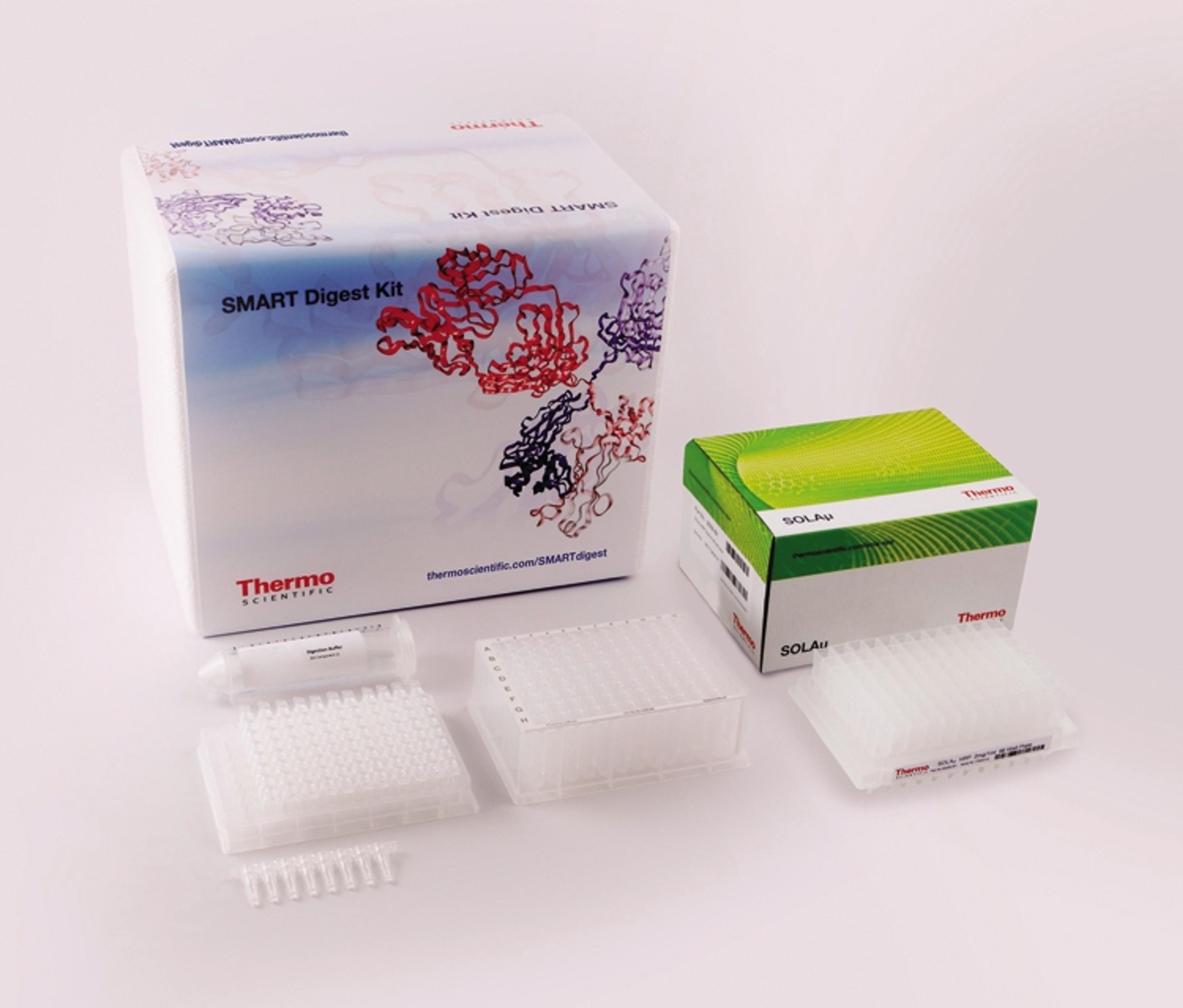
The Thermo Scientific™ SMART Digest™ kit will be showcased at ASMS booth 140. The kit uses a simplified 3-step, easy to implement process that can be automated. Its immobilized trypsin design ensures high quality data with a significantly reduced sample preparation time compared to traditional in-solution digestion methods.

Current protein digestion techniques are comprised of complex procedures that require determination of protein concentration, followed by sample reduction and alkylation steps prior to digestion with trypsin. This multifaceted preparation protocol can take up to 24 hours and is prone to both irreproducibility and poor sensitivity.

The increased reproducibility of digestion achieved with the SMART Digest kit makes it possible to implement generic, fast, robust methods, enabling high throughput processing of samples. Furthermore, it provides higher sequence coverage, while reducing both chemically induced post-translational modifications and the number of chemicals in the final sample. The design makes the SMART Digest kit accurate and sensitive, capable of generating high quality data at high throughputs.

Each kit contains everything required to perform digestion and collection of samples. For additional clean-up further kit options are available, which include a Thermo Scientific™ SOLAµ™ HRP SPE plate or a filter plate.

Thermo Scientific™ SMART Digest™ Kits

Thermo Fisher Scientific

Obtain high quality analytical results from protein digests by using Thermo Scientific™ SMART Digest™ Kits. A significant advance in sample preparation for biopharmaceutical and protein research, the kits provide fast and simple protein digestion with high reproducibility, high sensitivity, and high levels of data quality in a format that's compatible with automation. The SMART Digest Kits are a significant improvement over current in-solution protein digestion technologies, which are not reproducible, have poor sensitivity, and employ protracted methodologies not amenable to automation.   Features: Easy and simple Significantly increased speed of sample processing. 3-step sample preparation. Easily automate entire protocol for high-throughput processing. Reliable results Increased reproducibility over existing protocols. Higher sensitivity. Higher data confidence.

(2)

Links

Tags

LC-MSLC-MS (liquid chromatography-mass spectrometry) systems and equipment are used for separation and quantitative analysis of complex mixtures, combining liquid chromatography and mass spectrometry. Quantify proteins, contaminants, pesticides or screen for drug metabolites with a high level of sensitivity. LC-MS systems and equipment include reverse phase, normal phase and specialized columns integrated with various MS detectors such as time-of-flight (TOF), quadrupole, orbitrap or ion trap mass analyzers. LC-MS/MS instruments equipped with a qTOF or triple quadrupole analyzer give greater sensitivity and resolving power to your analysis. Find the best LC-MS equipment in our peer-reviewed product directory: compare products, check customer reviews and receive pricing direct from manufacturers.Mass SpectrometryMass spectrometry (MS) is a powerful analytical technique used to identify and quantify molecules based on the mass-to-charge ratio of gas-phase ions. It provides detailed information about the structure, composition, and properties of compounds and is widely used across fields such as environmental monitoring, materials science, drug discovery and development, food and beverage testing, and wider chemical research. Key MS techniques include tandem mass spectrometry (MS/MS), liquid chromatography–mass spectrometry (LS-MS) and inductively coupled plasma (ICP-MS). Choosing from these wide range of techniques and technologies can be a daunting task, so keep up to date with scientific applications, performance expectations, and customer reviews here all in one place. Visit our product directory to receive quotes direct from the manufacturer. GC-MS GC-MS (gas chromatography-mass spectrometry) instruments and equipment are used to separate, quantify and identify mixtures of small and volatile compounds, such as polycyclic aromatics, fatty acids and alcohols. Often used in drug detection, forensic investigation and environmental analysis for pesticides and contaminants, GC-MS is a powerful addition to your lab’s analytical capabilities. GC-MS/MS instruments equipped with a qTOF or triple quadrupole analyzers can give greater sensitivity and resolution to your analysis. Find the best GC-MS instruments and equipment in our peer-reviewed product directory: compare products, check customer reviews and receive pricing direct from manufacturers.MetabolomicsMetabolomics is the study of small metabolites (the intermediates and products of metabolism). It involves the identification and quantification of cellular metabolites using analytical technologies such as GC, HPLC, NMR, and LC/MS.BiopharmaceuticalsBiopharmaceuticals are proteins and other compounds (such as nucleic acids) produced by living organisms that have uses as therapeutics or for in vivo diagnostics. The most well known example of a biopharmaceutical product, and the first to be approved for therapeutic use, was recombinant human insulin.ASMSThe American Society for Mass Spectrometry (ASMS) is an organization dedicated to advancing the science and application of mass spectrometry. ASMS supports professionals through events, publications, and research initiatives, promoting innovation in areas like proteomics, metabolomics, and environmental analysis.