
Thermo Fisher Scientific Raises the Bar in Mass Spectrometry at ASMS 2017
4 Jun 2017
Product news
Thermo Fisher Scientific Inc., a world leader in serving science, strengthened its leadership in mass spectrometry by launching new technologies to advance cutting-edge research and improve results in applied markets during the 65th Annual American Society for Mass Spectrometry (ASMS) Conference. Visitors can learn about the company’s latest technologies in Booth 601 at the Indiana Convention Center from June 4-8 or the White River Ballroom F-J at the JW Marriott, Indianapolis.
“Thermo Fisher has been the undisputed leader in mass spectrometry for more than 50 years, and this year is no exception,” said Dan Shine, senior vice president and president, analytical instruments. “During ASMS, customers will learn how our new innovations in mass spectrometry are advancing biological research, translational medicine, and food and environmental analysis.”
Accelerating Proteomics Research
The new Thermo Scientific Q Exactive HF-X Quadrupole Orbitrap mass spectrometer is designed for exceptional sensitivity and reproducibility in the analysis of complex biological samples. Exceptional specificity supports increasing customer focus on protein identification, biomarker verification and quantitative proteomics workflows as well as biotherapeutic characterization.
“In order to make more meaningful progress in proteomics, we need tools that identify and quantify proteins, peptides, lipids, glycans and small molecules accurately and in less time,” said Dr. Jesper V. Olsen, professor and vice director of the Novo Nordisk Foundation and Center for Protein Research at the University of Copenhagen. “Using the Q Exactive HF-X Hybrid spectrometer, we have managed to identify 1,100 unique peptides per minute, which is a new world record.”
The Q Exactive HF-X Quadrupole Orbitrap mass spectrometer is available with new consumables and software that enable researchers to customize workflows and identify thousands of proteins of interest in a single run.
Breaking New Ground in Tribrid Mass Spectrometry
New options for the award-winning Thermo Scientific Orbitrap Fusion Lumos mass spectrometer can expand instrument power, performance and versatility. Used primarily in the structural characterization of large and small molecules, the system includes a new, integrated Ultraviolet Photodissociation (UVPD) feature that is standard on new systems and available as an upgrade to existing Fusion Lumos instruments.
This unique fragmentation mode is designed to improve productivity and provide researchers with accurate structural information.
Other options include Advanced Peak Determination (APD) and 1M resolution. Adding APD improves the performance of most proteomic workflows by providing high throughput while the 1M resolution Orbitrap option provides the ultra-high resolution necessary for obtaining unique structural and quantitative information.
Expanding Opportunities in Applied Markets
For applied markets, such as environmental and food safety, pharmaceutical and biopharmaceutical, and forensic toxicology, Thermo Fisher introduced two new triple-stage quadrupole (TSQ) mass spectrometers.
The new Thermo Scientific TSQ Altis Triple Stage Quadrupole (TSQ) mass spectrometer offers good sensitivity, selectivity and speed while providing the analytical flexibility, reproducibility and precision required for complex matrices.
“With the new TSQ Altis mass spectrometer, my lab can develop quantitative methods for biotherapeutic proteins and target receptors with extreme sensitivity, selectivity, accuracy and precision,” said Dr. Jun Qu, associate professor, department of pharmaceutical sciences, University at Buffalo in New York. “This is very exciting for our research since this capacity is very unique.”
The new Thermo Scientific TSQ Quantis Triple Stage Quadrupole (TSQ) mass spectrometer is a quantitative workhorse that is designed to support reliable workflows with the sensitivity and precision users require for quality results on every run. The TSQ Quantis Triple Stage Quadrupole (TSQ) mass spectrometer is designed to be simple to use and easy to maintain.
Custom Kits and New Software
Building on its leadership position in life science mass spectrometry, Thermo Fisher also announced an agreement with BIOCRATES Life Sciences AG, a leader in metabolic phenotyping, to offer the Biocrates AbsoluteIDQ p400 Kit. The kit enables researchers to reduce the complexity of metabolomics by enabling the rapid and reliable characterization of small molecules.
The new, ready-to-use Thermo Scientific InsuQuant Mass Spectrometric Kit is designed to simplify sample preparation during insulin bioanalysis. Users can achieve precise and sensitive separation on the Thermo Scientific Vanquish Flex Quaternary UHPLC system, and perform quantification of complex insulin analogues using the Q Exactive Hybrid Quadrupole-Orbitrap mass spectrometer.
In addition to previewing new versions of its industry-leading Thermo Scientific software, including ProteinCenter 4.0, TraceFinder 5.0 and Biopharma Finder 3.0, Thermo Fisher also introduced updated versions of its Proteome Discoverer 2.1 and Compound Discoverer 2.1 software.
To further address increasing customer needs for sharing data among the scientific community, Thermo Fisher offers a number of cloud-based applications. These include remote instrument monitoring, sample profiling and comparison of protein and gene lists.
For more information about Thermo Fisher and the American Society for Mass Spectrometry (ASMS) Conference, visit thermofisher.com/asms
Related products
Request Quote for All Products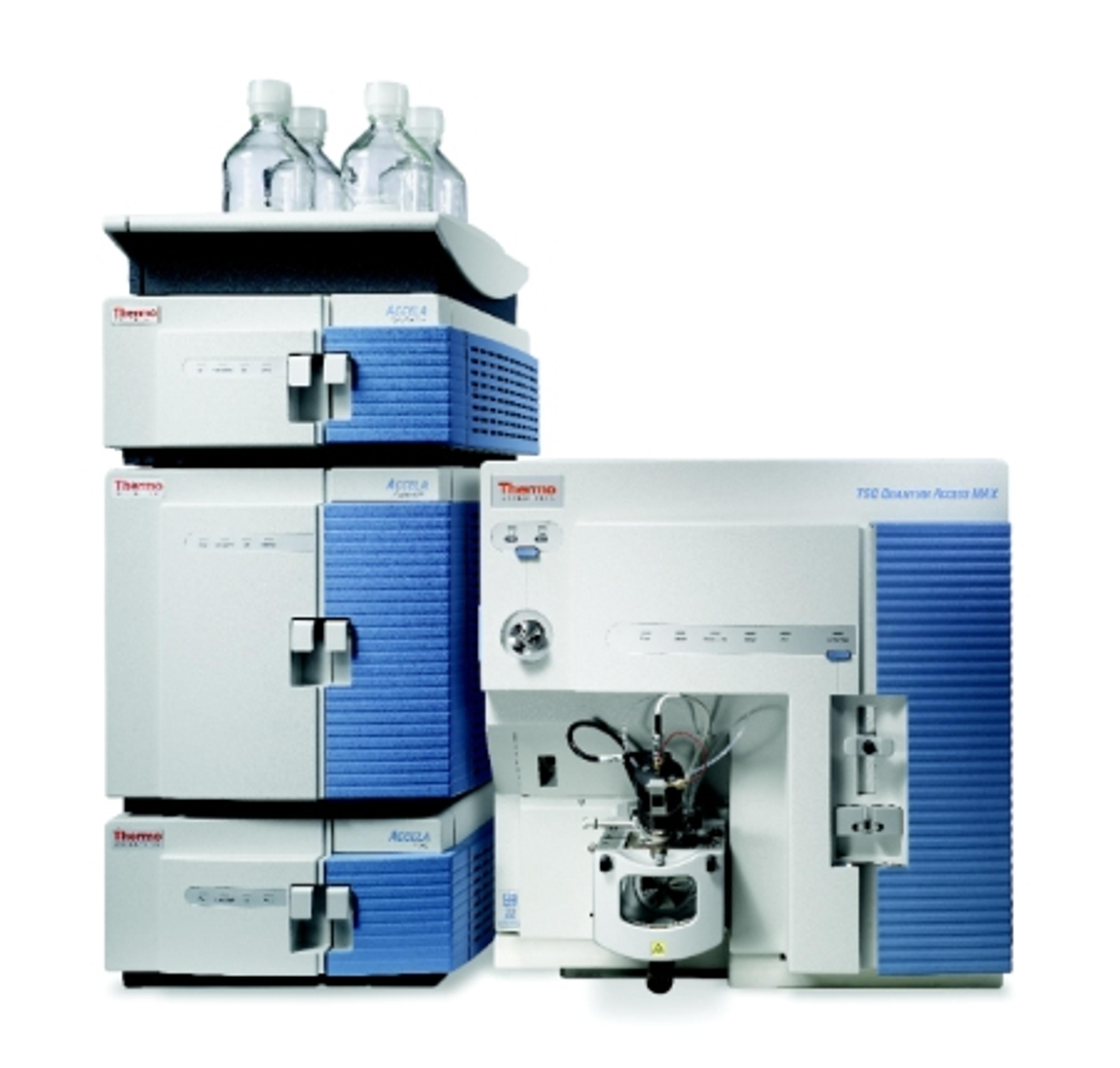
Thermo Scientific™ TSQ Quantum™ Access MAX Triple Quadrupole Mass Spectrometer
Thermo Fisher ScientificAchieve high quantitative sensitivity and specificity economically with the Thermo Scientific™ TSQ Quantum™ Access Max triple quadrupole mass spectrometer. Applications such as pharmaceutical development, environmental and food safety testing, clinical research, and forensic toxicology demand analytical sensitivity and specificity—even when budgets are constrained. The Thermo Scientific™ TSQ Quantum™ Access MAX Triple Quadrupole Mass Spectrometer is an outstanding LC-MS/MS value, providing excellent sensitivity, specificity, and flexibility that is also more affordable. Features: Thermo Scientific™ Ion Max™ API source with HESI-II probe reduces noise and increases sensitivity, enhancing quantitative performance. Up to 3,000 definable, timed SRMs and fast 25 ms positive/negative switching improve productivity. Quantitation-enhanced data-dependent MS/MS (QED-MS/MS) provides simultaneous compound confirmation and quantification. High-resolution selected reaction monitoring (H-SRM) with 2 ms dwell times enables quantification of hundreds of compounds in a single run. Mass range of 10–3000 m/z allows analysis of small molecules and intact proteins. Zero-cross-talk collision cell eliminates false positives. Optional FAIMS interface enhances specificity. Intuitive software with searchable compound libraries and database of methodologies for the analysis of pesticides, azo dyes and banned pharmaceuticals in water and food, make the system easy to use. Self-cleaning Ion Max API source heater with automatic source recognition simplifies use and increases reliability.
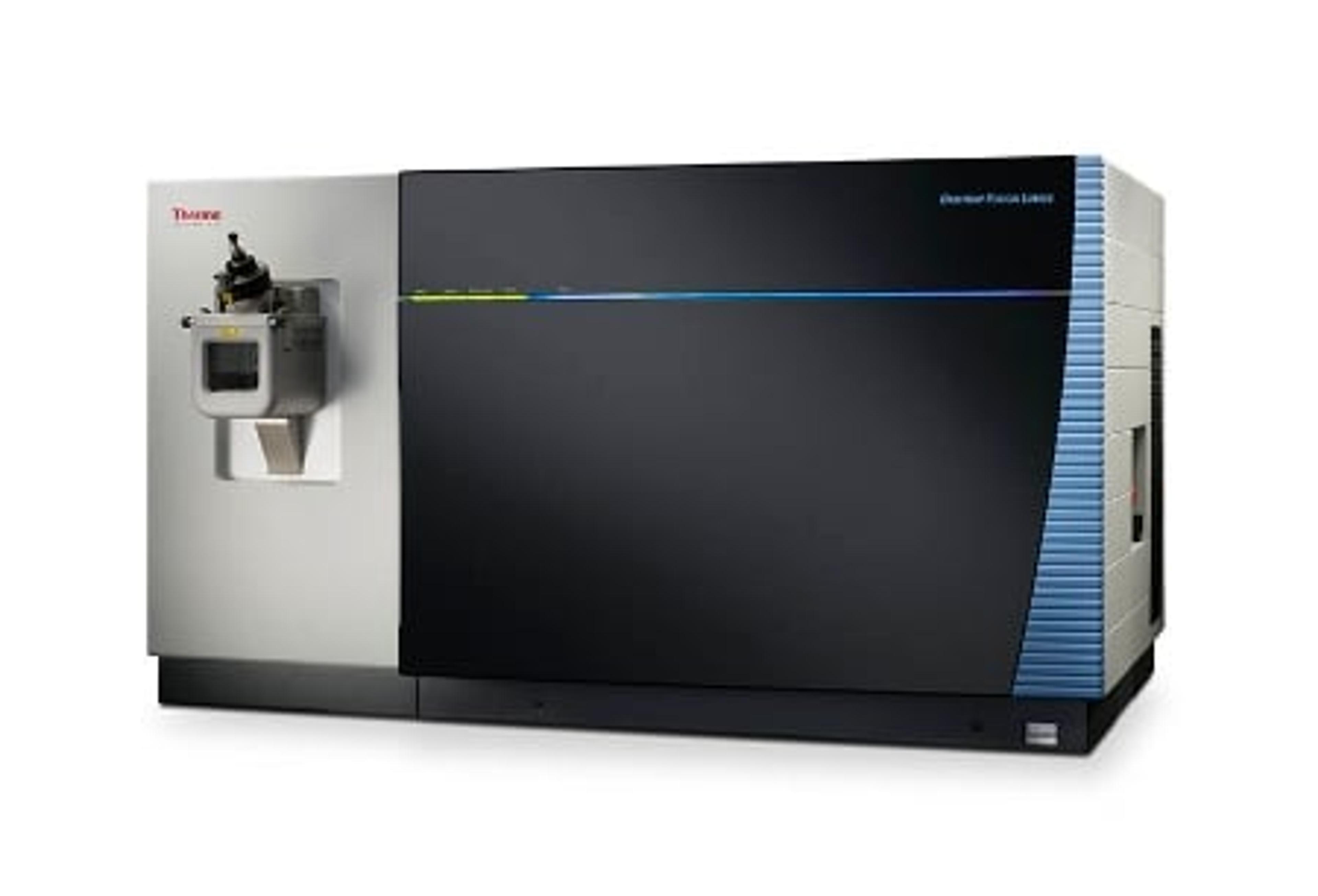
Thermo Scientific™ Orbitrap Fusion™ Lumos™ Tribrid™ Mass Spectrometer
Thermo Fisher ScientificTest new limits of detection, characterization and quantitation with the latest Tribrid™ mass spectrometer. The Thermo Scientific™ Orbitrap Fusion™ Lumos™ Tribrid™ Mass Spectrometer is designed to expand performance in advanced proteomics, biopharma and metabolomics applications, including quantitation using isobaric tags, low level PTM analysis, data independent acquisition (DIA), and top down proteomics. The new instrument features enhanced sensitivity resulting in improved analyte detection, characterization and quantitation, enabling scientists to perform more comprehensive sample analyses faster and with better accuracy than ever before. Novel Orbitrap Fusion Lumos MS Features: Novel high-sensitivity API interface combines a High Capacity Transfer Tube and an Electrodynamic Ion Funnel for increased ion flux and lower limits of detection Advanced Active Beam Guide prevents neutrals and high velocity clusters from entering the resolving quadrupole Advanced Quadrupole Technology combines high selectivity and efficiency of transfer for selected ions symmetrically across the isolation window Advanced Vacuum Technology improves transmission of high molecular weight ions to the Orbitrap analyzer Novel ETD HD—high dynamic range ETD provides significantly increased fragment ion coverage Established Tribrid MS Features: Tribrid architecture — includes quadrupole mass filter, linear ion trap and Orbitrap mass analyzers Ultrahigh resolving power up to 500,000 FWHM, with isotopic fidelity up to 240,000 FWHM at m/z 200 Acquisition rates of up to 20 Hz for both Orbitrap and linear ion trap MSn analyses Full parallelization of MS and MSn analyses with intelligent ADAPT™ (All Dynamically Available Parallelizable Time) technology Synchronous Precursor Selection (SPS) for MS and MSn experiments significantly increases the number of peptides and proteins identified and improves quantitative accuracy when using isobaric mass tags Flexibility of fragmentation — CID, HCD and optional ETD and EThcD available at any stage of MSn with detection in either the Orbitrap or linear ion trap detector enables detailed structure determination of metabolites, glycans and other small molecules Universal Method provides maximal peptide identifications without method optimization for samples of unknown concentration, reducing sample and instrument time requirements for routine peptide identifi cation experiments Intuitive and flexible drag-and-drop user interface simplifies method development and enables unique and complex workflows