Thermo Fisher Scientific Expands Cryopreservation Reagents for Cell Culture

8 Jan 2013

Product news

Thermo Fisher Scientific Inc., the world leader in serving science, has expanded its suite of cryopreservation reagents with the introduction of the Thermo Scientific HyClone HyCryo and HyCryo-STEM cryopreservation media, enabling researchers to maximize the preservation, recovery and growth of post-thaw cells for general cell culture and stem cell applications.

The new Thermo Scientific HyCryo™ media is a serum-free, animal component-free product intended for cryogenic preservation and storage of standard cell lines. Animal component-free assures the media is free of any human or animal non-human components to deliver better sample integrity and adaptability. Designed specifically for stem cell applications, Thermo Scientific HyCryo-STEM™ enhances cell recovery and post-thaw growth of pluripotent stem cells and neural progenitor cells. The serum-free formulation maintains differentiation potential and minimizes spontaneous differentiation of stem cells.

“Cell culture scientists that bank cell lines need the assurance that their cell lines are secure during cryogenic storage while maintaining their viability and integrity,” said Roberta Morris, business director, Thermo Fisher Scientific. “Our HyCryo formulation is designed to promote viability of frozen cells and ensure cellular integrity and recovery. Furthermore, HyCryo is a turnkey media solution, eliminating the added steps of mixing and filtering multiple products.”

HyCryo and HyCryo-STEM are designed to easily integrate into a researcher’s existing cell culture workflow and processes. Researchers can simply add the HyCryo cryopreservation media directly to prepared cells and transfer to a Thermo Scientific Nunc Cryovial for sample integrity during freezing and long-term storage.

HyCryo-STEM™ Cryopreservation Media

Thermo Fisher Scientific

Thermo Scientific™ HyCryo-STEM is designed specifically for stem cells, with a serum-free formulation that maintains differentiation potential and minimizes spontaneous differentiation of stem cells. HyCryo-STEM provides impressive cell recovery and post-thaw growth of pluripotent stem cells (ESC and iPSC) and neural progenitor cells such as mouse cortical stem cells (MCSCs) and rat cortical stem cells (RCSCs). The serum-free formulation maintains differentiation potential and minimizes spontaneous differentiation of stem cells. Features of HyCryo-STEM: Serum-free formulation maintains differentiation potential and minimizes spontaneous differentiation of stem cells. HyCryo-STEM has greater recovery of viable neural progenitor stem cells compared to industry standard cryopreservation media (growth media containing 10% DMSO). HyCryo-STEM achieves similar recovery of viable human stem cells compared to the industry standard cryopreservation media (a cocktail of 25% serum replacement and 10% DMSO). Provided as a 2X solution; 0.2µm sterile filtered For further manufacturing or research use. Not for diagnostic or therapeutic use.
(0)

HyCryo™ Cryopreservation Media

Thermo Fisher Scientific

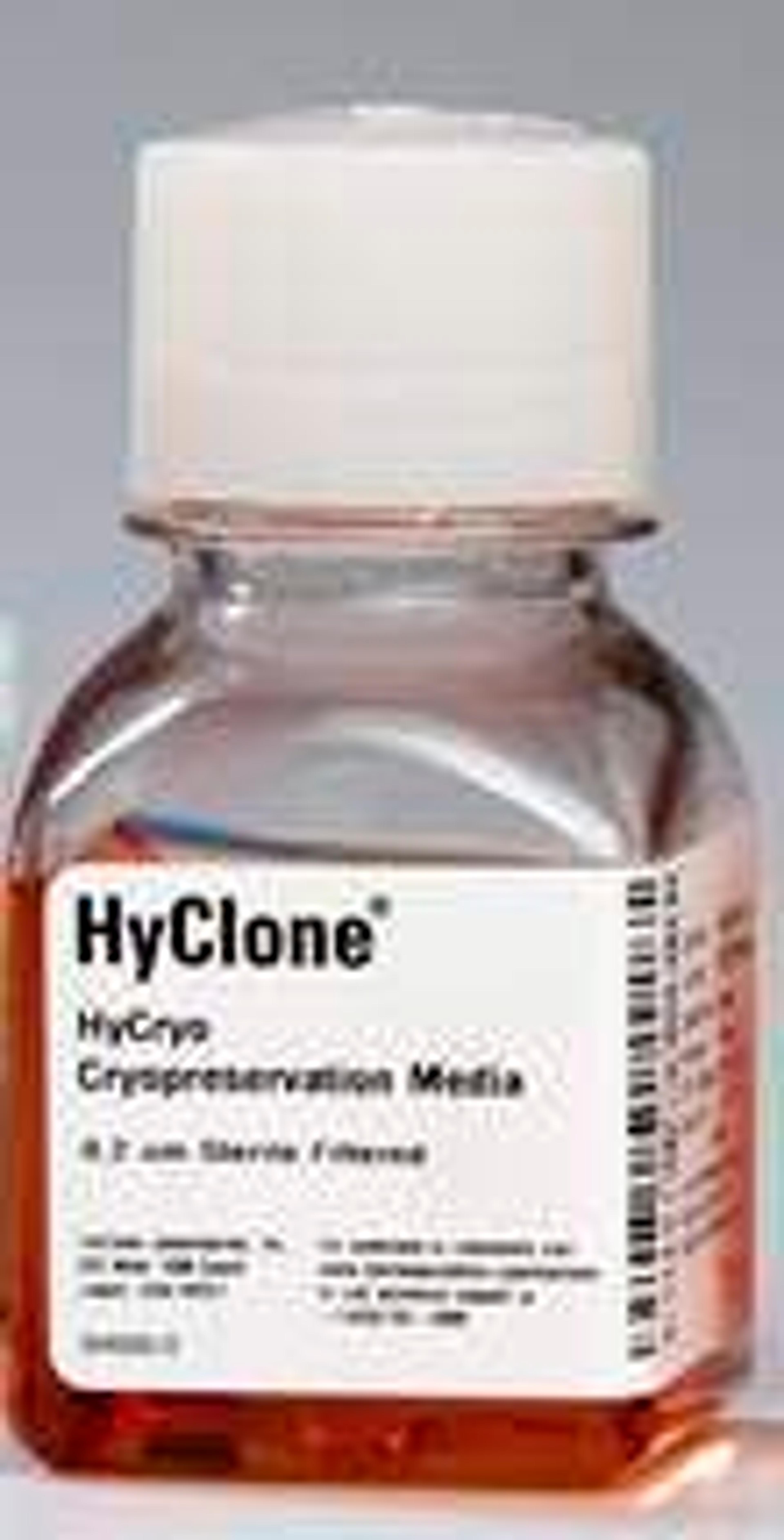
Thermo Scientific™ HyCryo Cryopreservation Media is a serum-free, animal origin-free product intended for cryogenic storage of your standard cell lines. HyClone™ HyCryo media is a serum-free, animal origin-free product intended for cryogenic storage for your standard cell lines. HyCryo gives you the recovery that you want from your cells with peace of mind knowing that your precious cells are faithfully preserved for your future research. Features of HyCro Cryopreservation Media: Serum-free, animal origin-free for cryogenic storage for standard cell lines Meets industry standard for viable cell recovery per vial; outperforms other cryo media solution in the market for viable cell recovery per vial Provided as a 2X solution; 0.2µm sterile filtered For further manufacturing or research use. Not for diagnostic or therapeutic use.

(0)

Tags

ElectrophoresisElectrophoresis equipment is used to separate mixtures of protein, DNA or RNA, based on their electric charge, size and other physical characteristics, by passing them through a medium such as a polyacrylamide gel, an agarose gel or a capillary tube. Electrophoresis equipment includes horizontal and vertical gel electrophoresis chambers, isoelectric focusing systems, 2D electrophoresis and capillary electrophoresis instruments. Precast gels with a gradient can be used or gels can be hand cast. Samples are run alongside ladders or markers to identify the approximate size of a molecule. Separated proteins and nucleic acids in the gel can be stained or probed with fluorescent markers and then imaged and detected using gel documentation instruments, transilluminators, densitometers and scanners. Find the best electrophoresis equipment in our peer-reviewed product directory: compare products, check customer reviews and receive pricing direct from manufacturers.Cell / Tissue CultureCell culture or tissue culture is used to study the biology of cells or tissues and to isolate cellular products in an environment which can be manipulated and well defined. Accurately control your culture environment with bioreactors or culture incubators, bind your cells to a surface or together with an extracellular matrix. Distinguish cell types with differential media or proliferate cells with certain characteristics using selective media. Enrich your media with supplements such as growth factors, sera and vitamins. Find the best cell and tissue culture products, kits and equipment in our peer-reviewed product directory: compare products, check customer reviews and receive pricing direct from manufacturers.Cell Lines Stem Cells and Primary CellsPrimary cell cultures, established cell lines and stem cells are vital for <i>in vitro</i> and <i>ex vivo</i> experimentation. High-quality cells, optimized for your applications, alongside optimized cell substrates, growth medium and supplements, are critical for experimental success. Explore a range of cells suitable for your applications, including isogenic cell lines, competent cells, induced pluripotent stem cell (iPSC)-derived cell lines, fungal/bacterial/mammalian cell lines, stem cells and cancer cell lines. Find the best cells for your research in our peer-reviewed product directory: compare products, check customer reviews and receive pricing direct from manufacturers.Labware and Lab SuppliesLabware and lab supplies include various forms of glassware, plasticware, reagents and personal protective equipment (PPE) and are used across all scientific laboratories, enabling daily tasks to be performed. Explore a range of flasks and beakers, petri dishes, carboys and storage bottles. Labware such as condensers, desiccators and burettes are also available for more specific tasks. Find the best labware and lab supplies in our peer-reviewed product directory: compare products, check customer reviews and receive pricing direct from manufacturers.Protein CrystallographyProtein crystallization is the process of crystallizing purified proteins for 3D structure analysis by x-ray crystallography. The main methods of protein crystallization include sitting drop, hanging drop and microbatch. It is important to control parameters such as pH, temperature and concentration. Following crystallization, detectors and software are used for data collection and analysis.Cell GrowthCell growth refers to the process by which cells increase in size and number. It is essential for tissue development, wound healing, and cancer research. Understanding and controlling cell growth is a fundamental part of cell biology and regenerative medicine. Browse our peer-reviewed product directory to find the best tools for studying cell growth, compare products, check reviews, and get pricing directly from manufacturers.CryopreservationCryogenicStem Cell ResearchStem cells have the ability to produce identical daughter cells as well as progeny, which commit and differentiate. Stem cell research has exciting prospects of biomedical applications in cellular disease modeling, pharmaceutical screening, and regenerative medicine.
Thermo Fisher Scientific Expands Cryopreservation Reagents for Cell Culture