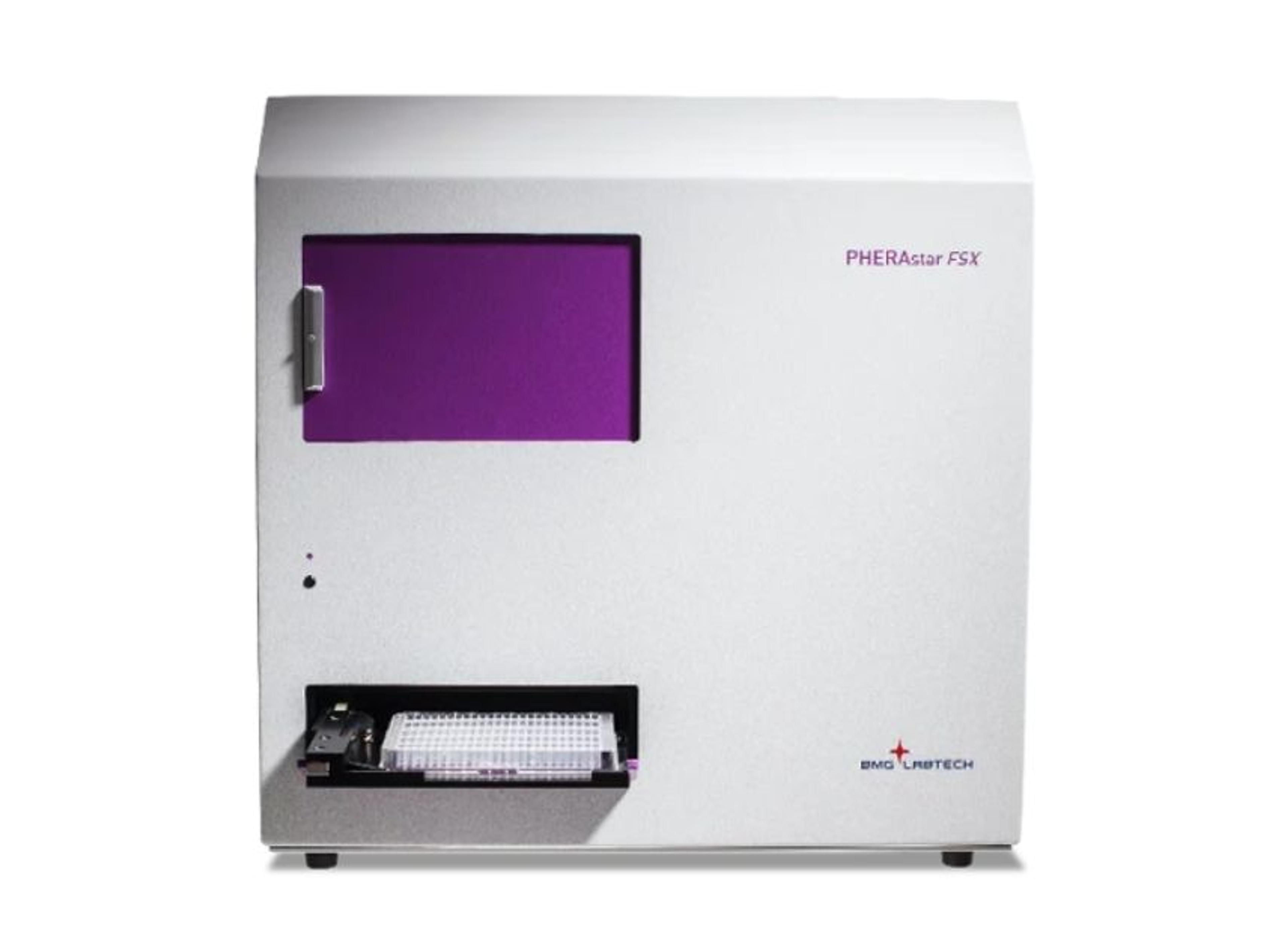
The New Gold Standard Microplate Reader for High Throughput Screening

BMG LABTECH introduces its new product PHERAstar® FSX at SLAS 2016

11 Nov 2015

Lois Manton-O'Byrne, PhD
Executive Editor

Product news

Visitors at the SLAS in San Diego will witness the international premiere of the new reference multi-mode HTS reader PHERAstar® FSX. The latest evolution in microplate reader instrumentation combines the best sensitivity on the market, highest speed and unmatched flexibility in plate formats up to 3456 wells. Visit booth #915 from January 23rd-27th to see German engineering at its best.

The ultimate microplate reader for HTS applications

Built upon the successful PHERAstar® FS platform, the PHERAstar® FSX has improved features that make it superior to any other microplate reader currently on the market. The reader performs all leading non-isotopic detection technologies with ease and speed. Unmatched sensitivity and speed in Fluorescence Intensity (FI) and Fluorescence Polarization (FP) makes the PHERAstar® FSX the most sensitive reader today. Moreover, the reader offers an ultrahigh dynamic range in Luminescence enabling a higher flexibility and more precise measurement results.

Simultaneous Dual Emission detection for Alpha Technology

In order to maximize efficiency, screening facilities must constantly strive to increase throughput and minimize sample expenditure, while controlling costs. To meet these requirements BMG LABTECH pioneered the technique of Simultaneous Dual Emission detection for microplate readers within the last years. The PHERAstar® FSX now implemented Simultaneous Dual Emission detection for AlphaPlexTM increasing throughput significantly by cutting read times in a half.

Next generation TRF Laser

The outstanding sensitivity of the PHERAstar® FSX is based on an innovative optical design including three independent light sources. To ensure best performance for any assay the PHERAstar® FSX comes with the next generation laser for TRF/TR-FRET. The new TRF laser accomplishes up to 60 flashes per second which increase throughput and precision of measurement in all plate formats.

For HTS automation purposes, the PHERAstar® FSX offers improved robotic integration capabilities, multi-user control and MARS data analysis software with included digital signature and FDA 21 CFR part 11 compliance, and can be equipped with BMG LABTECH's Stacker.

BMG LABTECH tutorial presents class leading technology

Besides exhibiting at SLAS, BMG LABTECH will host a 45 minute tutorial held by Associate Professor Pfleger from The University of Western Australia/Harry Perkins Institute of Medical Research. Professor Pfleger will present the research results performed of an international team which has for the first time demonstrated the principle of real time ligand binding to G Protein-Coupled Receptors (GPCRs), using Bioluminescence Resonance Energy Transfer (BRET). The BRET technique was shown to be a valuable alternative to radio ligand binding experiments and to extend researchers’ capability to allow assessment of real time binding kinetics in live cells. This research further extends the established capability of BRET to monitor protein-protein interactions to real time measurements in live cells, enhancing biologists’ and pharmacologists’ insights into real time cellular processes. Tutorial’s final time and place will be published on www.slas2016.org soon.

Links

Tags

MicroplatesMicroplates are multi-well plates used to increase the throughput of biological investigations. The number of wells microplates contain can range from 6 to 3243 wells, with the 96-well format being the most commonly used. Microplates can come tailored for a range of applications including cell culture, PCR, filtration, storage, non-binding surface, protein crystallization, as well as pre-coated, deep well and normal Standard microplates. Additionally, options for microplate colors include clear , black, white or black with clear bottom and white with clear bottom for absorbance microplate reader applications. Find the best microplates for your lab in our peer-reviewed product directory: compare products, check customer reviews and receive pricing direct from manufacturers.High-Throughput ScreeningHigh-throughput screening (HTS) is an automated drug discovery technique for identification of active compounds against a compound library. Use HTS readers and integrated assay preparation / analysis workstations to screen your compounds. Identify active compounds against various HTS libraries, including membranes, proteins and peptides and HTS cell lines. Find the best high-throughput screening products in our peer-reviewed product directory: compare products, check customer reviews and receive pricing direct from manufacturers.Microplate Readers / DetectorsMicroplate readers are used to automate the detection and analysis of labeled or label-free components in microplates during assays or live-cell monitoring. Microplate readers are generally distinguished by their mode of detection. Types include absorbance, luminescence, fluorescence intensity, fluorescence polarization, TRF / FRET and multimode microplate readers. Microplate readers deliver a high throughput of samples by reading multiple wells simultaneously, with the 96-well format the most commonly used. As a result, microplate readers are often used in the drug discovery, bioassays, research and pharmaceutical industries for screening applications. Microplate loading can also be automated, with robotic microplate stackers to increase throughput. Find the best microplate readers in our peer-reviewed product directory: compare products, check customer reviews and receive pricing direct from manufacturers.Cell-Based AssaysCell-based assays are used to monitor the presence, quantity and activities of a desired cellular analyte including drug molecules or biomarkers. This can reveal information on cell health (apoptosis, cytotoxicity, viability and proliferation assays), cell metabolism, cell migration and cell signaling mechanisms. Find the best cell-based assay products, kits and equipment with our peer reviewed product directory: compare products, check customer reviews and receiving pricing direct from manufacturers.SLASThe Society for Laboratory Automation and Screening (SLAS) is an organization focused on laboratory automation, high-throughput screening, and biotechnology innovation. SLAS promotes scientific advancements through conferences, publications, and industry collaborations. FluorescenceThe emission of fluorescence occurs when a photon of energy is supplied to a fluorescent chemical compound by an external source, causing it to become excited. Fluorescence can be detected and measured for different purposes using microplate readers, fluorescence microscopes, fluorescence scanners, and flow cytometers.High ThroughputHigh throughput experiments allow the simultaneous processing of several samples. This parallelization reduces the cost per experiment and increases reproducibility and output volume of data.ScreeningUsing robotics, data processing and control software, liquid handling devices and sensitive detectors, screening allows a researcher to quickly conduct millions of chemical, genetic or pharmacological tests.