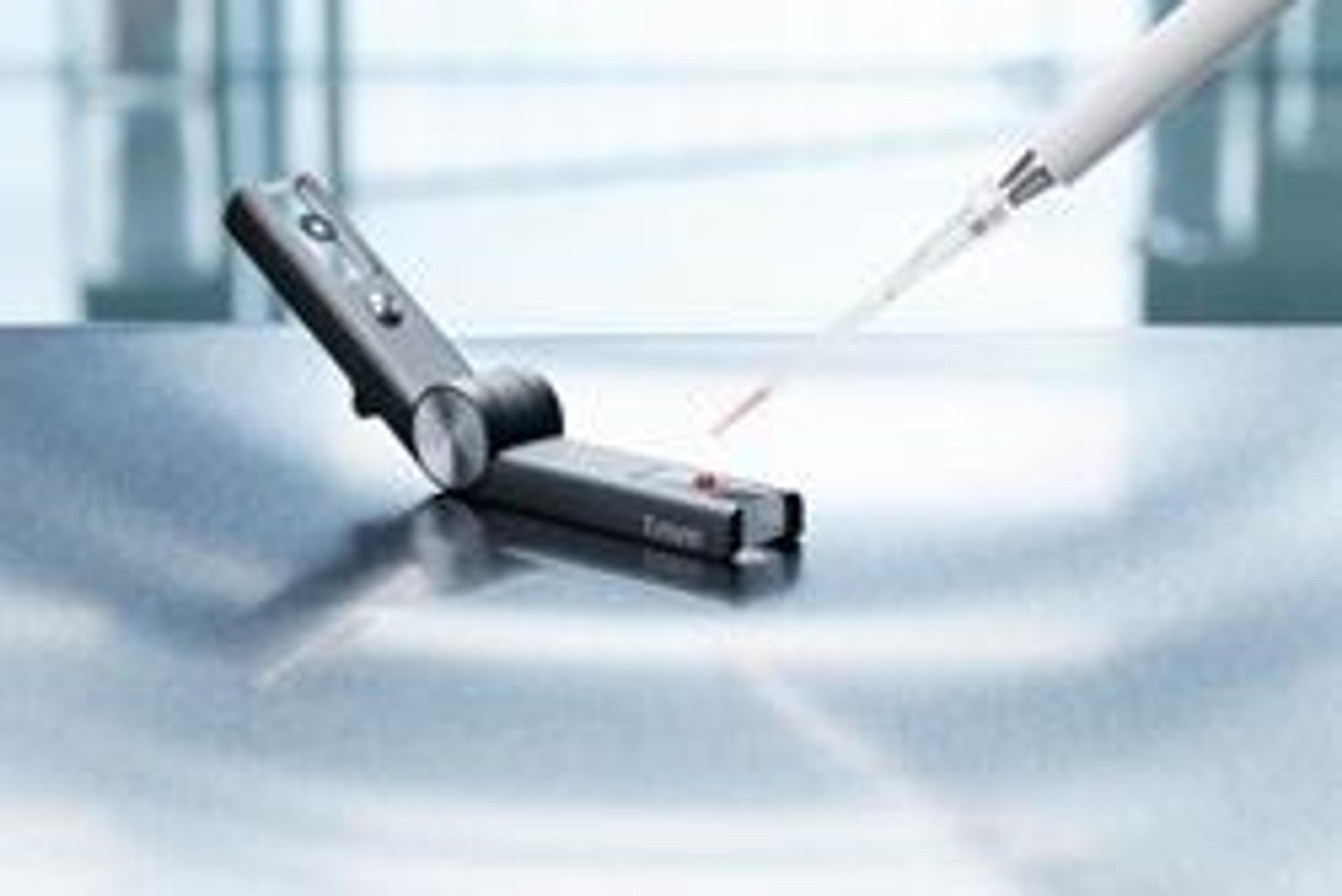
The new Eppendorf µCuvette G1.0 – Less is more

15 Nov 2012

Product news

The Eppendorf µCuvette™ G1.0 is a microliter measuring cell, and therefore it is especially suited for photometric measurements of high sample concentrations in the Eppendorf photometers (Eppendorf BioPhotometer or Eppendorf BioSpectrometer). Photometric measurements are only as accurate as the device and corresponding accessory. Thus, selecting the perfect cuvette is just as important as choosing the right device.

Concerning the Lambert Beers Law, the higher the concentration of a sample, the shorter the optical path length should be with which the sample will be measured. The μCuvette G1.0 features an optical path length of only 1 mm, which is 10 times shorter than the light path length of standard cuvettes. For example, this allows nucleic acid concentrations to be measured with high reproducibility in a much higher concentration range (up to 1,500ng/ µL) without prior dilution. Only 1.5μL of a sample is required for the measurement.

The µCuvette G1.0 has been developed exclusively for Eppendorf BioPhotometer and BioSpectrometer. The devices are pre-programmed to a layer thickness of 1mm. All BioSpectrometer are offering in addition a pre-programmed method to quantify nucleic acid using the µCuvette G1.0. After selecting this method or the 1mm layer thickness in the parameter settings, the software realizes all calculations considering the layer thickness. In addition, the optical characteristics of the devices, as e.g. the light beam focusing and light beam guidance, are optimally adjusted to those of the µCuvette G1.0. The usage in older BioPhotometer and BioSpectrometer devices is possible without limitations in performance.

This optimization as well as the connection of both cuvette parts by means of a low-backlash journal bearing joint provide for highly reproducible conditions during measurement.

µCuvette G1.0™

Eppendorf

The Eppendorf µCuvette G1.0 is a microliter measuring cell, and therefore it is especially suited for measuring high concentrations. The higher the concentration of a sample, the shorter the optical path length should be with which the sample will be measured. Thanks to a special Eppendorf coating procedure, the sample volume is positioned exactly and the drop will be shaped with precision. This technology makes it possible to fix the drop without producing any pronounced edges or projections. This minimizes the risk of sample carry-over and simplifies to a large extent the cleaning of the sample surface. Due to the used materials and the selected measuring principle, the self absorption of the µCuvette G1.0 is very low and can be compared to that of standard quartz glass cuvettes. The µCuvette G1.0 has been developed exclusively for Eppendorf BioPhotometer and BioSpectrometer. The devices are pre-programmed to a layer thickness of 1mm. The software realizes all calculations considering the layer thickness. In addition, the optical characteristics of the devices, as e.g. the light beam focussing and light beam guidance, are optimally adjusted to those of the µCuvette G1.0. This optimization as well as the connection of both cuvette parts by means of a low-backlash journal bearing joint provide for highly reproducible conditions during measurement. Application examples: • Concentration determination of nucleic acids and proteins • Measurement of high sample concentrations without dilution • Low sample volumes

(2)

Links

Tags

Sample PreparationSample preparation can improve the quality and speed of separation techniques. Products to assist sample preparation include filtration equipment, evaporators, membranes and sieves.UV-Visible SpectroscopyUltraviolet-visible (UV-Vis) spectrophotometers are used to measure the interaction of UV and visible light with a sample, including transmission, reflectance & absorbance. The two major instrument classes are single-beam or double-beam spectrophotometers. More specialized equipment includes colorimeters, spectroradiometers and refractometers. Portable and microvolume spectrophotometers are also available. For the modular spectroscopy lab, explore a range of light sources for combination with a spectrograph/spectrometer and optics. Find the best UV-Vis spectroscopy products in our peer-reviewed product directory: compare products, check customer reviews and receive pricing direct from manufacturers.ProteomicsProteomics is the systemic bioinformatics study of proteins and amino acids, including their structure, size, function and identification. Tools used in proteomics include chromatography, blotting and gels, protein arrays, mass spectrometry and ELISA and associated analysis software. Analyzers and proteomic systems should be sensitive, high resolution, fast and may be automated for high-throughput.DNA / RNA Extraction and PurificationPurified DNA and RNA are required for numerous downstream molecular biology applications. Consequently, the importance of high-quality DNA/RNA extraction and purification equipment cannot be underestimated. Many purification kits are available and are typically optimized for nucleic acid type and source, including plasmid DNA, genomic DNA, mRNA, RNA and viral nucleic acid purification kits. Automated extraction and purification of nucleic acids can be implemented with magnetic bead separator instruments or high-throughput purification workstations. Find the best DNA/RNA extraction and purification equipment in our peer-reviewed product directory: compare products, check customer reviews and receive pricing direct from manufacturers.Protein PurificationProtein purification is a vital step in drug discovery, therapeutics, biotech and life science research. The purification process typically involves subcellular or membrane protein extraction with cell lysis kits, separation of proteins from cell debris by filtration or spin columns, and the isolation of proteins of interest from other proteins and impurities with affinity purification (including fusion protein tags and antibody binding proteins A, G and L), immunoprecipitation or chromatographic methods, such as ion exchange, size exclusion and immobilized metal affinity chromatography. All purification methods come in multiple formats for your laboratory needs, including agarose or magnetic beads, resins, columns and filter plates. Find the best protein purification equipment in our peer-reviewed product directory: compare products, check customer reviews and receive pricing direct from manufacturers.Protein QuantificationThe detection and quantification of proteins in a sample is vital across life sciences, pharmaceutical research and clinical diagnostics, and a variety of equipment is available to scientists to simplify the workflow. Proteins of interest can be easily labeled and detected on light-based detection instruments. Immunoassay kits allow you to identify a specific protein of interest and protein detection beads or antibody microarrays allow you to identify multiple specific proteins at once. Protein interactions and enzyme activity can also be monitored with protein-protein interaction assays. Additionally, the biophysical characterization of proteins is made easy with biokinetic analyzers. Find the best protein detection and quantification products in our peer-reviewed product directory: compare products, check customer reviews and receive pricing direct from manufacturers.DNA QuantificationDNA quantification is the process of measuring the amount of DNA in a sample. It is vital in genomics, molecular biology, and biotechnology, helping to ensure accurate experiments and data analysis. Explore DNA quantification tools in our peer-reviewed product directory; compare products, check reviews, and get pricing directly from manufacturers.Protein BiologyThe analysis of protein expression, identity and function is vital for many areas of life science research and drug discovery. Some of the most commonly used techniques in protein analysis include Western blotting, electrophoresis and mass spectrometry.Nucleic Acid Concentration
The new Eppendorf µCuvette G1.0 – Less is more