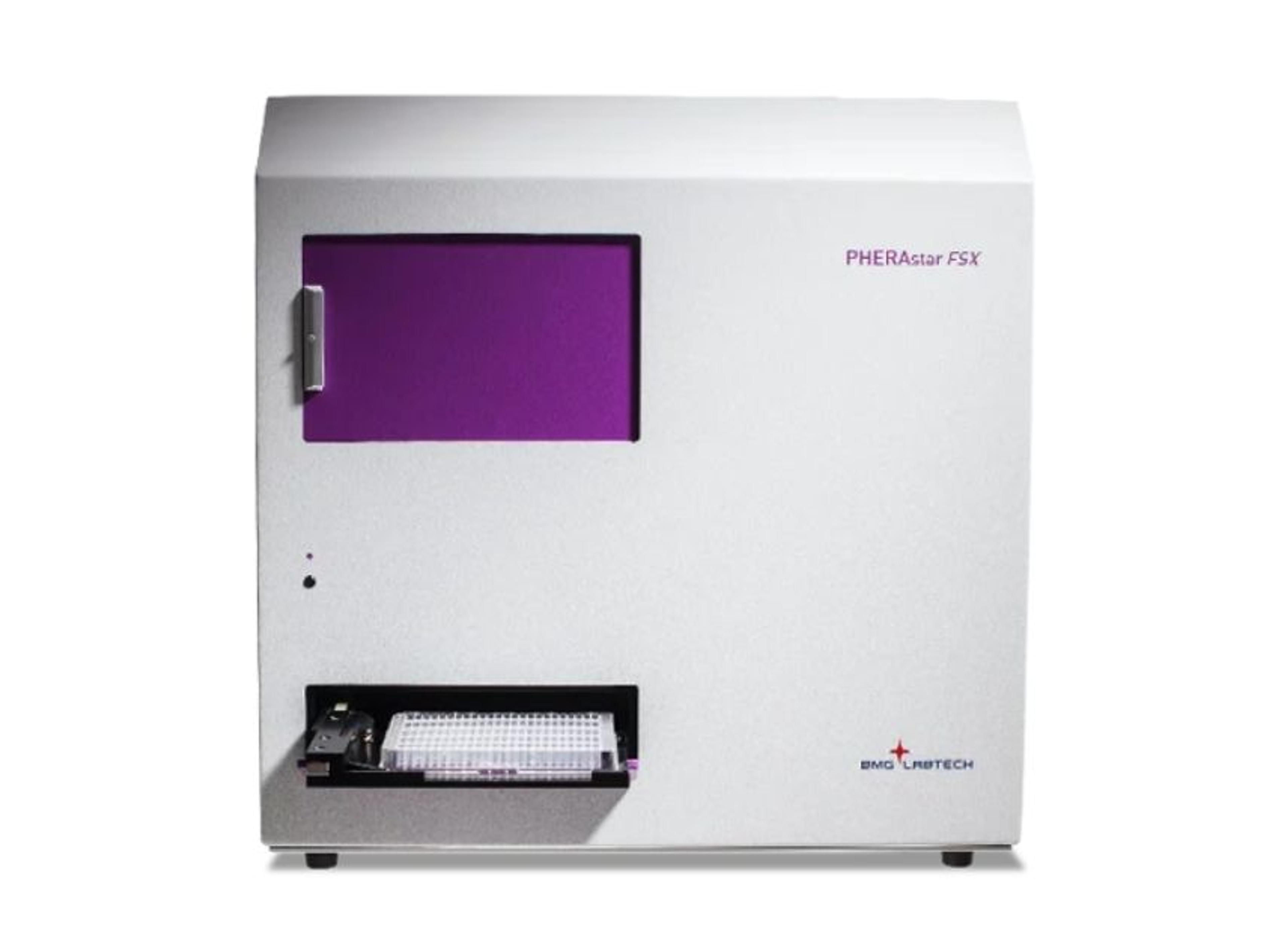
The Features of the PHERAstar FS Presented at SLAS

17 Jun 2012

Product news

Visit BMG LABTECH, The Microplate Reader Company, at Booth 43 at the 2012 Society for Laboratory Automation and Screening (SLAS) Asia Conference and Exhibition in Shanghai, China from 19-21 June 2012. This international venue will highlight the Advances in Drug and Life Sciences R&D Through Laboratory Technology.

BMG LABTECH will present the outstanding features of the PHERAstar FS, the gold-standard for HTS instruments.

To highlight the flexibility of the PHERAstar FS in primary and secondary HTS screens, BMG LABTECH presents two scientific posters. The first poster shows the capability to go to nanoliter volumes in different HTS assays and it was performed in conjunction with Labcyte, DiscoveRx and Brooks Life Science Systems. Using a new nanoHTS platform with 3456-well microplates that consisted of the Echo® 555 acoustic liquid dispenser, the AccessTM automation platform, and the PHERAstar FS microplate reader, GPCR and kinases in cell-based assay formats from DiscoveRx were investigated.

The second poster further demonstrates the flexibility of the PHERAstar FS in another HTS screen. Using the HTRF® IP-One assay from Cisbio, the PHERAstar FS clearly outperforms a leading HTS CCD-based microplate reader in terms of both speed and assay quality. See how the PHERAstar FS found low affinity ‘hits’ that were not even detected on the leading CCD-based instrument.

BMG LABTECH will also highlight their new microplate reader technology at Booth #43, which includes: Ultra-fast, full spectrum (220-1000 nm) absorbance analysis for chemical or biological samples; Atmospheric Control Unit (ACU) on a life science microplate reader for optimizing cell-based assay experiments or for inducing disease states such as hypoxia; and Direct Optic Bottom reading on the gold-standard HTS microplate reader for unmatched signal-to-noise ratios in all fluorescent protein assays such as GFP, YFP and mCherry.

Last but not least, don’t miss the introduction of the new NEPHELOstar Plus, the only laser-based microplate nephelometer for early drug solubility screening, detailed microbial growth monitoring or sensitive immuno-precipitation detection via light scattering.

Links

Tags

MicroplatesMicroplates are multi-well plates used to increase the throughput of biological investigations. The number of wells microplates contain can range from 6 to 3243 wells, with the 96-well format being the most commonly used. Microplates can come tailored for a range of applications including cell culture, PCR, filtration, storage, non-binding surface, protein crystallization, as well as pre-coated, deep well and normal Standard microplates. Additionally, options for microplate colors include clear , black, white or black with clear bottom and white with clear bottom for absorbance microplate reader applications. Find the best microplates for your lab in our peer-reviewed product directory: compare products, check customer reviews and receive pricing direct from manufacturers.High-Throughput ScreeningHigh-throughput screening (HTS) is an automated drug discovery technique for identification of active compounds against a compound library. Use HTS readers and integrated assay preparation / analysis workstations to screen your compounds. Identify active compounds against various HTS libraries, including membranes, proteins and peptides and HTS cell lines. Find the best high-throughput screening products in our peer-reviewed product directory: compare products, check customer reviews and receive pricing direct from manufacturers.Microplate Readers / DetectorsMicroplate readers are used to automate the detection and analysis of labeled or label-free components in microplates during assays or live-cell monitoring. Microplate readers are generally distinguished by their mode of detection. Types include absorbance, luminescence, fluorescence intensity, fluorescence polarization, TRF / FRET and multimode microplate readers. Microplate readers deliver a high throughput of samples by reading multiple wells simultaneously, with the 96-well format the most commonly used. As a result, microplate readers are often used in the drug discovery, bioassays, research and pharmaceutical industries for screening applications. Microplate loading can also be automated, with robotic microplate stackers to increase throughput. Find the best microplate readers in our peer-reviewed product directory: compare products, check customer reviews and receive pricing direct from manufacturers.Cell-Based AssaysCell-based assays are used to monitor the presence, quantity and activities of a desired cellular analyte including drug molecules or biomarkers. This can reveal information on cell health (apoptosis, cytotoxicity, viability and proliferation assays), cell metabolism, cell migration and cell signaling mechanisms. Find the best cell-based assay products, kits and equipment with our peer reviewed product directory: compare products, check customer reviews and receiving pricing direct from manufacturers.SLASThe Society for Laboratory Automation and Screening (SLAS) is an organization focused on laboratory automation, high-throughput screening, and biotechnology innovation. SLAS promotes scientific advancements through conferences, publications, and industry collaborations.
The Features of the PHERAstar FS Presented at SLAS