The Centrifuge Rotor You Can Change in Just Three Seconds
How customer feedback shaped the NuWind multi-application centrifuge
15 May 2017
Editorial article
Customer feedback highlighting the need for simplicity, ease-of-use, reliability and versatility was an important consideration addressed by manufacturer NuAire when developing the NuWind Multi-Application series of benchtop centrifuges. With this feedback in mind, the NuWind series has introduced key features for clinical and life sciences researchers, including ClickSpin rotor changing technology, the largest capacity available relative to its footprint and the ability to spin both plates and tubes in the same rotor, all along with an intuitive in-depth control panel that can store 100 different programs.
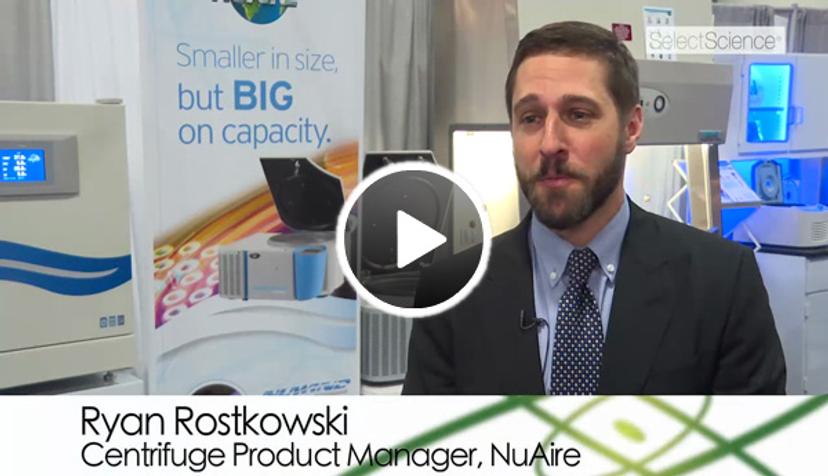
At AACR 2017, Ryan Rostkowski, Centrifuge Product Manager, NuAire, demonstrated just how easy the new ClickSpin technology makes changing centrifuge rotors – enabling you to do so in just three seconds, without the use of tools. He also highlights some of the other features and solutions the NuWind offers to scientists working across a range of applications.
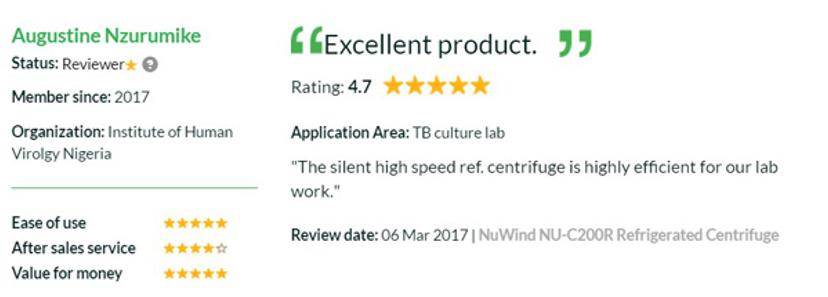
Available in refrigerated and ventilated models, the NuWind is suitable for those working in virology, bacteriology, immunology, genetics, molecular biology, proteomics, microbiology, and more. Scientists working in some of these fields are already sharing their experiences of using this new centrifuge and are recommending it to others. Read the reviews below to learn what your peers are saying, or share your own experience of the NuWind centrifuge by writing a review today.