Tech drives change and learning in cell and gene therapy

A survey exploring the science behind cell and gene therapies highlights the tech at the heart of this breakthrough area

1 Apr 2024

Lawrence Howes
Editorial Assistant

Editorial article

The scientific community is keen to learn more about genomics, DNA sequencing and next-generation sequencing (NGS), as well as gene editing and bioinformatics, according to findings from a cell and gene therapy survey conducted by SelectScience®. The survey was conducted against the backdrop of the first gene therapy regulatory approvals coming through in recent months.

More than half of respondents (57%), who are involved across the spectrum of cell and gene therapy, want to learn more about genomics, DNA, and next-generation sequencing. They are looking to advance their current knowledge, with almost half (47%) already employing the technology in their work.

Graph showing use of and interest in different cell and gene therapy technologies
Figure 1: Use of and interest in cell and gene therapy technologies

Tech changes way of working

When it comes to specific approaches, respondents felt that gene editing, specifically CRISPR, holds the most promise, reinforcing earlier findings that this is an area respondents are keen to learn more about.
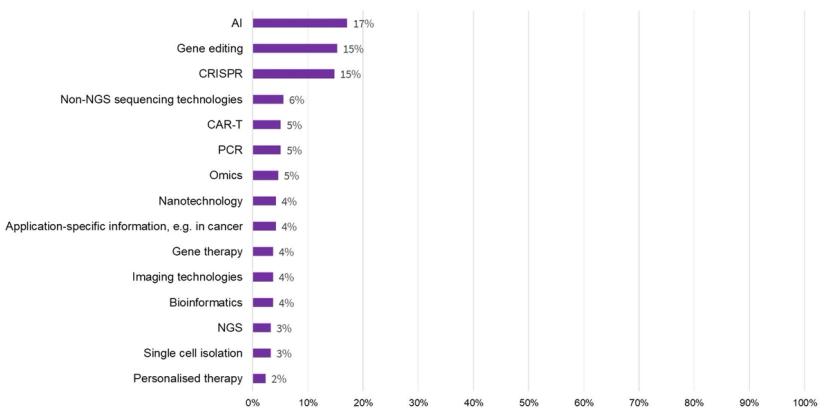
Graph showing most promising emerging technologies for advancing research
Figure 2: Most promising emerging technologies for advancing research

Uptake of AI remains low

The survey found that only 26.3% of respondents are using AI in their work, though 17% see it as one of the most promising emerging technologies helping to advance research ahead of gene editing (15%) and, specifically, CRISPR (15%).

Given the opportunity to comment on the emerging technologies they thought were particularly promising, respondents agreed that AI would have a significant impact on cell and gene therapy research, ahead of specific cell and gene therapy approaches. Respondents commented that AI has the potential to reduce the need for early stage trials in animals, as well as help to process vast amounts of data.

Getting to grips with and incorporating new technology is taking up increasing amounts of time, say respondents, with 78.4% listing technology as a challenge for them. Of these, more than one-third (34.0%) indicated it was a significant work challenge.
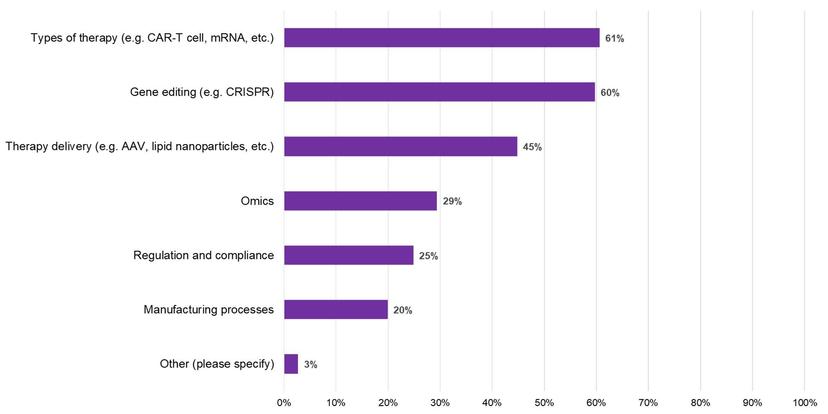
Graph showing most promising emerging technologies for advancing research
Figure 3: Key areas or developments in cell and gene therapy of greatest interest

Other challenges persist

The majority also have concerns about the feasibility of therapies, with 88.4% listing the development of scalable manufacturing processes as a challenge and a similar proportion (87.3%) concerned about the generation of sufficiently viable, potent, and safe products meeting patient- and disease-specific needs.

More than half of these (50.5% of the total sample) indicate that product generation is a significant challenge – a higher proportion than are intensely concerned about long-term efficacy and durability.

Despite this, the jury is still out in terms of the overall longevity of cell and gene therapy. Just over half (50.7%) see longevity as an issue, while 49.3% have no concerns about longevity. Around one in 20 (5.4%) chose to comment on why they considered longevity to be an issue.

Respondents highlighted Thermo Fisher Scientific, Agilent Technologies, and LGC Biosearch Technologies, among others, as the manufacturers they would choose for their cell and gene therapy workflow needs. Given the chance to name other important brands, Sartorius, and GenScript were mentioned as significant players in the field. Learn more about the application of the cutting-edge technologies available from some of these brands in our Cell and Gene Therapy Accelerating Science Feature >>

You can also hear what experts in the field had to say in our Accelerating Science Forum which discusses the longevity and compliance challenges of cell and gene therapy – Watch on demand.

Links

Tags

ELISAEnzyme-linked immunosorbent assays (ELISA), also known as enzyme immunoassays (EIA), are used for the detection and quantification of proteins, peptides and antibodies in a sample. ELISA often comes in kit format, with pre-selected antibody pairs to detect specific proteins or biomarkers of diseases such as diabetes and obesity, or cardiovascular and neurological disorders. Detection is made possible with chemiluminescent, fluorescent or colorimetric substrates and detection instruments such as microplate / ELISA readers. Other kits available include: Enzyme-linked immunospot (ELISPOT) assays for the quantification of protein-producing cells and chemiluminescent immunoassays (CLIA) kits. Find the best ELISA kits and products in our peer-reviewed product directory: compare products, check customer reviews and receive pricing direct from manufacturers.ProteomicsProteomics is the systemic bioinformatics study of proteins and amino acids, including their structure, size, function and identification. Tools used in proteomics include chromatography, blotting and gels, protein arrays, mass spectrometry and ELISA and associated analysis software. Analyzers and proteomic systems should be sensitive, high resolution, fast and may be automated for high-throughput.PCR and Thermal CyclingPolymerase chain reaction (PCR) kits and thermal cyclers are used for the in vitro amplification of DNA permitting subsequent analysis and experimental procedures. Explore a range of high-quality polymerase, primers and nucleotides or simplify your workflow with a PCR mastermix. Find reverse transcription PCR (RT-PCR) and cDNA synthesis kits for RNA products and libraries. Quantitatively measure the amplification of DNA with real-time PCR (qPCR) and droplet digital PCR (ddPCR) kits and systems, and discover automated PCR setup solutions to increase throughput. Alternative DNA amplification methods also include recombinase polymerase amplification (RPA) kits. Find the best PCR kits and thermal cyclers and purification equipment in our peer-reviewed product directory: compare products, check customer reviews and receive pricing direct from manufacturers.DNA SequencingDNA sequencing, such as sanger sequencing, is a biological technique that determines the precise order of nucleotide bases in a fragment or template of DNA. DNA sequencers and genetic analyzers are based on capillary electrophoresis, where labeled DNA fragments are electrophoretically separated by size as they migrate through a polymer. Find the best DNA sequencing products, including DNA sequencing kits, genomic libraries and genetic identity kits in our peer-reviewed product directory: compare products, check customer reviews and receive pricing direct from manufacturers.Gene Expression and Molecular CloningMolecular cloning is a set of techniques that utilizes vectors to transfer recombinant DNA into host cells and is an essential tool for investigating the expression of genes and proteins in bacterial or mammalian cells. A variety of vectors optimized for gene cloning and expression in a range of host organisms are available, alongside competent cells for genetic replication. Here, you can explore a range of molecular tools, high-quality genomic and cDNA libraries, premade clones, transformation and transfection reagents and mutagenesis or gene expression detection assays and expression arrays. Find the best gene expression and molecular cloning products in our peer-reviewed product directory: compare products, check customer reviews and receive pricing direct from manufacturers.Next Generation SequencingNext-generation sequencing (NGS), also known as whole-genome sequencing, high-throughput sequencing and massive parallel sequencing, produces and analyses thousands to millions of nucleotide sequences at once. Sequencing systems operate via varying technologies depending on the manufacturer, including sequencing by synthesis, ligation, pyrosequencing, ion semiconductor and single-molecule real-time sequencing. For NGS, library preparation is paramount to successful sequencing. In this section, explore a range of library preparation kits, from targeted, amplicon-based or hybridization-based kits including epigenomic, transcriptomic and genomic workflows to fragmentation kits. Find the best next-generation sequencing products in our peer-reviewed product directory: compare products, check customer reviews and receive pricing direct from manufacturers.DNA / RNA QuantificationDetection and quantification of nucleic acids is important in molecular biology, cloning, expression, forensics and clinical diagnostics. Nucleic acids can be detected by labeling with colorimetric, fluorescent or radio labels and using in situ hybridization kits to identify specific sequences. Multiple nucleic acids can be detected and quantified at once using RNA / DNA detection beads or RNA / DNA microarrays. Find the best DNA / RNA Quantification products in our peer-reviewed product directory: compare products, check customer reviews and receive pricing direct from manufacturers.Protein ExpressionProtein expression is the utilization of cell machinery for the synthesis of proteins and has become a critical tool in biotherapeutic, genomic, and proteomic research. Produce recombinant proteins with expression vectors in combination with a host cell suitable for high-level protein expression. For production of toxic proteins, consider cell-free expression vectors. Create and monitor post-translational modifications with protein modification kits. Find the best protein expression products in our peer-reviewed product directory: compare products, check customer reviews and receive pricing direct from manufacturers.Chem / BioinformaticsCheminformatics and bioinformatics are computational techniques used in chemistry and biology, respectively, for data acquisition, processing and storage. Cheminformatics focuses on compound information, whereas bioinformatics is mainly applied to analysis and modeling of genomics, genetic and sequencing information. Hardware and software is available for data acquisition, analysis, management and storage.NGSGene EditingGene editing is the precise alteration to an organism's DNA, with CRISPR being the most well-known technique. It is used in a wide range of applications, including the development of disease models and gene therapy, and crop improvement. Browse our peer-reviewed product directory to find the best gene editing solutions, compare products, check reviews, and get pricing directly from manufacturers.NanotechnologyGene TherapyGene therapy is a technique that modifies or replaces genes within an individual's cells to treat or prevent diseases. This approach holds potential for curing genetic disorders, cancers, and certain viral infections. Advances in gene editing technologies like CRISPR are driving the growth of gene therapy. Explore gene therapy tools and technologies in our peer-reviewed product directory; compare products, check reviews, and get pricing directly from manufacturers.CRISPRCRISPR technology enables precise editing of genes, allowing scientists to modify DNA at specific locations. This revolutionary tool is used in genetic research, drug development, and gene therapy. CRISPR has applications in agriculture, disease treatment, and creating genetically modified organisms (GMOs). Explore CRISPR solutions in our peer-reviewed product directory; compare products, check reviews, and get pricing directly from manufacturers.