
Sphere Fluidics and Heriot-Watt University collaborate to develop next-generation droplet generator instrumentation
Partnership awarded Innovate UK Knowledge Transfer Partnership grant
19 Jul 2020
Industry news
Sphere Fluidics, a company developing single-cell analysis systems underpinned by its patented picodroplet technology, and Heriot-Watt University, a specialist, pioneering Scottish University, have announced they have been awarded a Knowledge Transfer Partnership (KTP) grant from Innovate UK, the UK’s innovation agency. The grant will facilitate the development of novel droplet generator instrumentation, which will be used to expand Sphere Fluidics’ portfolio of microfluidic instruments for advanced biologics discovery and therapeutic cell line development.
Awarded to promote the collaboration of knowledge, technology and skills within the UK Knowledge Base, the KTP has been granted to Sphere Fluidics, in partnership with Dr. Graeme Whyte, Associate Professor at Heriot-Watt University. The two-year project will develop next-generation intelligent instrumentation and advance research across a range of picodroplet techniques, allowing scientists to discover rare cell phenotypes and to help to solve a range of biological questions ranging from antibody discovery to antimicrobial resistance, enzyme evolution and synthetic biology. The novel platform for semi-automated picodroplet production will be employed by the Company to improve control of droplet production, using advanced imaging technology.
As part of the project, Dr. John McGrath has been appointed to Sphere Fluidics’ team as a Research Scientist in physics and engineering, to support the transfer of cutting-edge research into the Company’s portfolio of single cell analysis instruments, including for several new commercial products. Used by researchers in a number of application areas, Sphere Fluidics’ picodroplet-based technologies provide improved throughput, accuracy, and sensitivity to enable leading-edge research and accelerate biopharmaceutical discovery and development.
Dr. Marian Rehak, VP of Research and Development at Sphere Fluidics, said: “This innovative project with Heriot-Watt University, will bring together aspects of microfluidic and optical design, technology development and product design engineering to develop a new class of instrument for cell-based picodroplet discovery. We are delighted to have been awarded the KTP Fellowship and to welcome Dr. John McGrath to the Sphere Fluidics team. The work demonstrates the importance of collaboration between academic and industrial partners to support the advancement of novel microfluidic technologies for ground-breaking research.”
Associate Professor Graeme Whyte, School of Engineering Physical Sciences, Heriot-Watt University said: “This partnership between Heriot-Watt University and Sphere Fluidics will support the rapid translation of academic findings into intelligent technological solutions. The microfluidic platform in development can be utilized by scientists to solve a range of important biological questions across the life sciences sector.”
Dr. John McGrath, Research Scientist at Sphere Fluidics, commented: “I am thrilled to be working alongside commercial and academic leaders in the research and development of microfluidic instruments and technology. The ease of use and broader application set of the instrument to be developed in this project should lower the barrier to entry for a wide number of scientists, who are focused upon high-throughput screening, synthetic biology, gene editing, and antimicrobial resistance workflows. The technology has the potential to be a key driver in increasing the uptake of picodroplet microfluidic instruments.”
Do you use Sphere Fluidics products in your lab? Write a review today for your chance to win a $400 Amazon Gift Card>>
Related products
Request Quote for All Products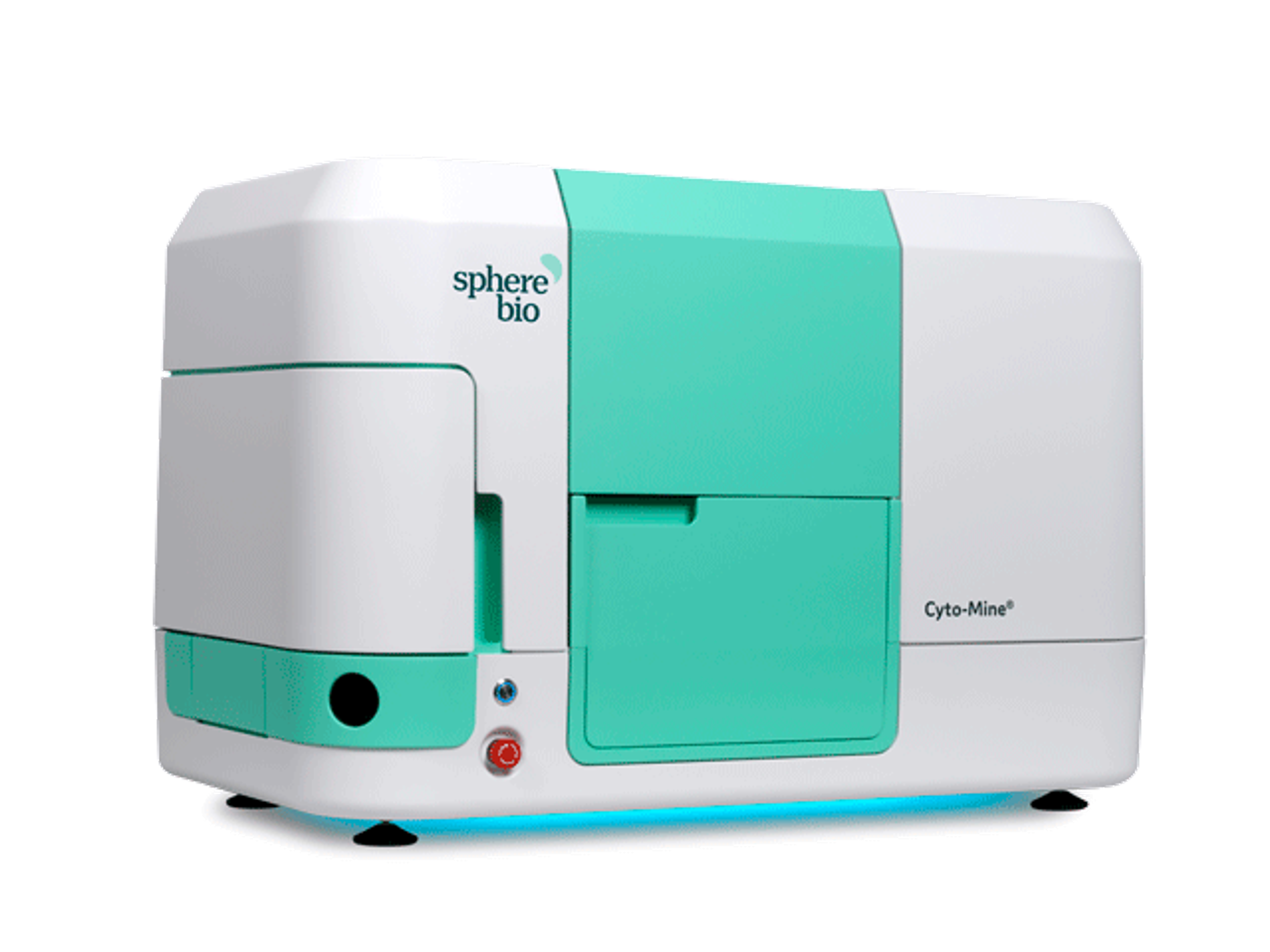
Cyto-Mine®
Sphere BioCyto-Mine® - The Single Cell Analysis and Monoclonality Assurance System. Cyto-Mine® is a fully automated platform which integrates high-throughput and selective single cell screening, sorting, isolation and monoclonality assurance using high quality imaging.