SmartCapture Technology from Aplegen

3 Apr 2016
Alex Waite
Editorial Assistant

Product news

At the heart of any good imaging system is the control software. Fortunately, all Aplegen gel documentation systems come with such a feature. In this case it is the SmartCapture Technology which provides the automated controls for the imaging systems across the product range.

Since all Aplegen systems, with the exception of the Omega Fluor, come complete with a system Tablet PC then the SmartCapture Technology software already comes pre-installed. Therefore the user simply has to open the box, switch on and is then ready to start capturing images of their gels or blots.

The SmartCapture Technology software controls the system lighting and links with the filtering system to provide the optimum settings required for the application. This can all be setup as a protocol so that the user simply has to click the capture button on subsequent visits to the imaging system. The main purpose of the software to automatically capture a perfect image whether you are working with fluorescence or chemiluminescence applications. This is where the one-click operation of SmartCapture Technology really stands out amongst its rivals. All Aplegen systems have superb cameras and optics so that the image quality is exceptional for all gels and blots. Since SmartCapture Technology also has automatic focusing this is one more advantage it has over competitive systems.

Another useful feature of SmartCapture Technology is its ability to email your image to another device once it has been captured by the gel documentation system. This means that images can be sent to your desk or workstation for further viewing or analysis without holding up other users who wish to use the system.

Aplegen offer a range of gel documentation systems including the Omega Fluor and the Omega Lum series. All have a range of exciting features and high specifications but at prices to suit any laboratory. Aplegen have been manufacturing and selling the Omega range of products for 8 years. During that time they have built up a strong following around the world and have many installations.

Says Aplegen: “Our systems are able to capture images across a wide range of applications. Above all, we offer affordable products but with industry leading technology. Once you have seen our systems in action you will look no further”.

Omega Lum™ C

Aplegen

Quickly grab quantitative images of your blots or gels right on your bench with the Omega Lum C. With its broad dynamic range and sensitive detection, you can’t get better data from your experiments anywhere else. And it is so easy – you’ll never want to use film again. The Omega Lum c is optimized for superior detection of chemiluminescent Western blots. A wide dynamic range and fast imaging speeds mean that you will spend less time trying to get the perfect image.When you are done imaging you can crop, contrast, and view the image intensity of your image right at the instrument. save your results to a usb or to your network, and you are done!Omega Lum™ C Features: Wide dynamic range for accurate quantification of low and high abundant samples in the same image Optimized camera and optics design for highest sensitivity and signal capture SmartCapture technology eliminates filter selection and focus adjustment Image your chemiluminescent blots easier than film 65,536 grayscales with over 8 million pixels for superior resolution Universal TIFF and JPEG file formats Compact footprint fits right on your bench top Accommodates large format protein and nucleotide gels (i.e. PROTEAN II, Subcell 96) Imaging Area: up to 15.0 x 20.0 cm
(0)

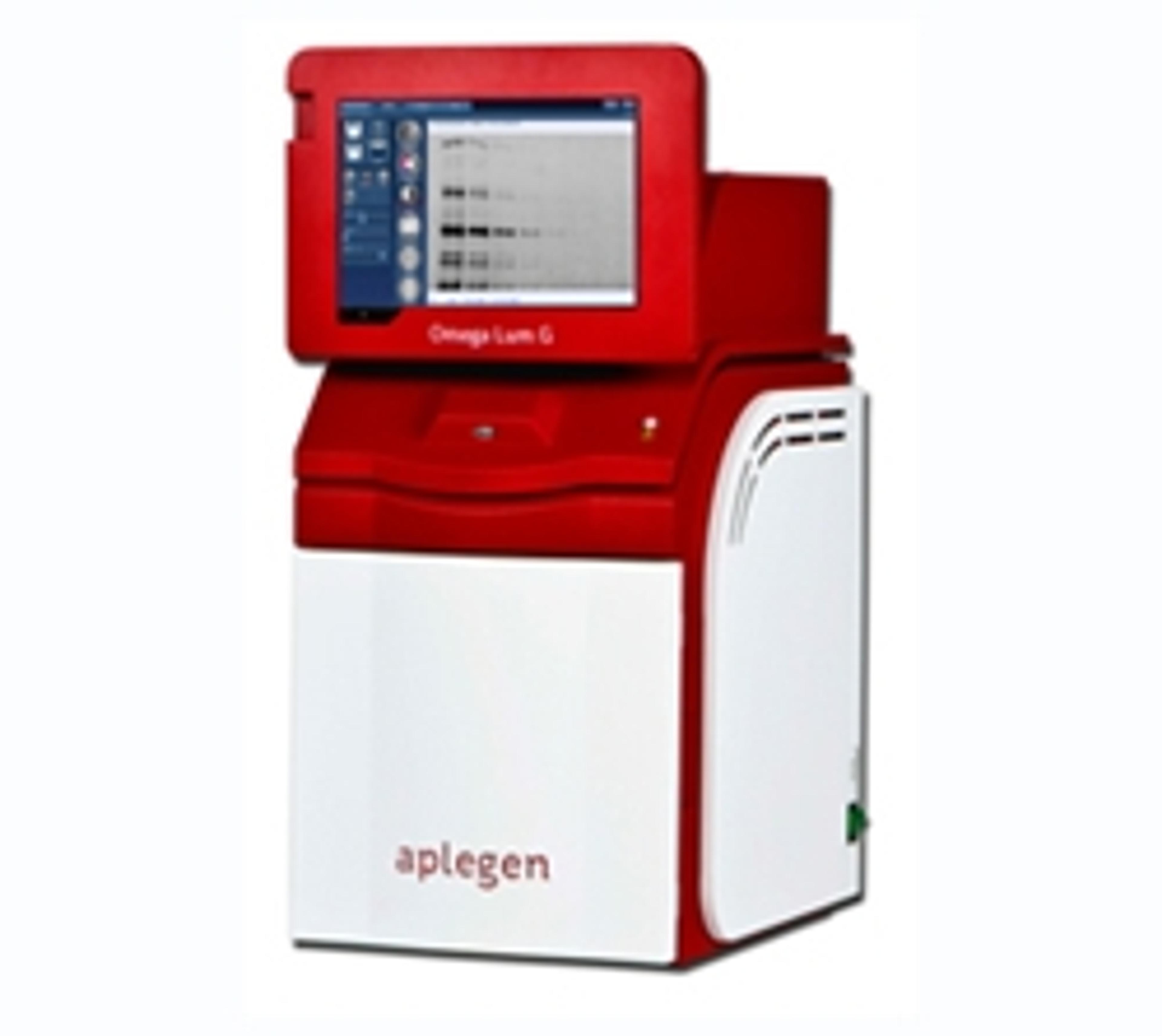
Omega Lum™ G

Aplegen

With the Omega Lum™ G snap an image of your gel or blot, get your data and go! Our SmartCapture technology simplifies imaging, so all you need is to pick your application, exposure, and capture your image. You will have a publication-ready image in seconds, and can get back to what’s important – your work. The Omega Lum G revolutionizes gel imaging by combining fluorescent gel and chemiluminescent imaging into one compact system, all for the price of a gel doc. This new system is redefining what you can expect from your lab’s imaging system.Imaging is simple: Log in to your custom profile, select your application, and press capture. Omega Lum™ SmartCapture technology automatically focuses your sample without hassling with hardware or software. Our compact, integrated system comes standard with a tablet computer and fits easily on a bench top.Omega Lum™ G Features: No filter selection or focus adjustment required Chemiluminescence for Western, Northern, and Southern blots Multiple excitation sources for nucleotide and protein stains Absorbance for Ponceau-stained membranes or petri dishes 65,536 grayscales with over 6 million pixels for excellent resolution Universal TIFF and JPEG file formats Compact footprint fits right on your bench top Accommodates large format protein and nucleotide gels (i.e. PROTEAN II, Subcell 96) Imaging Area: up to 20.5 x 25.0 cm

(0)

Links

Tags

Fluorescence SpectroscopyFluorometers and spectrofluorometers (also called fluorescence spectrometers) are used to measure the intensity and wavelength of fluorescent light emitted from a sample after excitation by illumination. Spectrofluorometers utilize monochromators to select the desired wavelengths, whereas filter fluorometers employ a set of filters. Spectrofluorometers for measuring steady-state fluorescence and lifetime fluorescence (or time-resolved fluorescence) are available, as well as fluorescence microscopes and microplate readers. Find the best fluorescence spectroscopy products in our peer-reviewed product directory: compare products, check customer reviews and receive pricing direct from manufacturers.Data AnalysisData analysis hardware and software is available to make data processing straight-forward yet powerful. Data software can be used for math and stats, technical graphing and image analysis. In addition, software is available for specific data analysis of electrophoresis, densitometry, ELISA and DNA sequencing.Gel Doc / Image AnalysisGel documentation (gel doc) or gel imaging systems are used for the analysis of proteins, antibodies and nucleic acid immobilized in polyacrylamide or agarose gels, membranes or microarrays. Explore a range of a gel imaging systems, densitometers, scanners, transilluminators or UV lamp + CCD cameras for your image analysis solutions. Colorimetric, fluorescent and/or radioisotopic samples can be visualized and documented for further analysis. See gel doc / Image analysis software for quantitative 1D and 2D analysis of your samples. Find the best gel doc / image analysis products in our peer-reviewed product directory: compare products, check customer reviews and receive pricing direct from manufacturers.Chem / BioinformaticsCheminformatics and bioinformatics are computational techniques used in chemistry and biology, respectively, for data acquisition, processing and storage. Cheminformatics focuses on compound information, whereas bioinformatics is mainly applied to analysis and modeling of genomics, genetic and sequencing information. Hardware and software is available for data acquisition, analysis, management and storage.Sample ManagementSample management systems include sample storage devices such as freezers and plate storers, sample environment enclosures and sample organization, retrieval and sorter systems. Useful system features include high-throughput, automation, robotic arms, automated liquid handling and associated database systems. Accessories in sample management include barcode scanners, heat sealers and tubes.Molecular Recognition SoftwareMolecular recognition software is widely used to analyze DNA, RNA, proteins and chemicals. The software can be useful for graphical viewing, comparative analyses, high-throughput screening, genomics, proteomics and phylogenetics. Molecular recognition software uses bioinformatics tools and analyses such as BLAST searches and generates structural predictions, 3D structures and sequencing information.Robotic InstrumentsRobotic instruments can be used for high-throughput automation of many lab processes. Such processes use instruments for assays like cell based assays and ELISA, for sample preparation like shakers, centrifuges and incubators, and for analysis such as sequencing and western blot analyzers. Useful features of robotic instruments include speed, reproducibility, barcode readers, software and automation.Robotic WorkstationsRobotic workstations are automated platforms enabling the user to perform high-throughput, multi-application processes, from sample preparation tasks such as PCR set-up, DNA purification and NGS library preparation, to integrated sample prep and analysis workstations. Automation makes processes consistent, fast, precise and fully walk-away. Find the best robotic workstations in our peer-reviewed product directory: compare products, check customer reviews and receive pricing direct from manufacturers.Software PlatformsSoftware platforms are useful for various stages of laboratory experiments from data collection to data storage and processing. For instance lab software is available for system control, data management, data analysis and qualification / validation.FluorescenceThe emission of fluorescence occurs when a photon of energy is supplied to a fluorescent chemical compound by an external source, causing it to become excited. Fluorescence can be detected and measured for different purposes using microplate readers, fluorescence microscopes, fluorescence scanners, and flow cytometers.Gel ImagingGel imaging captures high-resolution images of electrophoresis gels to analyze DNA, RNA, and proteins. Essential in molecular biology, this technique helps visualize results for accurate quantification and documentation. Discover top imaging systems and compare user-reviewed options in our directory.AutomationAutomation in laboratories and manufacturing processes enhances efficiency, precision, and scalability by reducing the need for manual intervention. It plays a critical role in improving productivity, minimizing human error, and accelerating workflows in fields like diagnostics, drug development, and industrial testing. Automation technologies include robotic systems, automated liquid handlers, and process control systems that streamline complex tasks and ensure consistent, reproducible results. Explore our peer-reviewed product directory to discover the best automation solutions, compare options, read user reviews, and get prices directly from manufacturers.Image AnalysisImage analysis involves the extraction of meaningful information from images, often using software to quantify and interpret visual data. It is widely used in cell biology, material science, and diagnostics. Increasingly, AI is being used to streamline image analysis. Explore image analysis tools in our peer-reviewed product directory; compare products, check reviews, and get pricing directly from manufacturers.ImagingImaging techniques are essential for obtaining visual representations of samples to understand structures, processes, and function in biological, chemical, and physical research. These tools range from traditional light microscopy to advanced imaging modalities like MRI and electron microscopy, providing researchers with valuable data for diagnostics, drug discovery, and material analysis. Explore imaging solutions in our peer-reviewed product directory to compare products, check reviews, and get pricing directly from manufacturers.Chemiluminescence
SmartCapture Technology from Aplegen