Siemens Installs World’s Longest Lab Automation Track at Thyrocare in India

18 Sept 2014
Sonia Nicholas
Managing Editor and Clinical Lead

Product news

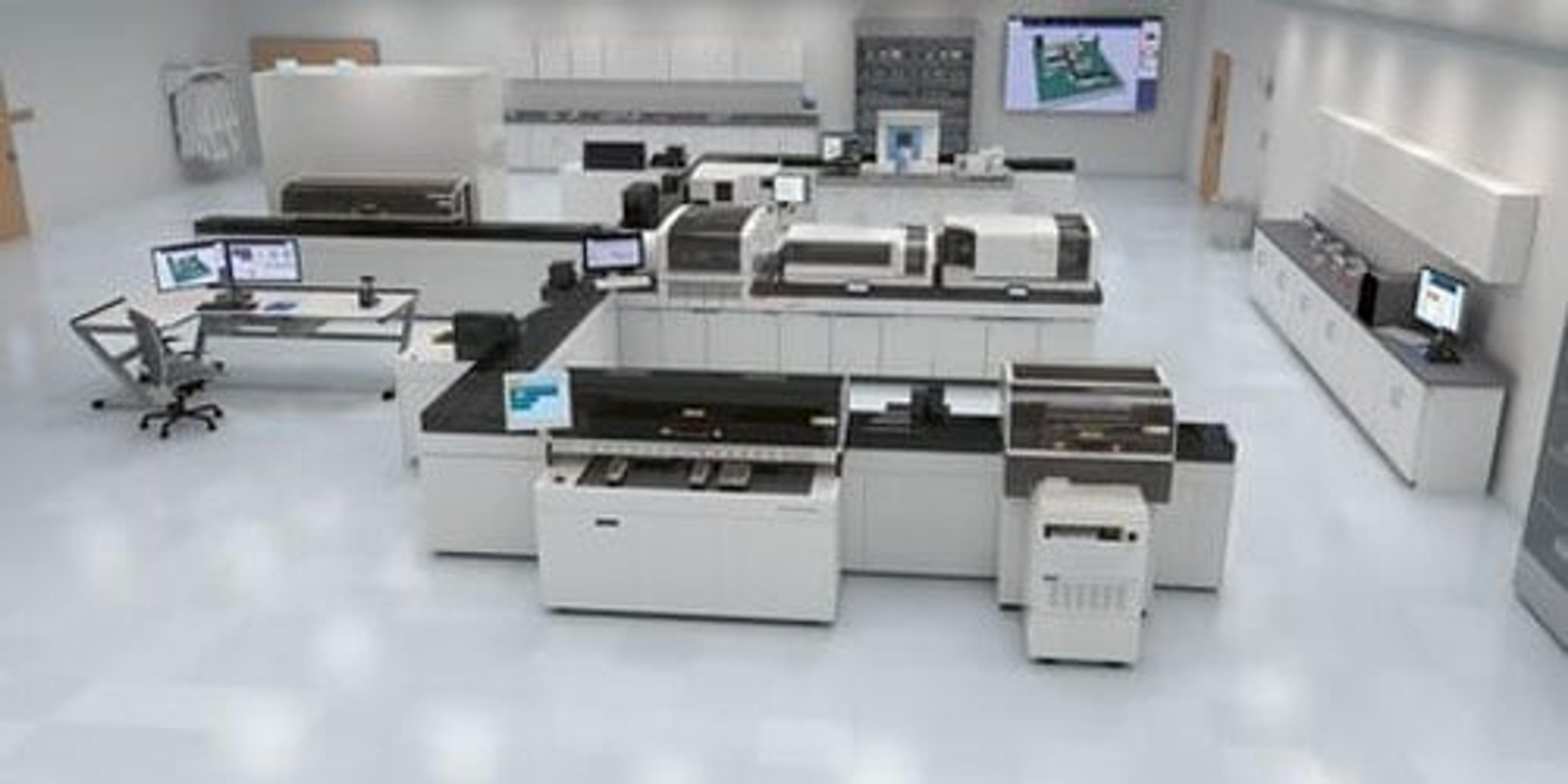
The automated track at Thyrocare is 93.5 meter long, which is currently the longest in the world

At 93.5 meters, the installation of Siemens Aptio Automation Solution is also India’s first. With the solution Thyrocare can perform approximately 200,000 tests per day. A total of 24 immunoassay and 7 chemistry systems are part of this automation solution.

In a significant boost to availability of in-vitro diagnostic testing services in India, the Diagnostics Division of Siemens Healthcare has successfully installed the world’s longest lab automation track at Thyrocare Technologies, Mumbai. The Siemens Aptio Automation installation at Thyrocare is also India’s first lab automation solution.

The installation at Thyrocare is 93.5 meter long, which is currently the longest in the world. It has 31 instruments (24 Advia Centaur XP Immunoassay systems and 7 Advia 2400 Chemistry systems) docked to the track, 10 rack loading / unloading robots and 5 decappers. Various intelligent features in the solution allow Thyrocare Technologies to perform approximately 200,000 tests per day involving both immunoassay and chemistry.

Dr. A Velumani, CEO and Founder, Thyrocare Technologies explains, “Aptio is sleek, dynamic and intelligent automation solution, very ideal for high volume laboratory for pre-analytical, analytical and post-analytical needs. Our floor is more productive and least expensive now.” He further adds, “In 2014 summer, the first phase of the 187 meter long track that we need for our business has been installed.”

Sushant Kinra, Head - Diagnostics Division, Siemens Healthcare India, mentions, “Siemens is aware of how our customers’ needs have evolved. Aptio Automation represents our latest innovation and vision on how we can help laboratories keep pace in this challenging environment and address their most pressing business and clinical demands.”

Aptio is an adaptable solution that allows for a phased implementation to accommodate both current and future needs of medium- to very high-volume laboratories. The solution promises to transform laboratory operations by combining Siemens’ industry-leading workflow expertise with peak performance, adaptability and intelligent technology. Aptio Automation’s circular track and modular design ensure adaptability to nearly any lab or testing environment.

Aptio Automation also offers connectivity to Siemens’ portfolio of automation-ready analyzers, thus facilitating a multidisciplinary approach to testing. Further, the point-in-space aspiration feature helps streamline workflow by reducing the need to aliquot (or divide) samples and its puck-based system with RFID enables individual sample routing and tracking, along with STAT prioritization.

Additionally, Aptio Automation delivers comprehensive analytics via powerful, centralized information technology, while having the flexibility to provide pre- and post-analytical capabilities. Siemens’ CentraLink™ Data Management System facilitates efficient sample flow, auto-verification, quick access to samples and proactive quality control (QC). Plus, the CentraLink System can be customized per end user, speeding up system access and supporting error reduction.

Aptio® Automation

Siemens Healthineers

Aptio® Automation combines intelligent technologies with Siemens Healthineers workflow expertise to deliver flexible solutions that advance your laboratory’s productivity. Accelerate processing and achieve consistent turnaround time using intelligent routing, single-sample flow, and primary tube sampling technologies.Improve utilization of lab resources through data-driven simulations, optimization modeling, and best practices of an experienced partner. Position your laboratory for future expansion and rapid access to innovations in automation and diagnostics with a highly adaptable, multidisciplinary track.

(2)

Links

Tags

Blood TransfusionBlood Transfusion involves giving donor blood to a recipient patient. Screening is essential to avoid transfusion reactions. Blood banks use immunohematological techniques to determine rh and ABO blood group, and screen for antibodies using specific antisera. Blood Banks use Direct Coombs Tests (DCT) and Indirect Coombs Tests (IAT) to detect hemolysis and Haemolytic Disease of the Newborn (HDN).HematologyIn Haematology / Hematology, complete blood cell counts (or full blood counts) are obtained using automated blood count analyzers to enumerate blood cell types.  Hematology also encompasses haemostasis and coagulation, thrombophilia and hemophilia, plasma viscosity and ESR analysis, hemoglobinopathies, cell morphology and haematinic measurement.ImmunologyImmunological techniques measure and characterize immune responses. Immunology kits and analysis systems often use techniques such as ELISA, radioimmunoassay (RIA) and immunodiffusion assays, Immunohistochemistry, and flow cytometry. Immunologists use equipment such as flow Cytometers, plate readers, plate washers and fluorescent microscopes.Cellular PathologyCellular Pathology deals with the microscopic analysis of tissue samples and cells. Sample preparation and processing includes fixation, staining, sectioning and slide mounting, using equipment such microtomes and cryostats. In choosing immunohistochemistry and immunocytochemistry kits, consider chromogens, staining method, antibodies, microscopes and imaging.Point-of-CarePoint-of-Care Testing (POCT) or Near Patient Testing (NPT) products are available for urine, blood and other clinical chemistry analyses. POCT includes: blood glucose testing, blood gas and electrolytes analysis, rapid coagulation testing (PT / INR), rapid cardiac markers diagnostics, drugs of abuse screening, urine strips testing, pregnancy testing, fecal occult blood analysis, food pathogens screening, hemoglobin diagnostics, infectious disease testing and cholesterol screening.Clinical ChemistryBiochemistry (or clinical chemistry) involves the analysis of bodily fluids using chemical tests. Techniques used include HPLC, chromatography, spectroscopy, mass spectrometry, immunochemical, electrophoresis, turbidometric / spectrophotometric assay, MRI and ISE analysis. Tests are often carried out on plasma or serum but urine (urinalysis) and fecal specimens are also processed.Clinical GeneticsMolecular Genetics covers the analysis of hereditary genetic disease and chromosomal abnormalities. Genetics can be analysed using DNA, RNA, and protein microarrays, PCR, RT PCR and DNA sequencing. Genetic equipment includes genetic workstations, thermal cyclers, cooling blocks and electrophoresis products. Diagnostic kits are used for DNA / RNA extraction and purification.Clinical MicrobiologyMicrobiology is the study of microorganisms including protists, prokaryotes, fungi, and, often, viruses. Microorganisms are a useful research tool as genetic vectors and, in immunology, for antibiotic susceptibility testing, cellular biology and genetics. Microorganisms commonly grow readily in incubators with microbial culture media; this can contain chromogenic supplements to differentiate between cell lines. Estimate your culture’s density of microorganisms with colony counters, or screen and select colonies for desirable clones with automated colony pickers. Additionally, equipment is available to monitor environments for the presence of microbes and identify with microbial identification instruments. Find the best microbiology products in our peer-reviewed product directory: compare products, check customer reviews and receive pricing direct from manufacturers.Clinical AutomationClinical laboratory automation refers to the use of automated systems in clinical laboratories to increase efficiency, reduce human error, and improve patient care. From sample analysis to total laboratory automation, this plays a critical role in modern diagnostics and laboratory workflows. Explore clinical automation solutions in our peer-reviewed product directory; compare products, check reviews, and get pricing directly from manufacturers.
Siemens Installs World’s Longest Lab Automation Track at Thyrocare in India