Sherlock Biosciences, IDT collaborate to manufacture CRISPR-based SARS-CoV-2 testing kits

Large-scale manufacturing of rapid diagnostic test kit and reagents to enable increased testing capacity for COVID-19 worldwide

10 Jun 2020

Diane Li
Assistant Editor

Industry news

Sherlock Biosciences and Integrated DNA Technologies (IDT) has announced the companies have entered into a strategic collaboration to enable large-scale manufacturing of the Sherlock™ CRISPR SARS-CoV-2 kit for the detection of the novel coronavirus that causes COVID-19. The test kit, for which Sherlock Biosciences recently received Emergency Use Authorization (EUA) by the U.S. Food and Drug Administration (FDA), will assist in managing the COVID-19 pandemic by increasing testing capacity and decreasing time to result.

The Sherlock kit is the first CRISPR-based diagnostic test to receive EUA for the detection of SARS-CoV-2. The kit provides specific and sensitive detection of the virus in patient samples, and it requires no specialized instruments to complete a test. Using standard laboratory equipment gives it a minimal footprint and contributes to a turnaround time of approximately one hour, significantly faster than other testing methods.

IDT is supporting the manufacturing of the kit by supplying several key components, including the Cas13a enzyme on which the test is based, as well as CRISPR RNA (crRNA) and primer mix. IDT’s product quality, speed, and ability to scale are key factors in helping to bring the Sherlock kit to market.

“Given the severity and scale of the COVID-19 pandemic, it is imperative to increase and improve upon existing diagnostic solutions,” said Rahul Dhanda, co-founder, president and CEO of Sherlock Biosciences. “We are pleased to partner with IDT, a leading comprehensive genomics solution provider. They have already been leading the charge in large-scale manufacturing of key components for the CDC EUA testing protocol to meet the demands of this global pandemic, and this is another avenue in which they are supporting testing needs. Through this strategic partnership, we will be able to scale production as needed to satisfy the demand for increased testing volumes, which should allow laboratory technicians to run tests at a higher throughput and provide results rapidly to improve patient care.”

“Sherlock has developed a unique methodology for quick and specific detection of SARS-CoV-2, and IDT is proud to leverage our high-quality products to support this groundbreaking testing method,” said Trey Martin, president of IDT. “We look forward to working closely with Sherlock to scale the production of its CRISPR test kit to meet demand in response to this global pandemic.”

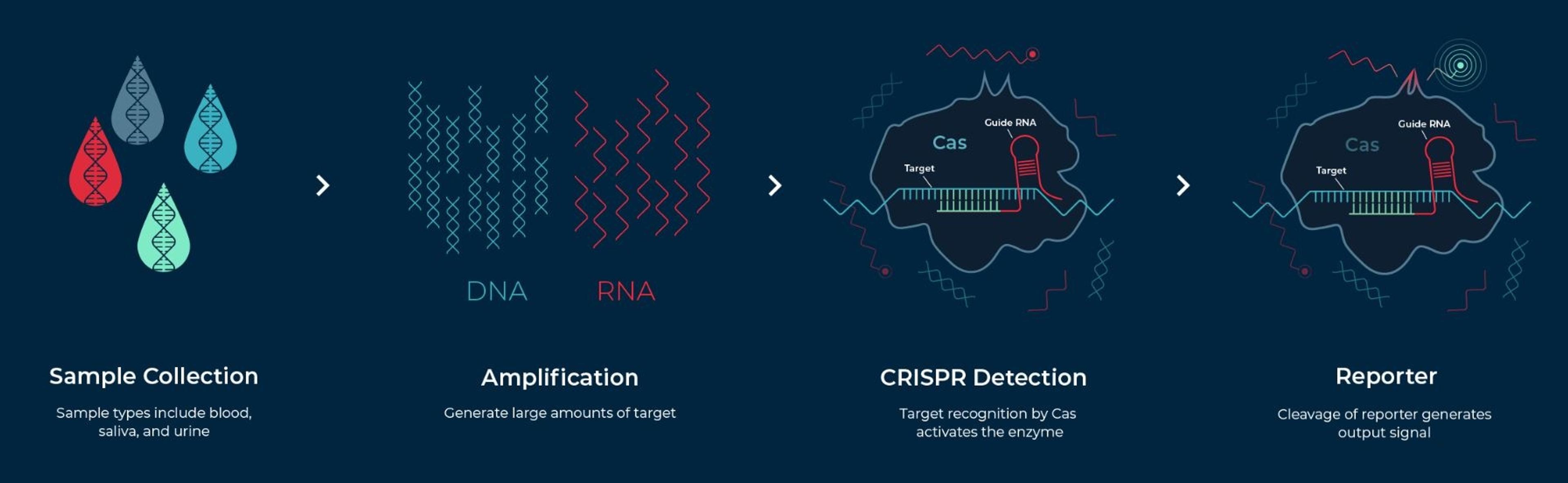
The Sherlock™ CRISPR SARS-CoV-2 test kit is designed for use in laboratories certified under the Clinical Laboratory Improvement Amendments of 1988 (CLIA), 42 U.S.C. §263a, to perform high complexity tests. Based on the SHERLOCK method, which stands for Specific High-sensitivity Enzymatic Reporter unLOCKing, the kit works by programming a CRISPR nuclease to detect the presence of a specific genetic signature – in this case, the genetic signature for SARS-CoV-2 – in a nasal swab, nasopharyngeal swab, oropharyngeal swab or bronchoalveolar lavage (BAL) specimen. When the signature is found, the CRISPR enzyme is activated and cuts both the target viral RNA and the reporter RNAs provided as part of the kit and used during the detection reaction. This releases a detectable signal, yielding results in about an hour. It is the first CRISPR-based diagnostic test to receive EUA from the FDA for qualitative detection of nucleic acid from SARS-CoV-2.

Want more of the latest science news straight to your inbox? Become a member of SelectScience for free today>>

SHERLOCK™

Sherlock Biosciences

SHERLOCK is an evolution of CRISPR technology, which others use to make precise edits in genetic code. SHERLOCK can detect the unique genetic fingerprints of virtually any DNA or RNA sequence in any organism or pathogen. Developed by our founders and licensed exclusively from the Broad Institute, SHERLOCK is a method for single molecule detection of nucleic acid targets and stands for Specific High Sensitivity Enzymatic Reporter unLOCKing. It works by amplifying genetic sequences and programming a CRISPR molecule to detect the presence of a specific genetic signature in a sample, which can also be quantified. When it finds those signatures, the CRISPR enzyme is activated and releases a robust signal. This signal can be adapted to work on a simple paper strip test, in laboratory equipment, or to provide an electrochemical readout that can be read with a mobile phone. Highly sensitive (can detect a single molecule in a sample) Highly specific (accurately detects the target) Integrates well with other tests and lab setups Quantitative (measures amount of target present) Rapid design and delivery to partners

(1)

Links

Tags

AntibodiesAntibodies are used in techniques such as confocal and fluorescence microscopy, flow cytometry, ELISA, ELISPOT, immunohistochemistry, western blotting and immunopreciptation. Select specific antigen reactivity, high specific affinity, low non-specific binding, monoclonal or polyclonal, primary or secondary antibodies and associated conjugates such as an enzyme or dye for visualization.Combinatorial ChemistryCombinatorial chemistry, also known as combichem, is a technique used in drug discovery to create libraries of structurally related compounds. A library is generated by synthesis with a chemical reactor system or by computer-based modeling of compound combinations. When undertaking combinatorial chemistry consider reagents, buffers, resins and standards.Data AnalysisData analysis hardware and software is available to make data processing straight-forward yet powerful. Data software can be used for math and stats, technical graphing and image analysis. In addition, software is available for specific data analysis of electrophoresis, densitometry, ELISA and DNA sequencing.Sample ManagementSample management systems include sample storage devices such as freezers and plate storers, sample environment enclosures and sample organization, retrieval and sorter systems. Useful system features include high-throughput, automation, robotic arms, automated liquid handling and associated database systems. Accessories in sample management include barcode scanners, heat sealers and tubes.Process ChemistryProcess chemistry is an important stage of drug development for scaling-up drug production or chemical synthesis reactions. It is useful for optimizing economical and efficient drug production. Process chemistry uses reactors and pump systems as well as reagents, standards and buffers.ImmunologyImmunological techniques measure and characterize immune responses. Immunology kits and analysis systems often use techniques such as ELISA, radioimmunoassay (RIA) and immunodiffusion assays, Immunohistochemistry, and flow cytometry. Immunologists use equipment such as flow Cytometers, plate readers, plate washers and fluorescent microscopes.Cellular PathologyCellular Pathology deals with the microscopic analysis of tissue samples and cells. Sample preparation and processing includes fixation, staining, sectioning and slide mounting, using equipment such microtomes and cryostats. In choosing immunohistochemistry and immunocytochemistry kits, consider chromogens, staining method, antibodies, microscopes and imaging.Biopharmaceutical AdvancesBiopharmaceutical advances follow the development of pharmaceuticals derived from biotechnology, also known as biotechnology medicines. Biopharmaceuticals may be produced from cell lines, plants, or microbial cells. Important considerations of biopharmaceutical use include application, cost, production process and purification.Clinical TrialsClinical Trials, an essential part of drug discovery process, assess the safety and effectiveness of a new medication or device in the pharmaceutical industry. Clinical Trials are a phased process (Phase 0, Phase I, Phase II, Phase III and Phase IV) which begins after initial preclinical testing.Clinical ChemistryBiochemistry (or clinical chemistry) involves the analysis of bodily fluids using chemical tests. Techniques used include HPLC, chromatography, spectroscopy, mass spectrometry, immunochemical, electrophoresis, turbidometric / spectrophotometric assay, MRI and ISE analysis. Tests are often carried out on plasma or serum but urine (urinalysis) and fecal specimens are also processed.Clinical GeneticsMolecular Genetics covers the analysis of hereditary genetic disease and chromosomal abnormalities. Genetics can be analysed using DNA, RNA, and protein microarrays, PCR, RT PCR and DNA sequencing. Genetic equipment includes genetic workstations, thermal cyclers, cooling blocks and electrophoresis products. Diagnostic kits are used for DNA / RNA extraction and purification.Clinical MicrobiologyMicrobiology is the study of microorganisms including protists, prokaryotes, fungi, and, often, viruses. Microorganisms are a useful research tool as genetic vectors and, in immunology, for antibiotic susceptibility testing, cellular biology and genetics. Microorganisms commonly grow readily in incubators with microbial culture media; this can contain chromogenic supplements to differentiate between cell lines. Estimate your culture’s density of microorganisms with colony counters, or screen and select colonies for desirable clones with automated colony pickers. Additionally, equipment is available to monitor environments for the presence of microbes and identify with microbial identification instruments. Find the best microbiology products in our peer-reviewed product directory: compare products, check customer reviews and receive pricing direct from manufacturers.Drug DeliveryDrug Delivery refers to dosage form, route of administration, formulations, technologies, and systems for transporting a pharmaceutical compound in the body as needed to safely achieve its desired therapeutic effect. Drug delivery is often approached via the biopharmaceutical or small molecule drug's formulation, but it may also involve medical devices or drug-device combination products. Considerations include instrumentation, software and services. RegulatoryPharmaceutical regulations impact on all areas of drug development, manufacture and control and supply. Services are provided from the early stages of drug development and clinical trials through to dossier submission, approval and marketing. Regulatory also includes submission of analytical studies from the pharmaceutical product and safety. EnzymesEnzymes are macromolecular biological catalysts used across life science, pharmaceutical and clinical research. Various enzymes can be purchased for research applications including ligases, high fidelity polymerases, nuclease, protease, restriction enzymes, tissue dissociation enzymes and enzyme inhibitors. Find the best enzymes in our peer-reviewed product directory: compare products, check customer reviews and receive pricing direct from manufacturers.