Sherlock Biosciences, binx health partner to develop first CRISPR-based point-of-care test for COVID-19

binx health’s proven molecular io platform combined with SHERLOCK CRISPR technology will enable rapid, accurate testing for SARS-CoV-2 in retail and near-patient settings

1 Jul 2020

Diane Li
Assistant Editor

Product news

Sherlock Biosciences and binx health have announced the companies have entered into a strategic partnership to develop the world’s first rapid, point-of-care diagnostic test for COVID-19 leveraging CRISPR technology. The organizations will combine the binx io diagnostic platform with SHERLOCK™ CRISPR technology to create a test that is robust and simple to use. This unique solution is designed to provide rapid and accurate results in a single patient visit across many diverse CLIA-waived settings, such as clinics, doctors’ offices, assisted living centers, pharmacies and other easily accessible consumer venues, which will assist in broadening ways of managing potential resurgences of the pandemic. The combination of technologies also portends strong positioning for other viral threats as they emerge.

The binx io is the fastest molecular platform in the world that has U.S. Food and Drug Administration (FDA) clearance for chlamydia and gonorrhea testing. The Company’s platform is based on a proprietary detection method that makes it suitable for broad application across infectious diseases. The platform has a demonstrated ability to rapidly detect complex infectious disease targets from bodily fluids with very high accuracy. The binx io molecular platform consists of an easy-to-use, desktop-sized instrument and single-use cartridge with multiplex capacity of up to 24 targets. Once a patient sample is added to the cartridge and loaded into the io instrument, the process is fully automated, requires no interpretation of data, and is designed to produce a clearly indicated onscreen “detected” or “not detected” result.

“We are pleased to partner with Sherlock Biosciences to help bridge a gap in COVID-19 testing—the need for highly accurate point-of-care diagnostic testing in CLIA-waived and near-patient settings,” said Jeff Luber, chief executive officer of binx health. “In April of this year, binx health made history with the first 30-minute, FDA-cleared molecular diagnostic instrument for chlamydia and gonorrhea in both men and women that for the first time delivers same-visit diagnoses. Our proprietary platform will now leverage Sherlock’s CRISPR-based assay combined with binx’s electrochemical detection for rapid viral detection of SARS-CoV-2 without the need for additional instrumentation. This union of technologies is designed to enable physicians, clinicians and other healthcare workers on the front lines of the global COVID-19 pandemic to make on-the-spot care decisions and to control and prevent further infections. We also have a unique alignment of vision with Sherlock for solutions that support ‘everywhere’ testing in near-patient retail and clinical settings.”

“This collaboration with binx health to advance our SHERLOCK diagnostic platform and offer an accurate, point-of-care test is the next critical step in combating the global COVID-19 crisis,” said Rahul Dhanda, co-founder, president and CEO of Sherlock Biosciences. “We are also excited to explore with binx how to utilize the io platform to bring accurate and affordable testing to hospitals, urgent care centers and other healthcare facilities for a range of diagnostic tests beyond COVID-19. We agree with the binx strategy that ‘everywhere care’ depends on highly accurate in-clinic and easy-to-use at-home solutions. Through both our SHERLOCK- and INSPECTR™-based platforms, we hope to serve as part of the solution to addressing the COVID-19 pandemic by making accurate, affordable diagnostics available everywhere they are needed: in the lab, point-of-care locales, low-resource settings and the home.”

The currently available SherlockTM CRISPR SARS-CoV-2 kit uses the SHERLOCK (Specific High-sensitivity Enzymatic Reporter unLOCKing) method to program a CRISPR molecule to detect the presence of a specific SARS-CoV-2 genetic signature in specimens collected from patients suspected of COVID-19 by their healthcare provider. The kit is intended for use in CLIA laboratories to assay nasal swabs, nasopharyngeal swabs, oropharyngeal swabs or bronchoalveolar lavage (BAL) specimens. When the signature is found, the CRISPR enzyme is activated and releases a detectable signal, yielding results in about an hour. The kit is the first CRISPR-based diagnostic test to receive EUA from the FDA for qualitative detection of nucleic acid from SARS-CoV-2. Sherlock is also pressing forward in developing its INSPECTR at-home testing platform to create an instrument-free, handheld test – similar to that of an at-home pregnancy test – for the rapid detection of the SARS-CoV-2 virus.

Want more of the latest science news straight to your inbox? Become a member of SelectScience for free today>>

SHERLOCK™

Sherlock Biosciences

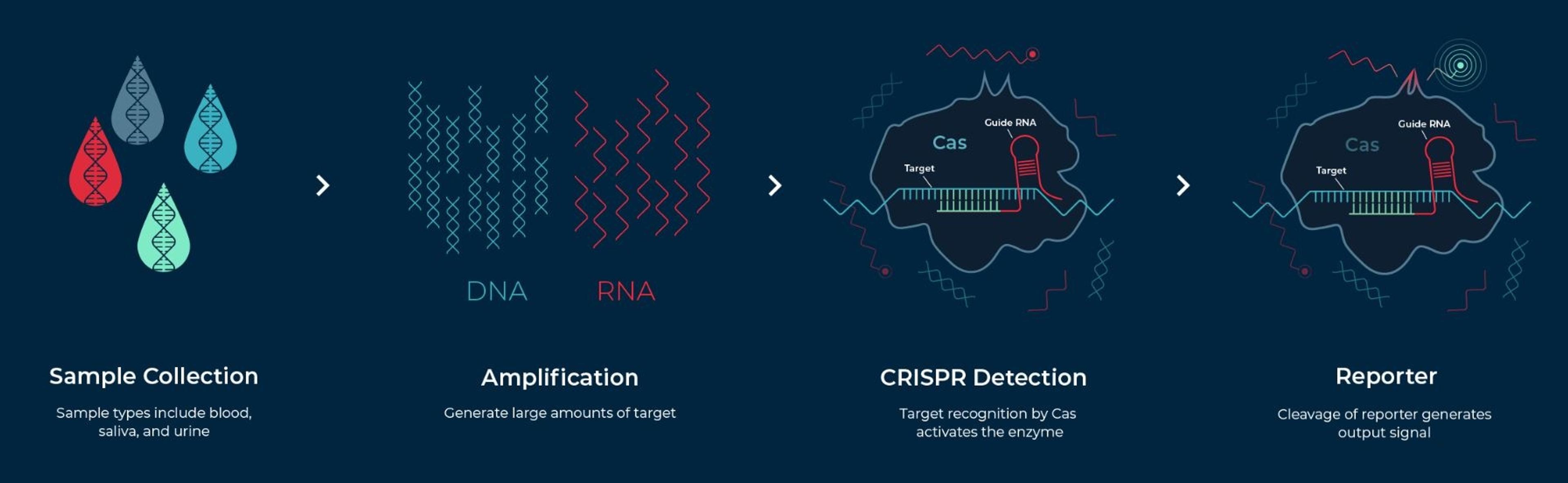
SHERLOCK is an evolution of CRISPR technology, which others use to make precise edits in genetic code. SHERLOCK can detect the unique genetic fingerprints of virtually any DNA or RNA sequence in any organism or pathogen. Developed by our founders and licensed exclusively from the Broad Institute, SHERLOCK is a method for single molecule detection of nucleic acid targets and stands for Specific High Sensitivity Enzymatic Reporter unLOCKing. It works by amplifying genetic sequences and programming a CRISPR molecule to detect the presence of a specific genetic signature in a sample, which can also be quantified. When it finds those signatures, the CRISPR enzyme is activated and releases a robust signal. This signal can be adapted to work on a simple paper strip test, in laboratory equipment, or to provide an electrochemical readout that can be read with a mobile phone. Highly sensitive (can detect a single molecule in a sample) Highly specific (accurately detects the target) Integrates well with other tests and lab setups Quantitative (measures amount of target present) Rapid design and delivery to partners

(1)

Links

Tags

Combinatorial ChemistryCombinatorial chemistry, also known as combichem, is a technique used in drug discovery to create libraries of structurally related compounds. A library is generated by synthesis with a chemical reactor system or by computer-based modeling of compound combinations. When undertaking combinatorial chemistry consider reagents, buffers, resins and standards.Data AnalysisData analysis hardware and software is available to make data processing straight-forward yet powerful. Data software can be used for math and stats, technical graphing and image analysis. In addition, software is available for specific data analysis of electrophoresis, densitometry, ELISA and DNA sequencing.Blood TransfusionBlood Transfusion involves giving donor blood to a recipient patient. Screening is essential to avoid transfusion reactions. Blood banks use immunohematological techniques to determine rh and ABO blood group, and screen for antibodies using specific antisera. Blood Banks use Direct Coombs Tests (DCT) and Indirect Coombs Tests (IAT) to detect hemolysis and Haemolytic Disease of the Newborn (HDN).ImmunologyImmunological techniques measure and characterize immune responses. Immunology kits and analysis systems often use techniques such as ELISA, radioimmunoassay (RIA) and immunodiffusion assays, Immunohistochemistry, and flow cytometry. Immunologists use equipment such as flow Cytometers, plate readers, plate washers and fluorescent microscopes.Cellular PathologyCellular Pathology deals with the microscopic analysis of tissue samples and cells. Sample preparation and processing includes fixation, staining, sectioning and slide mounting, using equipment such microtomes and cryostats. In choosing immunohistochemistry and immunocytochemistry kits, consider chromogens, staining method, antibodies, microscopes and imaging.Point-of-CarePoint-of-Care Testing (POCT) or Near Patient Testing (NPT) products are available for urine, blood and other clinical chemistry analyses. POCT includes: blood glucose testing, blood gas and electrolytes analysis, rapid coagulation testing (PT / INR), rapid cardiac markers diagnostics, drugs of abuse screening, urine strips testing, pregnancy testing, fecal occult blood analysis, food pathogens screening, hemoglobin diagnostics, infectious disease testing and cholesterol screening.Biopharmaceutical AdvancesBiopharmaceutical advances follow the development of pharmaceuticals derived from biotechnology, also known as biotechnology medicines. Biopharmaceuticals may be produced from cell lines, plants, or microbial cells. Important considerations of biopharmaceutical use include application, cost, production process and purification.Clinical TrialsClinical Trials, an essential part of drug discovery process, assess the safety and effectiveness of a new medication or device in the pharmaceutical industry. Clinical Trials are a phased process (Phase 0, Phase I, Phase II, Phase III and Phase IV) which begins after initial preclinical testing.Clinical ChemistryBiochemistry (or clinical chemistry) involves the analysis of bodily fluids using chemical tests. Techniques used include HPLC, chromatography, spectroscopy, mass spectrometry, immunochemical, electrophoresis, turbidometric / spectrophotometric assay, MRI and ISE analysis. Tests are often carried out on plasma or serum but urine (urinalysis) and fecal specimens are also processed.Clinical GeneticsMolecular Genetics covers the analysis of hereditary genetic disease and chromosomal abnormalities. Genetics can be analysed using DNA, RNA, and protein microarrays, PCR, RT PCR and DNA sequencing. Genetic equipment includes genetic workstations, thermal cyclers, cooling blocks and electrophoresis products. Diagnostic kits are used for DNA / RNA extraction and purification.Clinical MicrobiologyMicrobiology is the study of microorganisms including protists, prokaryotes, fungi, and, often, viruses. Microorganisms are a useful research tool as genetic vectors and, in immunology, for antibiotic susceptibility testing, cellular biology and genetics. Microorganisms commonly grow readily in incubators with microbial culture media; this can contain chromogenic supplements to differentiate between cell lines. Estimate your culture’s density of microorganisms with colony counters, or screen and select colonies for desirable clones with automated colony pickers. Additionally, equipment is available to monitor environments for the presence of microbes and identify with microbial identification instruments. Find the best microbiology products in our peer-reviewed product directory: compare products, check customer reviews and receive pricing direct from manufacturers.Drug DeliveryDrug Delivery refers to dosage form, route of administration, formulations, technologies, and systems for transporting a pharmaceutical compound in the body as needed to safely achieve its desired therapeutic effect. Drug delivery is often approached via the biopharmaceutical or small molecule drug's formulation, but it may also involve medical devices or drug-device combination products. Considerations include instrumentation, software and services. RegulatoryPharmaceutical regulations impact on all areas of drug development, manufacture and control and supply. Services are provided from the early stages of drug development and clinical trials through to dossier submission, approval and marketing. Regulatory also includes submission of analytical studies from the pharmaceutical product and safety. Point of Care SolutionsPoint of care solutions provide medical diagnostics and treatments at or near the site of patient care. These technologies offer rapid results, helping healthcare providers make quick decisions. From glucose monitors to molecular diagnostics, point of care solutions are transforming healthcare delivery by reducing wait times and improving patient outcomes. Explore the best point of care products in our peer-reviewed product directory, compare options, check reviews, and get pricing directly from manufacturers.Molecular DiagnosticsMolecular diagnostics use an individual’s genetic code and gene expression to diagnose and monitor diseases. The technique is used increasingly in the field of infectious diseases and oncology, as well as areas such as coagulation, HLA typing and pharmacogenomics. Molecular diagnostics plays a pivotal role in personalized medicine.
Sherlock Biosciences, binx health partner to develop first CRISPR-based point-of-care test for COVID-19