Sherlock Biosciences announces initial results of automation study with NorDx Laboratories on CRISPR-based test for SARS-CoV-2

Leading clinical laboratory runs first-ever successful automation of a CRISPR test for high-throughput, using Sherlock’s SARS-CoV-2 process

26 Jul 2021

Diane Li
Assistant Editor

Industry news

Sherlock Biosciences, an Engineering Biology company dedicated to making diagnostic testing better, faster and more affordable, has announced initial results from an automation study of its CRISPR-based test for SARS-CoV-2 in partnership with NorDx Laboratories, a member of MaineHealth – a recognized leader in New England and Maine’s largest integrated healthcare system. The study is the first-ever successful automation of a CRISPR test for high-throughput, and automating Sherlock’s assay enables laboratories to test clinical samples from thousands of patients a day on a single system, streamlining workflows and improving patient outcomes.

“We believe that Sherlock’s CRISPR-based technology holds promise as a potential answer to high volume testing needs,” said Robert Carlson, M.D., medical director at NorDx. “Fighting the pandemic requires testing methods that can be easily automated for high-throughput and rapidly adapt to new and emerging variants.”

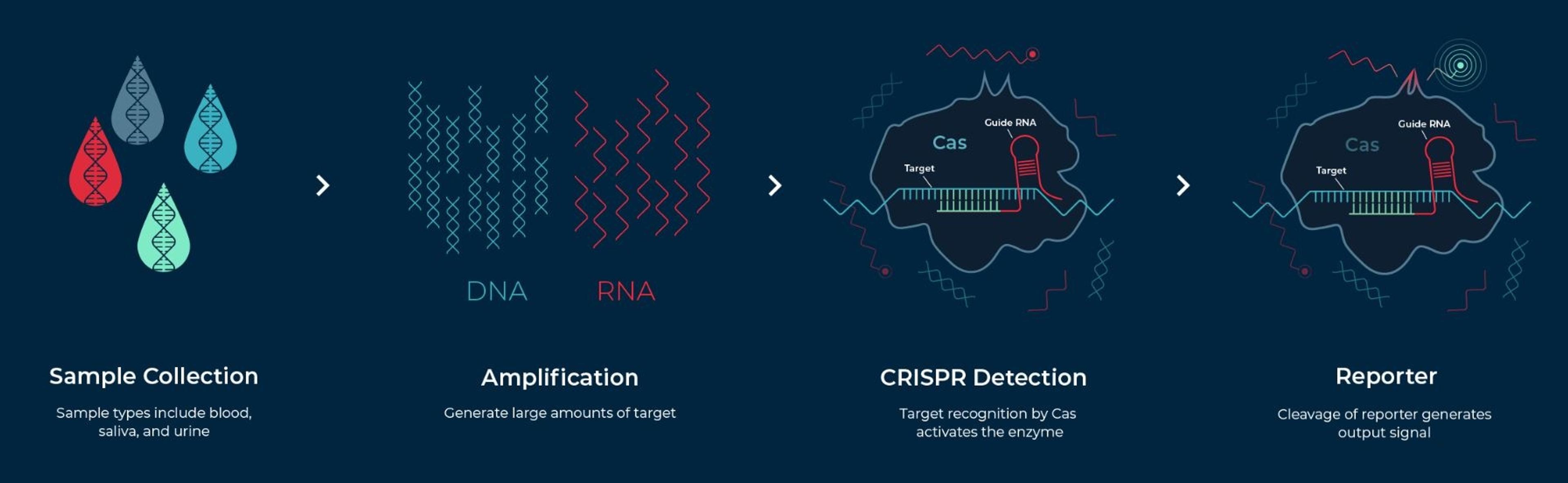
The Sherlock CRISPR SARS-CoV-2 test kit is designed for use in laboratories certified under the Clinical Laboratory Improvement Amendments of 1988 (CLIA), 42 U.S.C. §263a, to perform high complexity tests. Based on the SHERLOCK method, which stands for Specific High-sensitivity Enzymatic Reporter unLOCKing, the kit works by programming a CRISPR nuclease to detect the presence of a specific genetic signature – in this case, the genetic signature for SARS-CoV-2 – in a nasal swab, nasopharyngeal swab, oropharyngeal swab or bronchoalveolar lavage (BAL) specimen. When the signature is found, the CRISPR enzyme is activated and cuts reporter RNAs provided as part of the kit to release a detectable signal, yielding results in about an hour.

“Because Sherlock holds the most comprehensive IP position in CRISPR diagnostics, we are in a unique position to enable partners to achieve highly-automated and point-of-care solutions for any molecular diagnostic test” said Rahul Dhanda, co-founder, president and CEO of Sherlock Biosciences. “We are excited by these initial results and look forward to partnering with the NorDx team to further demonstrate that our robust method can be easily automated to provide a fast, user-friendly and inexpensive method for containing the pandemic through rapid and accurate detection of SARS-CoV-2.”

Do you use Sherlock Biosciences products in your lab? Write a review today for your chance to win a $400 Amazon gift card>>

SHERLOCK™

Sherlock Biosciences

SHERLOCK is an evolution of CRISPR technology, which others use to make precise edits in genetic code. SHERLOCK can detect the unique genetic fingerprints of virtually any DNA or RNA sequence in any organism or pathogen. Developed by our founders and licensed exclusively from the Broad Institute, SHERLOCK is a method for single molecule detection of nucleic acid targets and stands for Specific High Sensitivity Enzymatic Reporter unLOCKing. It works by amplifying genetic sequences and programming a CRISPR molecule to detect the presence of a specific genetic signature in a sample, which can also be quantified. When it finds those signatures, the CRISPR enzyme is activated and releases a robust signal. This signal can be adapted to work on a simple paper strip test, in laboratory equipment, or to provide an electrochemical readout that can be read with a mobile phone. Highly sensitive (can detect a single molecule in a sample) Highly specific (accurately detects the target) Integrates well with other tests and lab setups Quantitative (measures amount of target present) Rapid design and delivery to partners

(1)

Links

Tags

Genome AnalysisGenomics, the study of genomes, includes functional genomics, evolutionary genomics and comparative genomics. There are many genomic technologies such as DNA sequencing of whole genomes, computational biology and bioinformatics. DNA and nucleic acids must be isolated and concentrated from cells for analysis with kits, automated analyzers and software. Other useful technologies for studying genomics include PCR, microarrays and electrophoresis.Gene Expression and Molecular CloningMolecular cloning is a set of techniques that utilizes vectors to transfer recombinant DNA into host cells and is an essential tool for investigating the expression of genes and proteins in bacterial or mammalian cells. A variety of vectors optimized for gene cloning and expression in a range of host organisms are available, alongside competent cells for genetic replication. Here, you can explore a range of molecular tools, high-quality genomic and cDNA libraries, premade clones, transformation and transfection reagents and mutagenesis or gene expression detection assays and expression arrays. Find the best gene expression and molecular cloning products in our peer-reviewed product directory: compare products, check customer reviews and receive pricing direct from manufacturers.Clinical GeneticsMolecular Genetics covers the analysis of hereditary genetic disease and chromosomal abnormalities. Genetics can be analysed using DNA, RNA, and protein microarrays, PCR, RT PCR and DNA sequencing. Genetic equipment includes genetic workstations, thermal cyclers, cooling blocks and electrophoresis products. Diagnostic kits are used for DNA / RNA extraction and purification.Epigenetic AnalysisEpigenetic analysis products are used to study heritable phenotype changes that do not alter the DNA sequence, such as DNA modifications affecting gene activity. Determine whether genes have been methylated with DNA methylation quantification kits or methylation microarrays. Assess epigenetic regulation with histone modification kits or ChIP-on-chip microarrays. Kits are also available for bisulfite conversion and amplification of your samples, as well as epigenomic library preparation kits for next-generation sequencing (NGS). Find the best epigenetic products in our peer-reviewed product directory: compare products, check customer reviews and receive pricing direct from manufacturers.DNA / RNA Extraction and PurificationPurified DNA and RNA are required for numerous downstream molecular biology applications. Consequently, the importance of high-quality DNA/RNA extraction and purification equipment cannot be underestimated. Many purification kits are available and are typically optimized for nucleic acid type and source, including plasmid DNA, genomic DNA, mRNA, RNA and viral nucleic acid purification kits. Automated extraction and purification of nucleic acids can be implemented with magnetic bead separator instruments or high-throughput purification workstations. Find the best DNA/RNA extraction and purification equipment in our peer-reviewed product directory: compare products, check customer reviews and receive pricing direct from manufacturers.DNADeoxyribonucleic Acid (DNA) is the main component of chromosomes and the carrier of genetic information of living organisms. Find out here about PCR, NGS, ChIP-Seq, gel imaging, and many other techniques which can be used for the analysis of DNA.Gene EditingGene editing is the precise alteration to an organism's DNA, with CRISPR being the most well-known technique. It is used in a wide range of applications, including the development of disease models and gene therapy, and crop improvement. Browse our peer-reviewed product directory to find the best gene editing solutions, compare products, check reviews, and get pricing directly from manufacturers.Genome EditingGenome editing involves altering the DNA of an organism, which holds promise for disease treatment, agriculture, and gene therapy. Techniques like CRISPR-Cas9 are revolutionizing this field, enabling precise genetic modifications. Explore genome editing tools in our peer-reviewed product directory; compare products, check reviews, and get pricing directly from manufacturers.Genetic EngineeringCRISPRCRISPR technology enables precise editing of genes, allowing scientists to modify DNA at specific locations. This revolutionary tool is used in genetic research, drug development, and gene therapy. CRISPR has applications in agriculture, disease treatment, and creating genetically modified organisms (GMOs). Explore CRISPR solutions in our peer-reviewed product directory; compare products, check reviews, and get pricing directly from manufacturers.CoronavirusCoronaviruses are a large family of viruses that can cause illnesses ranging from the common cold to more severe diseases like COVID-19. Research into the biology, transmission, and treatment of coronaviruses has become a global priority, particularly since the emergence of SARS-CoV-2. Understanding the virus�s structure and behavior is essential for developing vaccines, diagnostics, and antiviral treatments. Explore our peer-reviewed product directory to discover the latest research tools, diagnostic tests, vaccines, and treatments for coronavirus, compare products, read reviews, and receive pricing directly from manufacturers.Covid-19COVID-19, caused by the SARS-CoV-2 virus, has led to a global health crisis with profound impacts on societies and economies. Research into diagnostics, vaccines, treatments, and understanding viral mechanisms continues to evolve. The pandemic has accelerated innovations in healthcare and biopharmaceuticals, including novel vaccine platforms and rapid testing technologies. Browse our peer-reviewed product directory to find top COVID-19 testing kits, research tools, vaccines, and treatments, compare products, read reviews, and receive direct pricing from manufacturers.